Back


2011 Supreme(Online)(KER) 23957
HIGH COURT OF KERALA
P.BHAVADASAN, J
KADEEJAMMAL – Appellant
Versus
P.N.LAILA BEEVI – Respondent
SA 655 1996
SRI.PEEYUS A KOTTAM, SRI.P.R.VENKETESH, SRI.T.P.MATHAI, SRI.P.G.PARAMESWARA PANICKER, SENIOR ADVOCATE FOR 1, SRI.P.B.MOHANKUMAR FOR R1, SMT.ASHA P.KURIAKOSE FOR R6
For a valid gift under Islamic law, there must be complete dominion transfer, and any conditions limiting this transfer render the gift invalid.
Headnote:
Gift - Partition Suit - Act Section List: ["138", "148", "149", "150", "164"] - The court analyzed the validity of a gift deed under Islamic law, focusing on the conditions of delivery and ownership transfer. The interpretation of the deed governed the outcome, leading to a decision on property partition.
Fact of the Case:
A couple executed a gift deed favoring four out of seven children. Upon the father's death, the excluded children filed for partition, disputing the deed's validity, citing non-delivery of property ownership.
Issues: The legal questions revolved around the validity of the gift deed, its terms regarding ownership transfer, and whether the specified conditions invalidated the gift.
Ratio Decidendi: The court emphasized that a gift must entail absolute dominion transfer and that any conditions reducing this dominion render the gift invalid as per Islamic law.
Final Decision: The appeal was dismissed, confirming the lower appellate court's judgment.
JUDGMENT
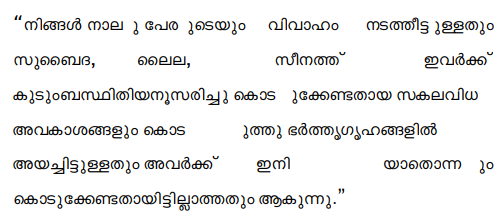
Muhammed Hussain Rawther and Kadeeja Ummal had seven children, namely, Saidu Muhammed Basheer, Ameer Rawther, Aishamma @ Pathumma, Kadir Beevi @ Hajira Beevi, Subaida Beevi, Laila and Seenath. The couple executed Ext.A1 gift deed in favour of four of their children excluding Subaida, Laila Beevi and Seenath. Consequent on the death of Muhammed Hussain Rawther, Laila Beevi and Seenath filed a suit for partition of the assets left behind by Muhammed Hussain Rawther. He died on 26.3.1988.
2. The suit was resisted by the defendants pointing out that since the parents of the plaintiffs had executed Ext. A1 gift deed, at the time of death of Muhammed Hussain Rawther he retained no properties to which the plaintiffs could succeed as heirs.
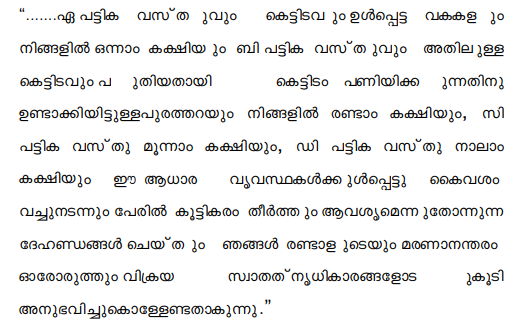
3. The main question that was posed before the trial court for consideration was whether Ext.A1 gift deed was valid or not. According to the plaintiffs, since the ownership and domain over the property had not passed on to the donees pursuant to Ext.A1 gift deed, the gift was invalid. If that be so, according to them, so far as the properties of Muhammed Hussain Rawther were concerned, he died intestate. The defendants responded by pointing out that the gift had taken effect and delivery of the properties made mention of in the gift deed to each of the respective donees has been effected. The trial court found that Ext.A1 was a valid document and gifts had taken effect and therefore no estate was left behind by Muhammed Hussain Rawther to be inherited by the plaintiffs, their siblings and their mother.
4. The plaintiffs carried the matter in appeal as A.S.61 of 1992 before the Sub Court, Muvattupuzha. The lower appellate court after referring to the various provisions of the Muslim Law found that the gift was invalid and accordingly passed a preliminary decree, which reads as follows:
“In the result, appeal is allowed setting aside the judgment and decree of trial court that
(i) a preliminary decree is passed for partition of the plaint A schedule properties allowing the plaintiffs to 6/72 each share of the plaint A schedule properties
(ii) Defendants 3 and 6 are restrained from committing waste in the plaint A and B schedule properties.
(iii) The share of the income entitled by the plaintiffs is left open to be considered in the final decree proceedings. Plaintiffs are free to apply for passing final decree within a period of 3 months from today. Plaintiffs are allowing to get costs of the proceedings from the estate.”
5. Defendants 1, 3 and 6 in O.S. 36 of 1990 assailed the lower appellate court judgment and decree on the ground that the lower appellate court was not justified in holding that the gift was invalid.
6. Notice is seen issued on the following questions of law:
“A) Whether Ext.A1 gift deed is a valid one.
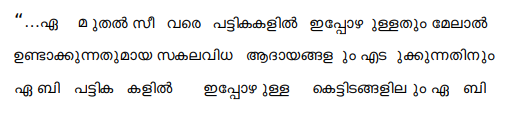
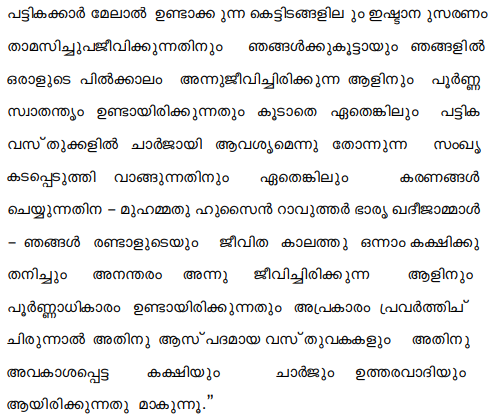
B) Whether the stipulation in the gift deed that donor reserving the right to recurring income during his life time will made the gift invalid.
C) Whether a partition suit is maintainable with regard to property which is not in ownership and possession of the deceased at the time of his death.”
7. Learned counsel appearing for the appellants pointed out that the lower appellate court had erred in law and on facts in coming to the conclusion that the gift evidenced by Ext.A1 is invalid. Evidence was clear to the effect that in pursuance to Ext.A1 gift deed, the respective donees had taken possession of the properties and were enjoying it as if it belonged to them. Several assignments have been effected after Ext.A1 and infact donors had conceded that the gift has taken effect by joining in some of the assignment deeds. Learned counsel pointed out that it is true that the donors had reserved life estate over the properties gifted as per Ext.A1, but since the corpus was transferred, reservation of life interest over the suit property and the right to take income therefrom does not derogate from the gift or does not cut down the gift. Even assuming that there are some provisions which deroga