Back
Back





2009 Supreme(Online)(KER) 47105
HIGH COURT OF KERALA
V.RAMKUMAR, J
ABU – Appellant
Versus
STATE OF KERALA – Respondent
CRL.A/1076/2003
SRI.P.V.KUNHIKRISHNAN
Conscious possession of explosives is essential for a conviction under the Explosives Act, and mere ownership is insufficient.
Headnote:
Explosives - Possession of Explosives - Explosives Act, 1884, Section 9(B)(1)(b) and Explosive Substances Act, 1908, Section 5 - The court found insufficient evidence to prove conscious possession of explosives, leading to the appellant's acquittal.
Fact of the Case:
The appellant was convicted for unlawfully possessing explosives. While evidence suggested explosives were found in his house, the prosecution failed to demonstrate that he had conscious possession of those substances.
Finding of the Court:
The court concluded that the prosecution did not prove beyond a reasonable doubt that the appellant had conscious possession of the explosives, leading to the overturning of the conviction.
Issues: Whether the conviction under Section 9(B)(1)(b) of the Explosives Act is sustainable based on the evidence regarding possession of the explosive materials.
Ratio Decidendi: The court established that mere ownership of a property does not equate to possession of explosives and emphasized the necessity of proving conscious possession for a conviction.
Final Decision: The appeal was allowed, and the appellant was acquitted of the charges.
JUDGMENT
The appellant, who was the sole accused in S.C. No. 397 of 1999 on the file of the Additional Sessions Court, Fast Track (Adhoc-I), Kozhikode, challenges the conviction entered and the sentence passed against him by the said court for an offence punishable under Section 9 (B)(1)(b) r/w Section 5 of the Explosives Act, 1884 .
2. The case of the prosecution can be summarised as follows:-
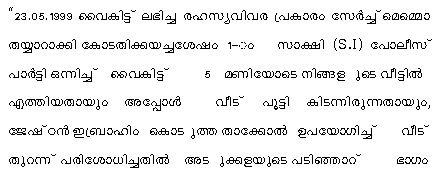
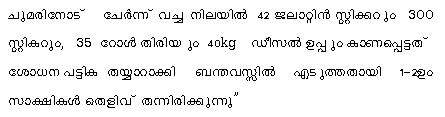
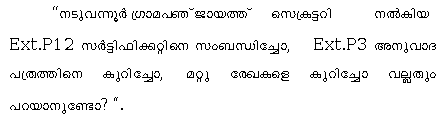
On 23.05.1994, at about 4 p.m., PW1, the Circle Inspector of Police, Balussery received a credible secret information to the effect that explosive substances were unlawfully stocked in Chembottu house bearing building No. I/140 of Naduvannur Panchayat belonging to the accused. Immediately after preparing a search memorandum, PW1 along with his police party including the A.S.I (PW2), proceeded to the said house and reached there at 5 p.m. The house was found locked. The house was opened using a key handed over by PW5 (Ibrahim), the elder brother of the accused. On searching the house, 42 gelatin articles, 300 detonators, 35 rolls of safely fuses and 40 kgs. of diesel salt consisting of ammonium nitrate were found kept towards the western side of the kitchen room. The aforesaid explosive articles were seized under Ext.P2 search list to which PWs 3 and 4 affixed their signatures as independent witnesses. 4 sets of samples were taken from the gelatin sticks, ammonium nitrate, detonators and safety fuses. The samples were forwarded to the Chief Controller of Explosives, Ernakulam for analysis through court. As per Ext.P7 Certificate issued by the Deputy Chief Controller of Explosives the samples were found to be explosive substances. As per Ext.P12 ownership certificate issued by the Secretary, Naduvannur Grama Panchayat, the accused was found to be the owner of the aforesaid house. Since the accused was found in possession of explosives in contravention of the rules made under Section 5 of the Explosives Act, 1884 , he has committed an offence punishable under Section 9 (B)(1)(b) of the . Since the accused was also found to be knowingly in possession of the aforesaid explosive substances giving rise to a reasonable suspicion that he was not in possession of the same for any lawful object, he has committed an offence punishable under Section 5 of the Explosive Substances Act, 1908.
3. On the accused pleading not guilty to the charge framed against him by the court below for the aforementioned offences, the prosecution was permitted to adduce evidence in support of its case. The prosecution altogether examined 10 witnesses as P.Ws 1 to 10 and got marked 13 documents as Exts. P1 to P13.
4. After the close of the prosecution evidence, the accused was questioned under Sec. 313 (1)(b) Cr.P.C. with regard to the incriminating circumstances appearing against him in the evidence for the prosecution. He denied those circumstances and maintained his innocence. He submitted that he was permanently residing in his wife's house and that no explosives had been stocked in the house in question and that he has absolutely nothing to do with this case.
5. As this was not a case of no evidence for the prosecution, the learned Additional Sessions Judge did not record an order of acquittal under Section 232 Cr.P.C. The appellant did not adduce any defence evidence when called upon to enter on his defence.
6. The learned Additional Sessions Judge, after trial, as per judgment dated 27.06.2003 acquitted the appellant of the offence punishable under Section 5 of the Explosive Substances Act, 1908, but convicted him of the offence punishable under Section 9 (B)(1)(b) of the Explosives Act, 1884 . For the said conviction, the appellant was sentenced to undergo rigorous imprisonment for one year and to pay a fine of Rs.2000/- and on default to pay the fine, to suffer simple imprisonment for one month. It is the said judgment which is assailed in this appeal.
7. I heard Adv.Sri.P.V.Kunhikrishnan the learned counsel appearing for the appellant and Adv.Sri.Jayasooria, the le