


 Back
Back





2025 Supreme(Online)(Ker) 69981
IN THE HIGH COURT OF KERALA AT ERNAKULAM PRESENT THE HONOURABLE MR. JUSTICE HARISANKAR V. MENON TH TUESDAY, THE 28 DAY OF JANUARY 2025 / 8TH MAGHA, 1946 WP(C) NO.11956 OF 2019 PETITIONER:
M/S.GEOJIT FINANCIAL SERVICES LIMITED, 11TH FLOOR, 34/659-P CIVIL LINE ROAD, PADIVATTOM, KOCHI, KERALA-682 024, REPRESENTED BY ITS CHIEF FINANCIAL OFFICER. BY ADVS.
JOSE JACOB SRI.K.H.SREENATH RESPONDENTS:
1 UNION OF INDIA, REPRESENTED BY SECRETARY, MINISTRY OF FINANCE, DEPARTMENT OF REVENUE, NORTH BLOCK, NEW DELHI-110001.
2 STATE OF KERALA, REPRESENTED BY THE SECRETARY, COMMERCIAL TAXES, GOVERNMENT OF KERALA, THIRUVANANTHAUPRAM-695 001.
3 CHIEF COMMISSIONER, OFFICE OF CHIEF COMMISSIONER, CENTRAL TAX, CENTRAL EXCISE AND CUSTOMS, THIRUVANANTHAPURAM ZONE-695 001.
4 PRINCIPAL SECRETARY AND COMMISSIONER, OFFICE OF THE PRINCIPAL SECRETARY AND COMMISSIONER, STATE GOODS AND SERVICE TAX DEPARTMENT, KERALA, COCHIN-682 018.
BY ADVS.
SMT.SOWMIAVATHY T.C., CGC SRI.P.R.SREEJITH, SC, CENTRAL BOARD OF EXCISE AND CUSTOMS THIS WRIT PETITION (CIVIL) HAVING BEEN FINALLY HEARD ON 23.01.2025, THE COURT ON 28.01.2025 DELIVERED THE FOLLOWING:
“C.R.”
JUDGMENT
The petitioner, stated to be engaged in providing various financial services, has filed the captioned writ petition seeking to challenge Ext.P4 order issued by the Appellate Authority for Advance Ruling, Kerala, under the provisions of the CGST/SGST, Act, 2017.
2. The petitioner states that as on 30.06.2017, it had a stock of computers, laptops etc., purchased from within the State of Kerala, paying the tax due under the provisions of the Kerala Value Added Tax Act, 2003 (for short, “KVAT Act”). It states that during the pre-GST period, it was not having registration under the KVAT Act, since it was only a service provider not covered thereunder. However, when GST was introduced on 01.07.2017, it claimed that it was eligible for availing transitional credit under Chapter XX of the Kerala State Goods and Services Tax Act, 2017 (hereinafter referred to as “KSGST Act”) as regards the tax paid on the purchase of computers/laptops. Therefore, the petitioner submitted Ext.P1 application seeking an advance ruling as seen from Ext.P1. The questions posed for consideration by the authority under the statute, which read as under:
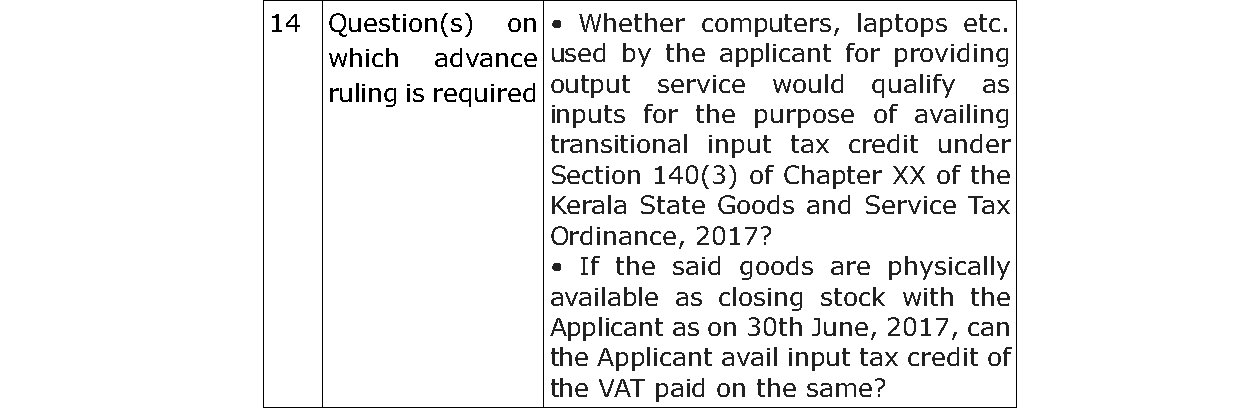
The authority under the statute issued Ext.P2 dated 19.09.2018, finding that the petitioner had no liability under the VAT period and hence, it is not entitled to transitional credit under Chapter XX of the KSGST Act. The authority referred to the provisions of Section 2(59) of the KSGST Act providing for the definition of the term “input” as also the definition of the term “capital goods” under the KVAT Act and answered the query raised, holding that the computers/laptops used by the petitioner would not qualify for transitional credit under Section 140(2) and (3) of the KSGST Act.
3. Though the petitioner preferred a further appeal, the Appellate Authority under the Act dismissed the appeal filed as above by Ext.P4 dated 14.12.2018.
4. It is in the afore circumstances that the captioned writ petition is filed by the petitioner seeking a declaration as to its entitlement for transitional credit under the KSGST Act.
5. I have heard Sri.Jose Jacob, the learned counsel for the petitioner, Sri.Arun Ajay Shankar, the learned Government Pleader and Sri.P.R.Sreejith, the Senior Standing Counsel (CBIC).
6. Sri.Jose Jacob, the learned counsel for the petitioner, would contend that:
i. The claim raised by the petitioner was under Section 140(3) and not under Section 140(2) of the KSGST Act.
ii. Hence, the very consideration of the issues in Ext.P2/P3 was flawed.
iii. He relies on the provisions of the KSGST Act, KVAT Act, etc., to contend that the expression “capital goods” has a different connotation with respect to the claim under Chapter XX of the KSGST Act as regards the extension of transitional credit.
7. Sri.Arun Ajay Shankar, the learned Government Pleader, would contend that:
i. Since the petitioner was not entitled to the input credit under the existing law (KVAT), it cannot be extended under GST.
ii. The petitioner is not entitled to the benefits of transitional credits since computers/laptops are admittedly “capital goods” which are excluded from the coverage of the term “input” under Section 2(59) of the KSGST Act.
8. Sri.Sreejith, the learned Senior Standing Counsel, apart from adopting the submissions made by the learned Government Pleader as above, would submit that:
i. Even under Section 140(3) of the KSGST Act, the petitioner is not eligible since it was not entitled to the input credit when it purchased the computers/laptops.
ii. Insofar as the items concerned were not entitled to input credit under the VAT period, the petitioner is not entitled to the transitional credit.
iii. The reference to the definition of the expression “capital goods” under Explanation to Chapter XX of the KSGST Act is not applicable to the claim under Section 140(3) since the term “capital goods” is not referred to anywhere under Section 140(3). Therefore, the Explanation under Chapter XX would apply only to Section 140(2) and simila












