Back





2026 Supreme(Online)(Ker) 48514
IN THE HIGH COURT OF KERALA AT ERNAKULAM
P.M. Manoj, J
Lucy Joseph – Appellant
Versus
Sudheer – Respondent
MACA NO. 986 OF 2019
Important Points
Subject
Motor Accident Claims - Compensation
Act Referred
Kerala Service Rules: R.90
Headnote
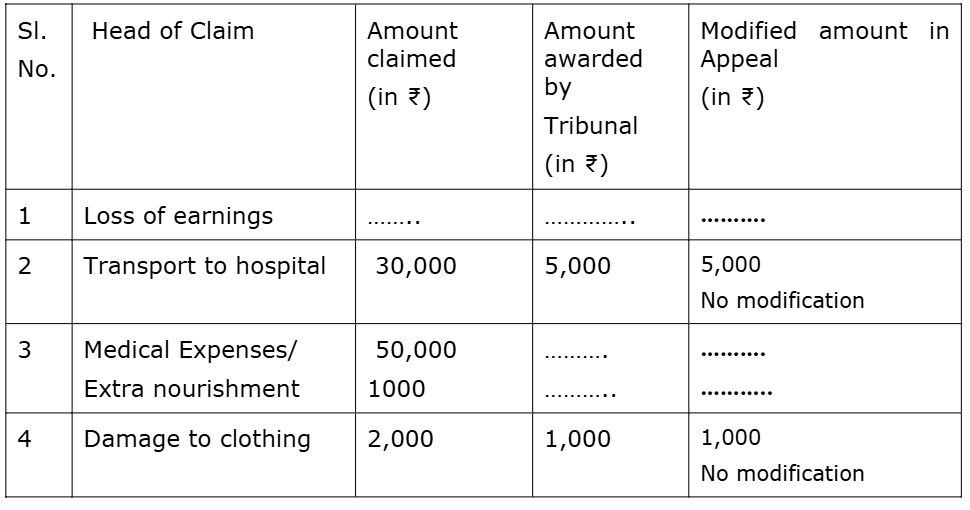
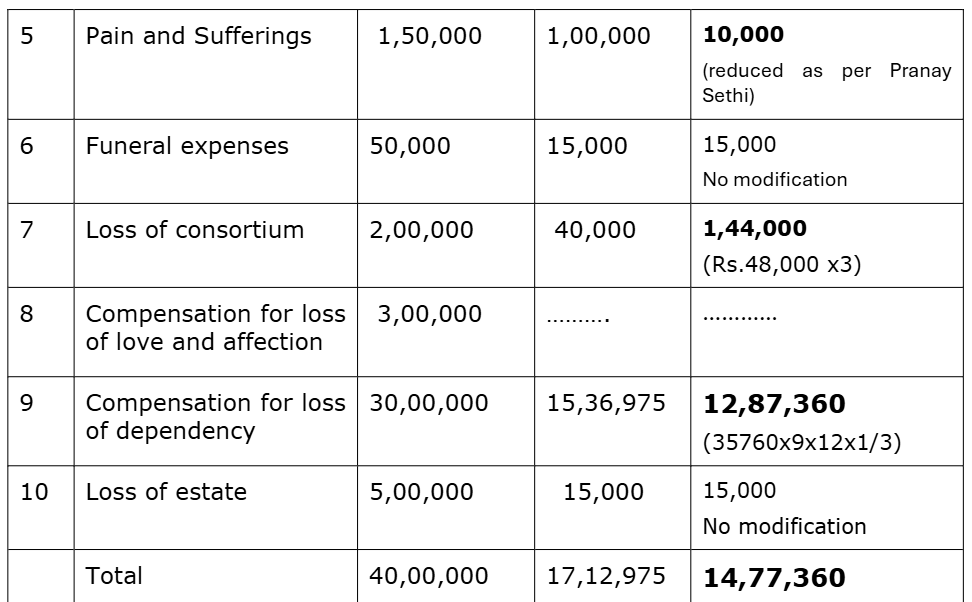
(B) Motor Vehicles Act, 1988 - Section 168 - Just compensation - Conventional heads - Award of pain and suffering and loss of consortium - Fixed standard for conventional damages as per settled law. (Paras 34, 35)
Facts of the case:
The appellants, legal heirs of a deceased retired government employee, appealed against the Tribunal's calculation of compensation. The Tribunal had erroneously deducted the family pension received by the widow from the deceased's personal pension and added an incorrect figure as post-retirement income. The core dispute involved whether the statutory family pension, which would accrue to the family regardless of the manner of death, should be subtracted from the calculation of loss of dependency.
Findings of Court:
The Court concluded that the Tribunal failed to correctly calculate the monthly income by wrongly identifying the revised family pension as the personal pension and erred in principle by deducting the family pension. The Court corrected the multiplicand based on verifiable pension data and post-retirement work income, reduced the excessive award for pain and suffering, and adjusted the consortium award in line with authoritative precedents.
Issues: Whether the family pension granted to a surviving spouse is liable to be deducted from the personal pension or income of the deceased for the purpose of computing the loss of dependency under the Motor Vehicles Act.
Ratio Decidendi: Family pension is a statutory right earned through past service that does not correlate with the accidental death. As heirs are entitled to this benefit regardless of the cause of death, it cannot be considered a 'pecuniary advantage' liable for deduction for the purpose of computing compensation under the Motor Vehicles Act. Any deduction would ignore the contractual or statutory nature of the benefit and defeat the objective of providing 'just compensation'.
Result: Appeals allowed in part; award amount modified to Rs.14,77,360/- with 8% interest.
For the Appellants/Petitioners: Mathew John (K), Mathew Devassi, Aby J Augustine
For the Respondents: V.P.K. Panicker
| Table of Content |
|---|
| 1. establishing liability for negligence and initial compensatory assessment. (Para 1 , 2 , 3 , 5 , 6 , 7) |
| 2. family pension is not a pecuniary advantage deductible under the motor vehicles act. (Para 8 , 9 , 10 , 11 , 12 , 13 , 14 , 15) |
| 3. contentions regarding the deductibility of family pension for retired employees. (Para 16 , 17 , 18 , 19 , 20 , 21 , 22 , 23) |
| 4. statutory characterization of family pension and exclusion from dependency-loss calculation. (Para 25 , 26 , 27 , 28 , 29 , 30 , 31 , 32) |
| 5. recalculation of just compensation and modification of the tribunal award. (Para 33 , 34 , 35) |
JUDGMENT
The appeal is preferred by the appellants who are aggrieved by the deduction of family pension from the deceased's pension while calculating his notional income, and also by the lower amounts awarded under various other heads.
2. The brief facts involved in this case are as follows: On 18.04.2016, the deceased, Xavier, was travelling in a car bearing registration number KL-05-AF-8178. The vehicle was being driven by the 1st respondent along the Vadakkancherry National Highway public road. When they reached the vicinity of the Mangalam bridge, the 1st respondent lost control of the vehicle due to rash and negligent driving and rammed into the bridge divider. Consequently, Xavier sustained severe head and bodily injuries, to which he succumbed.
3. The primary contention raised before the Tribunal was that the accident occurred solely due to the negligence of the 1st respondent driver. The 2nd respondent is the owner of the car, and the 3rd respondent is the insurer, who is liable to indemnify the 2nd respondent and pay a total compensation of ₹40 lakhs.
4. At the time of the accident, the deceased was 57 years old. Following his retirement as a Senior Superintendent in the Forest Department, he was working as a General Insurance Agent. The claim petition was filed by his wife and two children, who contended that he was drawing a monthly pension of ₹22,739 at the time of his death. This forms the background against which the claim of ₹40 lakhs was raised.
5. The 1st respondent, along with the legal representative of the deceased 2nd respondent (impleaded as the additional 4th respondent), remained ex parte. The 3rd respondent filed a written statement admitting that the vehicle was covered by a valid insurance policy at the time of the accident. However, they contended that the deceased had no regular employment or income, and argued that the compensation claimed is excessive.
6. The Tribunal framed issues with respect to the cause of the accident, the quantum of compensation, and the liability to pay the same. For the purpose of adjudicating these issues, documents marked as Exts.A1 to A8 were taken on record.
7. In light of the FIR (Ext.A1) and the final report (Ext.A2), and in the absence of any contradictory evidence, the Tribunal concluded that the 1st respondent was rash and negligent at the time of the accident. Since the insurance policy was admitted, the 3rd respondent was held liable to indemnify the 4th respondent, who is the owner of the vehicle. The Tribunal also concluded that the death occurred due to the injuries sustained in the accident, that the claimants are the legal heirs of the deceased, and that there is no record to show that they have any independent source of income. Upon considering these various factors, the Tribunal concluded that the legal heirs are entitled to a compensation of ₹17,12,975/-.
8. However, this appeal is preferred primarily on the ground that the Tribunal committed a grave error in computing the monthly income of the deceased. To fix the monthly income, the Tribunal primarily considered the pay/leave salary slip (Ext.A7), which showed that the deceased drew a total salary of ₹53,080/- in a pay scale starting at ₹52,800/-. However, going by Ext.A5, it appears that the deceased retired from service with effect from 30.11.2014, and his pension was sanctioned with effect from 01.12.