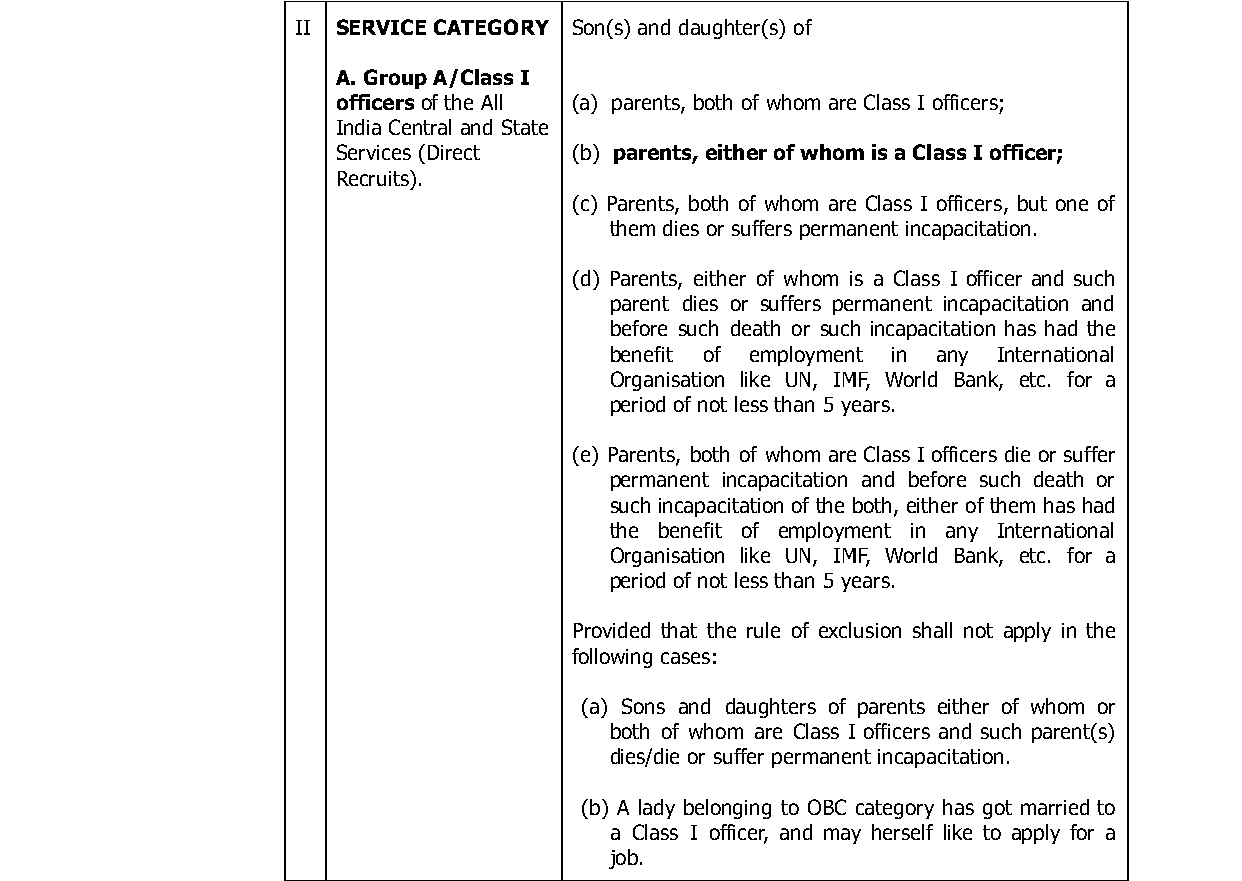
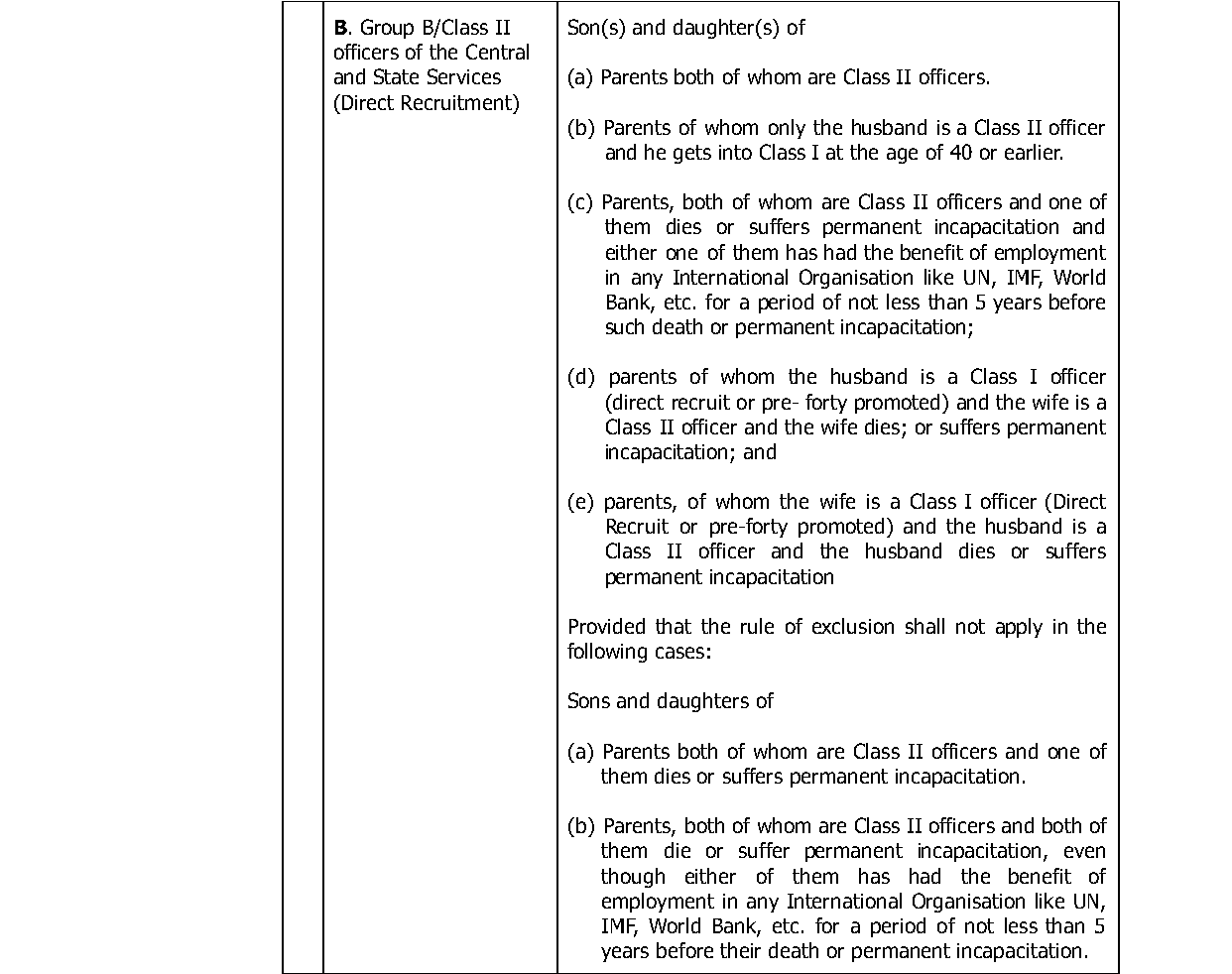
1. Challenge to denial of Non-Creamy Layer status for admission, disputing whether the claimant’s mother’s direct entry into Class I judicial service constitutes creamy layer exclusion. (Para 2 , 5 )
 Back
Next 


2026 Supreme(Online)(Ker) 67917
IN THE HIGH COURT OF KERALA AT ERNAKULAM
Raja Vijayaraghavan V, J, K. V. Jayakumar, APM Judge
STATE OF KERALA – Appellant
Versus
SAMATHA M M – Respondent
WA 2222/2026
Important Points
A clarification to an Office Memorandum cannot displace its substantive criteria or extend benefits to categories not expressly covered. Children of direct Class I/Group A recruits are excluded from OBC reservation based on status, regardless of the age of entry into service.
Subject
Constitutional Law - Reservation
Act Referred
Headnote
(A) Constitutional Law - Article 16(4) - Reservation for Other Backward Classes (OBC) - Creamy Layer - Office Memorandum dated 08.09.1993 and Clarification Letter dated 14.10.2004 - Determination of creamy layer status for children of parents in Government service - Where a parent is a directly recruited Class I/Group A officer, the exclusionary criteria under Category II A apply - A clarification issued to address specific cases of promotion from Class III/IV to Class I at the age of 40 or earlier cannot be extended to direct recruits from a professional background, even if the age of entry into service is above 40 years - Harmonious construction cannot be used to create an exception not provided in the governing memorandum (Paras 16, 19, 23, 26).
(B) Administrative Law - Nature of clarifications - A clarificatory letter must be understood within the framework of the original Office Memorandum and cannot displace or override its substantive provisions. A clarification may explain the application of a provision but cannot alter the substantive policy or create an independent basis for eligibility inconsistent with the governing framework (Paras 27-29).
(C) Equality and Discrimination - The principle of equality does not require persons falling within materially different service categories to be treated identically, irrespective of the distinctions expressly recognized under the applicable policy - Mere difference between direct recruitment and promotion does not constitute actionable discrimination if the classifications are based on a valid policy framework (Para 33).
Facts of the case:
An application for a Non-Creamy Layer certificate for an entrance examination was rejected by the authority on the ground that the applicant's mother was a directly recruited Class I/Group A officer in the judicial service. The applicant contended that since the mother entered the service at the age of 41 and was previously a practicing advocate with a low professional income, she should be treated as non-creamy layer based on a clarification regarding the age of entry into Class I service.
Findings of Court:
The court found that the clarification in question applied specifically to employees who were initially recruited as Class III or IV and subsequently entered Class I service. It did not apply to direct recruits into Class I from the legal profession. The mother's status as a direct Class I officer attracts the exclusionary criteria of the 1993 Office Memorandum, and her prior professional income is irrelevant to the service-status criterion.
Issues: Whether the benefit of a clarification regarding the age of entry into Class I service, originally intended for promoted employees from lower service categories, can be extended to a direct recruit Class I officer to determine Non-Creamy Layer status.
Ratio Decidendi: The governing Office Memorandum establishes distinct categories for exclusion from reservation benefits. The 2004 clarification is limited to specific factual situations regarding promotion from Class III/IV to Class I and does not modify the general exclusionary rule for direct Class I recruits. A clarification cannot be interpreted to alter substantive policy or extend benefits to classes not expressly covered by the original instrument.
Result: Writ Appeal allowed.
Legal Category Hierarchy
Advocates:
For the Appellants/Petitioners: P.A. Mohammed Shah
For the Respondents: Parvathy Kottool
For the Appellants/Petitioners: P.A. Mohammed Shah
For the Respondents: Parvathy Kottool
Table of Contents
2. Petitioner claimed prior advocacy status and age of entry exempt her from exclusion, while the State argued direct entry into Class I service triggers mandatory creamy layer exclusion. (Para 7 )
3. The court held that clear exclusionary categories in the governing Office Memorandum cannot be diluted by external interpretations or misapplied clarifications intended for lower-service-entry scenarios. (Para 14 , 15 , 16 , 17 , 18 , 19 , 23 , 27 , 28 , 30 , 31 , 34 , 36 )
4. The Creamy Layer exclusion for Class I/Group A officers under the 1993 Office Memorandum applies to direct recruits without exception for previous private professional practice or age-based criteria. (Para 19 , 26 , 29 , 38 )
5. The appeal is allowed, setting aside the lower court judgment and upholding the rejection of the application for a Non-Creamy Layer certificate. (Para 39 )
6. Can private practice experience be used to exempt a direct-recruit Class I officer from creamy layer exclusion?
No. The exclusionary criteria under the 1993 Office Memorandum are based on the service status of the parent. Direct recruitment into Class I service triggers exclusion, and previous earnings or professional status do not provide a basis for an exemption. (Para 19 , 24 , 31 )
7. Does the 2004 clarification (Ext. P10) modify the exclusion criteria for all Class I officers?
No. The clarification specifically addresses lower-level government employees promoted to Class I service at age 40 or earlier; it does not extend to, or alter the status of, persons directly recruited into Class I judicial service. (Para 21 , 22 , 23 , 25 , 29 )
8. Are executive clarifications allowed to override the substantive provisions of a government Office Memorandum?
No. A mere administrative letter or clarification cannot supersede or alter the substantive policy framework established by an executive instrument issued under constitutional power. (Para 27 , 28 )
9. Does the principle of equality mandate equal treatment across distinct service categories regarding creamy layer status?
No. The reservation framework relies on distinct service-based categories; equality does not require identical treatment where the governing policy differentiates between recruitment modes and service classes. (Para 33 )
JUDGMENT
Raja Vijayaraghavan V, J.
1.The State has preferred this intra-court appeal challenging the judgment dated 23.10.2026 passed by the learned Single Judge of this Court in W.P.(C) No.28587 of 2026.
2.The aforesaid writ petition was filed by the minor child, the 1st respondent herein, represented by her father. The 1st respondent intended to appear for the Common Law Admission Test (CLAT) 2027, the entrance examination for admission to the much sought after undergraduate law programmes. The principal prayer in the writ petition was to quash Ext. P8 rejection order, whereby her request for inclusion in the Non-Creamy Layer category and for issuance of a Non-Creamy Layer Certificate was rejected. The petitioner also sought a declaration that her creamy layer status could not be determined solely on the ground that her mother presently holds a Class I/Group A post, without considering the applicable criteria prescribed in Office Memorandum No. 36012/22/93 Estt. (SCT) dated 08.09.1993, issued by the Ministry of Personnel, Public Grievances and Pensions, Department of Personnel and Training, Government of India.
3.Since the last date for submitting applications to appear for the entrance examination scheduled to be held on 06.12.2026 was 31.10.2026, and in view of the urgency expressed, with the consent of both sides, we took up the matter for final disposal on the date of admission itself.
4.We have heard the submissions of Sri P.A. Mohammed Shah, the learned Additional Advocate General appearing for the appellants and Smt. Parvathy Kottool, the learned counsel appearing for the writ petitioner, who is the 1st respondent herein.
5.Before adverting to the contentions advanced by the parties, it would be apposite to set out the brief facts that led to the filing of the writ petition:
a. The 1st respondent is a minor. She is a Muslim and belongs to the Mappila community, which is included under the category of “Muslims” in the list of Socially and Educationally Backward Classes (SEBC) notified by the Government of Kerala vide G.O.(P) No. 208/66/Edn. dated 02.05.1966, as subsequently amended.
b. The 1st respondent states that her father was appointed as Assistant Public Prosecutor Grade II at Gram Nyayalaya, Azhutha, Peerumedu, on 31.07.2018, in the pay scale of ₹40,500 to ₹85,000. He was subsequently promoted as Assistant Public Prosecutor Grade I on 27.07.2023, in the pay scale of ₹63,700 to ₹1,23,700, as evidenced by Ext. P2 service certificate produced before this Court in the writ petition.
c. According to the 1st respondent, her mother joined the Kerala State Higher Judicial Service on 16.07.2021 as an Additional District and Sessions Judge and is presently serving as Additional District and Sessions Judge IV, Kollam, when she was 41 years of age. She contends that, prior to her appointment to the Kerala State Higher Judicial Service, her mother was practising as an advocate and that, during the financial year 2019–2020, her gross income was approximately ₹1,20,130, as evidenced by Ext. P4, a copy of her Income Tax Return.
d. In the meantime, Ext. P5 press release was issued by the 5th respondent, inviting applications for CLAT 2027. In order to produce the requisite certificate and claim the benefit of reservation, the 1st respondent submitted Ext. P7 application before the Tahsildar, Kunnamkulam Taluk.
e. The 1st respondent asserts that the Tahsildar rejected her application on the ground that her mother was a directly recruited Class I officer and, therefore, she was not entitled to an OBC Non-Creamy Layer Certificate under Ext. P9, Office Memorandum No. 36012/22/93 Estt. (SCT) dated 08.09.1993, issued by the Government of India (hereinafter referred to as the “1993 Office Memorandum”).
f. According to the 1st respondent, the 1993 Office Memorandum was subsequently clarified by the competent authority through Ext. P10 clarification letter. The said clarification specifically provides that, where the father was directly recruited as