Back





2026 Supreme(Ker) 1467
2026 KER 87660
IN THE HIGH COURT OF KERALA AT ERNAKULAM
P.V. Kunhikrishnan, J.
T.B. Mini – Petitioner
Versus
The Hon'ble Registrar General – Respondent
WP(C) NO. 37581 OF 2026
Decided On : 17-11-2026
Advocates Appeared :
For the Petitioner : Smt.K.Nandini
For the Respondent : Sri. P A Mohammed Shah, Addl. Ag, Sri. Harikumar G, Shri.M.Jayakrishnan, Cgc
JUDGMENT :
P.V. Kunhikrishnan, J.
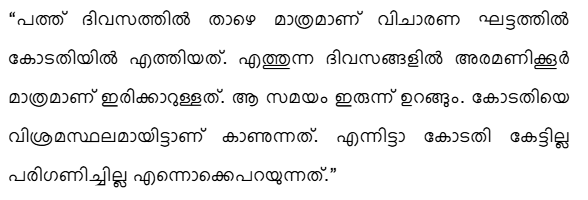
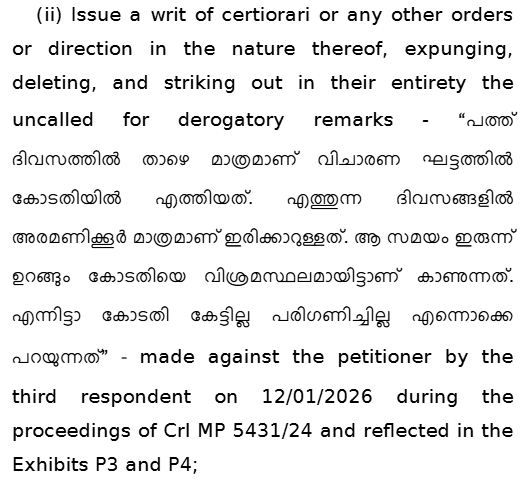
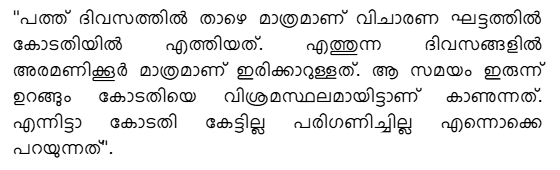
The petitioner is a lawyer practising before this Court and various other courts, including the trial courts. The petitioner is aggrieved by an alleged statement by the then Principal District and Sessions Judge, Ernakulam, Smt. Honey M. Varghese, which, according to the petitioner, was stated in open court to the effect that ‘the petitioner was sleeping in the court whenever she came and that she was treating the court as a resting place’. According to the petitioner, the same amounts to criminal contempt by the Judge and this Court has to place the matter before the Hon’ble Chief Justice for consideration to initiate suo motu proceedings against the Judge concerned, under Section 16 of the Contempt of Court Act, 1971 read with Rule 7 of Contempt of Court (High Court of Kerala) Rules, 1988 (for short ‘Act 1971 and Rules 1988’).
2. Before discussing the case of the petitioner in detail, I have to make certain observations generally. Courtroom remarks by a presiding officer may be momentary, but their circulation may embarrass the person against whom they are made. Lawyers deserve dignity and fair treatment, and they should not leave the court, after arguing a case, feeling that the court insulted or humiliated them. A lawyer's right to argue a case on behalf of his/her client before a court of law includes the right to receive fair treatment from the Bench. A judge decides a case based on the arguments raised by a lawyer. Judges and lawyers are officers of the court, and one is not above the other. At the same time, the members of the Bar should not be carried away by social media reactions simply because a Judge made certain observations in open court with good intentions. As is usually observed, the Bench and Bar are two sides of the same coin. In other words, Judges and lawyers are part of the same family. While deciding cases, Judges may sometimes crack jokes at lawyers, and lawyers may crack jokes at Judges. The dialogues in the courtroom should be confined to the courtroom itself. Judges or lawyers may not intend any harm when they make comments or jokes in court, because a serious courtroom, where only interpretations of law and facts are discussed, can be boring for Judges, lawyers, and litigants, and a joke can ease the mood and atmosphere. Therefore, it is improper for the media to cover such dialogues between a lawyer and a Judge in a way that tarnishes the image of a lawyer or a Judge. The media should know what to neglect and what to project based on their journalistic experience in a sensible manner. Equally, members of the Bar should not be carried away by social media reactions. In such situations, let us neither amplify a colleague’s embarrassment nor rush to hold the Bench in contempt without having the full picture and the context in which any remarks are made by the Judge. Our response should be guided by professional solidarity, restraint and mutual respect, rather than by the impulse to share. I am sure that the media, who always protect the democratic principles of the country, know what to report and what not to report, and they will always uphold those journalistic principles in future too. I leave it there.
3. According to the petitioner, she is not only a lawyer, but a senior trade union leader, a pro bono counsel for the distressed clients, and also espouses the cause of women and the underprivileged. The third respondent was the Principal District and Sessions Judge, who conducted the trial in SC No.118/18 and also during the pendency of Crl. MP 5431/24 (In the writ petition, the number is shown as Crl. MP 5431/24, but in the exhibits produced in Ext. P2, it is shown as Crl. MP 5341/24). It is submitted that, because of the petitioner’s reputation, experience, and capability as a lawyer, the petitioner was engaged to appear on behalf of the victim involved in SC No.118/18, which was tried by the third respondent. She was engaged from 2024 onwards, even though the trial