Back
Back





2024 Supreme(Online)(MAD) 42603
HIGH COURT OF MADRAS
Mrs. Justice R. Hemalatha, J
ANANTHABABU – Appellant
Versus
D.SASIVARNAN – Respondent
S.A.No.487 of 2020 and C.M.P.No.6883 of 2024
Mr.P.Krishnan for Appellants, Mr.J.Ravikumar for RR1 and 2, R3: No appearance
A decree obtained through fraud is a nullity and can be challenged in any court, but the burden of proof lies on the party alleging fraud, requiring clear evidence.
Headnote:(A) Civil Procedure Code - Fraud - A decree obtained through fraud is considered a nullity and can be challenged in any court, including collateral proceedings. The burden of proof lies on the party alleging fraud, requiring clear evidence of intent to deceive. (Paras 12, 22)
(B) Collusion - Allegations of collusion between parties must be substantiated with concrete evidence; mere allegations are insufficient. (Paras 18, 20)
Facts of the case:
The plaintiff sought to declare a decree null and void, alleging fraud in a prior suit. He claimed the agreements were merely security for a loan, not sales. The defendants denied these allegations.
Findings of Court:
The court found no evidence of fraud or collusion, affirming the validity of the prior decree.
Issues: The main issues were whether fraud was committed by the third defendant and if the decree was valid.
Ratio Decidendi: The court ruled that mere allegations of fraud without substantial proof do not suffice to invalidate a decree. The plaintiff's conduct raised suspicion regarding his claims.
Result: The Second Appeal is dismissed.
JUDGMENT
The appellant, A.V.Ananthababu is the plaintiff in O.S.No.49/2008 on the file of the Sub Court, Ranipet. He filed the suit for a declaration that the decree in O.S.No.127/2006 on the file of the Sub Court, Ranipet is null and void and for a mandatory injunction directing the first defendant to return the original documents of title deeds in respect of the suit property and for costs.
2. For the sake of convenience, the parties are referred to as per their ranking in the trial court and at appropriate places, their rank in the present second appeal would also be indicated.
3. The case of the plaintiff in a nutshell is as follows :
3.1. The plaintiff obtained a loan of Rs.2,45,000/- from the first defendant on 22.03.2006. A sale agreement (Ex.A1) was entered into between him and the first defendant on the same day in respect of the suit property. The first defendant obtained his signatures on blank promissory notes, blank papers, blank cheques, blank vakalat etc. on the date of the sale agreement.
3.2. On 08.06.2006, another sale agreement (Ex.A2) came to be executed between him and the wife of the first defendant (second defendant) for a higher sale consideration in respect of the very same suit property. Both the sale agreements were executed only as a security for the loan obtained by the plaintiff from the first defendant and therefore, the plaintiff never intended to sell the property in favour of the first defendant or his wife, the second defendant. Though there was a specific mention in both the sale agreements that possession of the suit property was handed over to the defendants it was not done so and the plaintiff continued to be in possession and enjoyment of the suit property.
3.3. While so, the first defendant filed the suit in O.S.No.127/2006 before the Sub Court, Ranipet, for specific performance of contract against the plaintiff based on the agreement dated 22.03.2006 (Ex.A1). In the plaint, the first defendant did not mention the second sale agreement dated 08.06.2006 (Ex.A2) entered into between the plaintiff and the second defendant. In both the sale agreements dated 22.03.2006 and 08.06.2006 (Ex.A1 and Ex.A2) it was clearly mentioned that the first defendant can only claim the amount as compensation / damages and not the property.
3.4. According to the plaintiff, in the settlement deed dated 09.03.2006 (Ex.A4) executed by his father in his favour, the value of the suit property was indicated as Rs.55,65,308/-. The first defendant also was aware of the market value of the suit property, but in the sale agreement dated 22.03.2006 (Ex.A1) the sale consideration was mentioned as Rs.2,45,000/-. In the second sale agreement dated 08.06.2006 (Ex.A2) it was indicated as Rs.9,00,000/-.
3.5. On 12.06.2006, the plaintiff handed over all his title deeds to the first defendant. All these facts would go to show that the sale agreement dated 22.03.2006 (Ex.A1) was executed only as a security for the loan advanced by the first defendant in favour of the plaintiff. The plaintiff never intended to sell the suit property in favour of the first defendant.
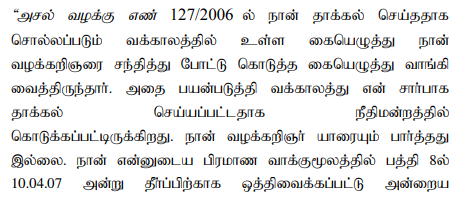
3.6. However, the first defendant suppressing all these facts had filed the suit in O.S.No.127/2006 before the Sub Court, Ranipet. The first defendant had misused the blank vakalat duly signed by the plaintiff. Thiru. S.Govinda Ragavan, the counsel (third defendant) signed the vakalat and presented it before the Sub Court, Ranipet, as if he was engaged by the plaintiff.
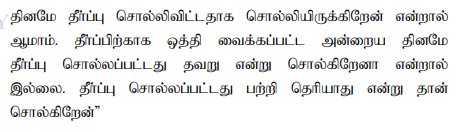
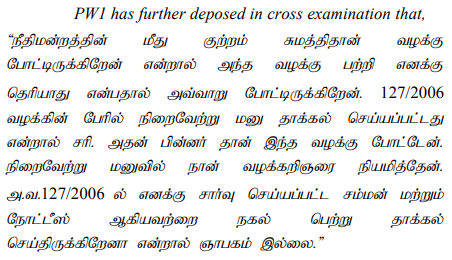
3.7. The suit was posted for filing written statement on 21.03.2007. However, on 16.03.2007 a petition in I.A.No.72/2007 was filed for advancing the hearing date and the third defendant (counsel) filed the written statement. Thereafter, the case was posted on 21.03.2007 for framing issues and issues were also framed. Subsequently, the case was posted for trial on 27.03.2007 and the first defendant examined himself as P.W.1 and marked three documents. The third defendant also cross examined P.W.1 on the same day