
 Back
Back





HIGH COURT OF MADRAS
G.K. ILANTHIRAIYAN, J
Vakil Hosur Hills Owners – Appellant
Versus
The Secretary to Government – Respondent
W.P.Nos.7792 of 2017 & 14138 of 2024
COMMON ORDER
The writ petition in W.P.No.7792 of 2017 has been filed challenging the proceedings in R.C.No.15094/2016/LA2 dated 19.10.2016 on the file of the second respondent and the approval order dated 16.11.2016 on the file of the third respondent, thereby converted the subject property into house plot and granted technical approval. The writ petition in W.P.No.14138 of 2024 has been filed challenging the order passed by the fourth respondent dated 13.02.2024, thereby granted planning permission in No.72/24 and building permission in No.153/BL/2024/00072.
2. The petitioner in both writ petitions are one and the same and the subject property is also one and the same. Therefore, this Court is inclined to pass a common order in both writ petitions. The parties are referred to as per their ranking in W.P.No.14138 of 2024.
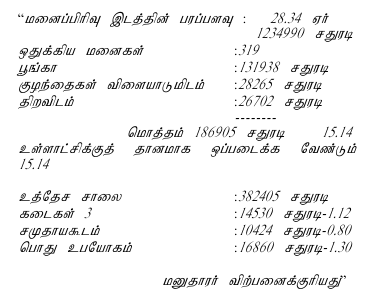
3. The petitioner association is consisting the member of owners of their respective villas in the lay out of Vakil Hosur Hills. As per the lay out, 319 villas and individual houses were proposed to develop for residential purpose. The lay out was duly approved by the second respondent by its proceedings in Ma/va/Na.U.E.No.77/2006, on certain conditions. While granting approval, the area of lands have been categorized and reserved for specific purpose. Accordingly, the total extend of the land is 28.38 ares (1234990 sq.ft.); the number of residential plot is 319; the land ad measuring 131938 sq.ft., is earmarked for park and 28265 sq.ft., is earmarked for children play area. That apart, the land ad measuring 26702 sq.ft., is reserved for open space area and the land ad measuring 382405 sq.ft., is allotted for roads; 14530 sq.ft., of land is earmarked for three shops and 10424 sq.ft., land is earmarked for community hall and 16860 sq.ft., land is earmarked for public purpose.
4. After approval as per the lay out plan, the fifth respondent was not authorized to sell the lands which was specifically reserved for public purpose. Thus it is clear that the duty cast upon the developer to create facilities and amenities for the space earmarked for public purpose. Though in the approval order of the second respondent termed the land reserved for public purpose is saleable by the developer, it cannot be sold as the developer stands in the capacity of custodian, trustee for the residents for the purpose of creating the facilities like schools, clinic, community hall and to be handed over the same for maintenance by the petitioner association.
5. Further as per the condition on agreement for sale cum construction, the developer ought to have completed all the facilities and amenities including basic amenities and special amenities within 24 months from the date of this agreement, with six months grace period. Thereafter, the developer ought to have handed over such facilities in favour of the petitioner association, in order to maintain the same. Therefore, the fifth respondent cannot claim any right or title over the land which is specifically earmarked for that purpose.
6. While being so, the fifth respondent attempted to sell the entire land ad measuring 16860 sq.ft., land which is earmarked for public purpose to the third parties violating the lay out approval conditions as well as the sale cum construction agreement. Though the petitioner raised several objections, the fifth respondent sold out the subject property on 29.06.2016 vide document No.10274 of 2016 in favour of one Bharathidasan and Jayanthimani. Thereafter, they applied for conversion of the land from commercial to residential purpose. Without hearing the petitioner, the subject property was converted into house plots and granted permission to develop the same as residential plots. Therefore, both the orders are challenged in W.P.No.7792 of 2017 and it is pending with interim order that any registration pertaining to the land reserved for public purpose would be subject to the result of the writ petition.
7. While pending the above writ petition, the sixth res



An indispensable Tool for Legal Professionals, Endorsed by Various High Court and Judicial Officers
Please visit our Training & Support
Center or Contact Us for assistance

Scan Me!
India’s Legal research and Law Firm App, Download now!


For Daily Legal Updates, Join us on :



 Back to top


