


 Back
Back





2025 Supreme(Online)(Mad) 57577
IN THE HIGH COURT OF JUDICATURE AT MADRAS
C.Saravanan, J
D.Sigamoni – Appellant
Versus
The Secretary to Government, Transport Department, Fort St.George, Chennai – Respondent
W.P.Nos.20524, 20525 & 20526 of 2014
For the Appellants/Petitioners: No Appearance
For the Respondents:Mr.G.Prasanna, Government Advocate
The court confirmed that training periods, during which contributions to the pension fund were made, must be counted as pensionable service, irrespective of the designation of 'trainee'.
Headnote:(A) Constitution of India - Article 226 - Tamil Nadu Pension Rules, 1978 - Writ petitions seeking inclusion of trainee period for pension calculation - Court held that pensionable service should include periods for which contributions were made, regardless of the designation as trainee or regular employee - Impugned order rejecting the inclusion of training period quashed. (Paras 5, 40)
(B) Employment Law - Definition of 'Employee' under Payment of Gratuity Act, 1972 - Clarification provided regarding eligibility of trainees for pensionary benefits based on contributions made during training period - Determination of pensionable service clarified. (Paras 12, 36)
Facts of the case:
Petitioners, former employees of the State Transport Corporation, sought to include their trainee periods in the pensionable service, arguing that they had made contributions during this period, which were not recognized in the pension calculation by the Respondents. (Paras 4, 7)
Findings of Court:
The Court found merits in the Petitioners' claims and directed a fresh evaluation of their training periods in determining pension benefits. (Paras 40)
Issues: The primary issue was whether the trainee period, during which contributions were made, should count towards pensionable service. (Paras 5)
Ratio Decidendi: The court ruled that the inclusion of training periods is valid when contributions were made, emphasizing that the definitions within pension rules should be interpreted to favor the employee's contributions regardless of their designation. (Paras 36, 40)
Result: Writ petitions disposed of with directions for fresh consideration.
| Table of Content |
|---|
| 1. writ petitions filed by retired employees regarding pension calculation. (Para 1 , 2 , 3 , 4) |
| 2. petitioners claim training period should count for pension. (Para 5 , 7 , 8) |
| 3. respondent argues training period not eligible for pension. (Para 10 , 11 , 12 , 13) |
| 4. court considers previous rulings on pension eligibility. (Para 14 , 15) |
| 5. court reviews employee and beneficiary definitions in pension rules. (Para 16 , 17 , 18) |
| 6. employment definitions differ in various labor laws. (Para 19 , 20 , 21) |
| 7. court examines definitions relevant for pension calculations. (Para 22 , 23 , 24 , 25) |
| 8. court analyzes eligibility service and pensionable service rules. (Para 26 , 27 , 28) |
| 9. clarification on contributory vs non-contributory service. (Para 29 , 30 , 31 , 32) |
| 10. pensionable service tied to contributions made. (Para 33 , 34 , 35) |
| 11. court's decision on remitting case for fresh order on contributions. (Para 36 , 37 , 38) |
| 12. court's final directive on remittance and fresh consideration. (Para 39 , 41) |
COMMON ORDER
Today, these Writ Petitions were taken up for consideration. There is no representation on behalf of the Petitioners.
2. Since the Petitioners herein are senior citizens, whose cause is going un-presented, I am inclined to consider the case on merits after examining the records and considering the arguments of the learned Government Advocate for the 1st Respondent.
3. These Writ Petitions have been filed for the relief detailed hereunder:
| S.No. | Name of the Petitioner | Writ Petition No. | Prayer in the Writ Petitions |
| 1 | D.Sigamani | 20524 of 2014 | For issuance of a writ of certiorarified mandamus calling for the records of the 3rd Respondent in Letter No.44/P2/Tha.Aa.Po.Ka.U.O.Ni.Po/ 2013-880 dated 06.12.2013 peruse and to quash the same and also, to direct the 2nd and 3rd Respondents to include the company trainee period i.e., from 01.12.1982 to 31.01.1984 while calculating pensionable period and give arrears of pension amount to the petitioner. |
| 2 | M.Arumugam | 20525 of 2014 | For issuance of a writ of certiorarified mandamus calling for the records of the 3rd Respondent in Letter No.44/P2/Tha.Aa.Po.Ka.U.O.Ni.Po/ 2013-880 dated 06.12.2013 peruse and to quash the same and also, to direct the 2nd and 3rd Respondents to include the trainee period i.e., from 19.04.1982 to 30.04.1984 while calculating pensionable period and give arrears of pension amount to the petitioner. |
| 3 | G.Krishnamoorthy | 20526 of 2014 | For issuance of a writ of certiorarified mandamus calling for the records of the 3rd Respondent in Letter No.44/P2/Tha.Aa.Po.Ka.U.O.Ni.Po/ 2013-880 dated 06.12.2013 peruse and to quash the same and also, to direct the 2nd and 3rd Respondents to include the trainee period i.e., from 18.06.1982 to 01.08.1984 while calculating pensionable period and give arrears of pension amount to the petitioner. |
4. The Petitioners were employees of the State Transport Corporation who have approached this Court long after their retirement.
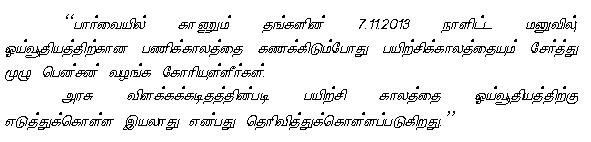
5. The point for consideration in these Writ Petitions is whether the request of the Petitioner(s) for including the period undergone by them during the training was to be reckoned for determining their pensionary benefits. The 3rd Respondent vide Orders dated 06.12.2013 rejected the request of the Petitioner(s) (hereinafter referred to as the 'Impugned Order').
Aggrevied by the same, the Petitioners have filed these Writ Petitions. 6. The Impugned Orders dated 06.12.2013 in these Writ Petitions read identically. For the sake of convenience and clarity, the text of the Impugned Order dated 06.12.2013 in W.P.No.20524 of 2014 is reproduced below:
7. The case of the Petitioners is that these Petitioners have contributed to the monthly Provident Fund even during their training period at service at the Respondent Department and that only the balance amount was paid to them. The further case of the Petitioners is that the Petitioners' services were subsequently regularized and they retired from service after they attained the age of su












