
 Back
Back





IN THE HIGH COURT OF JUDICATURE AT MADRAS
Sathi Kumar Sukumara Kurup, J
Tmt.Rajamma (Died)2. Prasad 3. Swarna 4. Lalitha 5. Prema6. Annapoorna7. Uma – Appellant
Versus
Jujuvadi Muniappa – Respondent
Second Appeal No.721 of 2008
| Table of Content |
|---|
| 1. case facts about family property and claims. (Para 2) |
| 2. arguments about partition validity and evidence. (Para 3 , 4 , 11 , 15) |
| 3. court's considerations on documentary evidence. (Para 5 , 12 , 14 , 18) |
| 4. court rulings on admissibility of documents and burden of proof. (Para 24 , 30 , 39) |
| 5. conclusion reaffirming prior court findings on partition. (Para 37 , 38 , 42) |
JUDGMENT
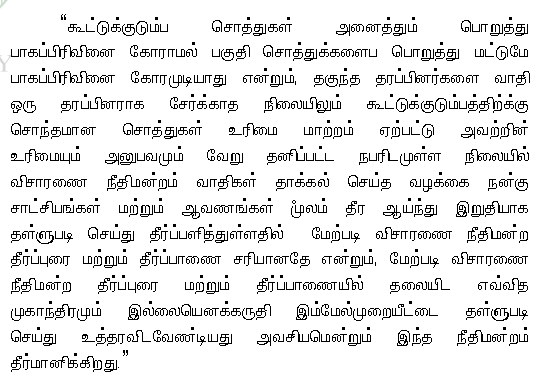
This Second Appeal is filed against the Decree and Judgment of the learned the Subordinate Judge, Hosur made in A.S.No.19 of 2003 dated 30.07.2004 confirming the decree and judgment of the learned District Munsif and Judicial Magistrate, Denkanikottai made in O.S.No.138 of 1994 dated 04.04.2003.
2. The brief facts of the case are as follows:
2.1. The Appellants, who are the Plaintiffs in O.S.No.138 of 1994, filed the suit for partition and possession of the suit properties of 3.50 acres of land, one tiled-roof house and a tamarind tree.
2.2. It is the case of the Plaintiffs that the suit property along with other properties originally belongs to the Hindu undivided family of Base Goudu. After his death, the three sons of Base Goudu, namely, Nanjegoudu, Mahadevappa and Veerabadrappa constituted as members of the undivided Hindu Joint Family. After the death of Veerabadrappa, whose wife had also predeceased him, Nanjegoudu, the husband of the 1st Plaintiff Rajamma and Mahadevappa the 1st Defendant constituted the undivided Hindu Joint family owning the suit properties. Thus, Nanjegoudu is entitled to half share in all the properties of the undivided Hindu Joint Family and during his lifetime, there was no division between him and Mahadevappa, the Defendant-1. The said Nanjegoudu died on 30.12.1979 leaving his half share in the suit property and the Plaintiffs as his legal representatives have succeeded the same.
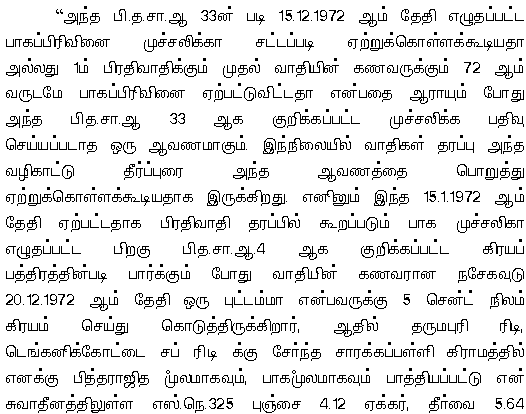
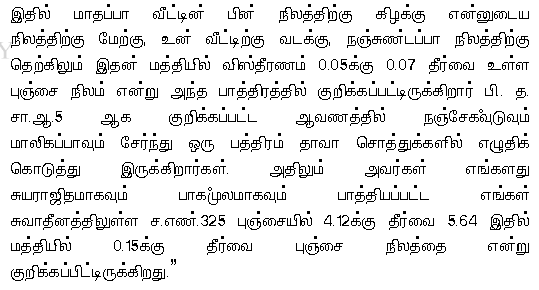
3. The submission of the learned Counsel for the Appellants is that both the trial Court as well as the Appellate Court have been wrongly influenced by Ex.B-33, the alleged partition Muchalika dated 15.12.1972 between Mahadevappa, Nanjegoudu and others and on that basis had wrongly concluded that there is already a partition between the brothers and therefore, dismissed the suit.
4. The learned Counsel for the Appellants invited the attention of this Court in the case of Yellapu Uma Maheswari and another v. Buddha Jagadheeswara Rao and Others reported in (2015) 16 Supreme Court Cases 787, in which it is held that an unstamped and unregistered Muchalika is not admissible as an evidence. An unstamped or inadequately stamped document cannot be admitted in evidence for any purpose in accordance with Section 35 of the Indian Stamp Act, 1899 unless it is properly stamped. It can be stamped and admitted in evidence provided, penalty under Proviso Clause (a) of of the Indian Stamp Act, is paid. A document which creates or assigns any right either in the present or in the future on any immovable property has to be compulsorily registered under Section 17 of the Registration Act, 1908 . A document which has to be compulsorily registered cannot be received in evidence with respect to any transaction relating to the property mentioned in the document as per the prohibition under Section 49 of the Registration Act.
5. A family arrangement or a Muchalika in effect grants right or title to certain portions of property to a few individuals and also at the same time takes away the rights and title of some of the parties to the other portions. This document therefore comes squarely under Section 17 of the Registration Act, 1908 , as a document which has to be compulsorily registered and under section 49 of the , a document which has to be compulsorily registered cannot be admitted in evidence.
6. It is further submitted by the learned Counsel for the Appellants that even though the learned District Munsif, Denkanikottai in judgment dated 04.04.2003 had accepted the stand of the Plaintiffs that an unstamped and unregistered Muchalika marked under Ex.B-33 c





An indispensable Tool for Legal Professionals, Endorsed by Various High Court and Judicial Officers
Please visit our Training & Support
Center or Contact Us for assistance

Scan Me!
India’s Legal research and Law Firm App, Download now!


For Daily Legal Updates, Join us on :



 Back to top


