Back
Back





2025 Supreme(Online)(Mad) 68821
IN THE HIGH COURT OF JUDICATURE AT MADRAS
ANITA SUMANTH, C.KUMARAPPAN, JJ
S.Velmurugan – Appellant
Versus
The State of Tamil Nadu – Respondent
W.P.(MD)No.3437 of 2022|W.M.P.(MD)Nos.3006 and 24339 of 2022
For the Appellants/Petitioners: Mr.S.Xavier Rajini
For the Respondents:Mr.Veerakathiravan Additional Advocate General, Mr.R.Thilak Kumar Government Pleader
The court affirmed that land designated for educational purposes must not be diverted for administrative buildings, emphasizing the importance of maintaining adequate playground space for children's welfare.
Headnote:(A) Constitution of India - Article 226 - Writ of Mandamus - Public interest litigation filed to restrain the construction of government buildings in the playground of a school for girls - The purpose of the land designated for educational use must be preserved in the interest of children’s welfare. (Paras 1-37)
(B) Encroachment - State’s encroachment into school premises not permissible when space provided is meant for educational facilities - The land originally endowed for educational purposes cannot be diverted for administrative uses. (Paras 7, 27)
(C) Minimum Land Requirements - Government directives indicate a need for sufficient playground space within school premises, ensuring a conducive environment for education - Balance between educational needs and available space must be maintained to support physical health. (Paras 23-36)
Facts of the case:
The petitioner contested the proposed construction of a hostel and child welfare office on playground land in a historically significant government girls’ school built in 1949, arguing against the truncation of playground space.
Findings of Court:
The court directed that the area designated for the school must remain exclusively for educational purposes and ordered the removal of administrative offices from the premises.
Issues: The petition raised matters concerning land classification, usage diversion for administrative purposes, and the adequacy of playground area for student welfare.
Ratio Decidendi: The court ruled that the educational integrity of dedicated school land must be respected, prohibiting encroachment for administrative needs, thus reinforcing the principles of child welfare and educational access.
Result: Writ petition allowed.
| Table of Content |
|---|
| 1. contested construction of administrative buildings on educational land. (Para 1 , 3 , 4 , 5 , 6) |
| 2. arguments presented for and against land usage and its implications. (Para 2 , 7 , 8 , 10) |
| 3. court observations on land classification and educational significance. (Para 9 , 35 , 36) |
| 4. legal directives on non-encroachment of educational land. (Para 27 , 28) |
| 5. final ruling prohibiting construction of buildings on playground. (Para 37) |
ORDER
(Order of the Court was made by DR.ANITA SUMANTH, J.)
This writ petition has been filed in public interest seeking mandamus forbearing the respondents from constructing the Government children’s hostel and District Child Welfare Office in the playground of the Sethu Lakshmi Bai (SLB) Girls High School, Nagercoil, Kanyakumari District.
2.We have heard the detailed submissions of Mr.Xavier Rajini, learned counsel for the petitioner, Mr.Veerakathiravan, learned Additional Advocate General for Mr.Thilak Kumar, learned Special Government Pleader for the respondents.
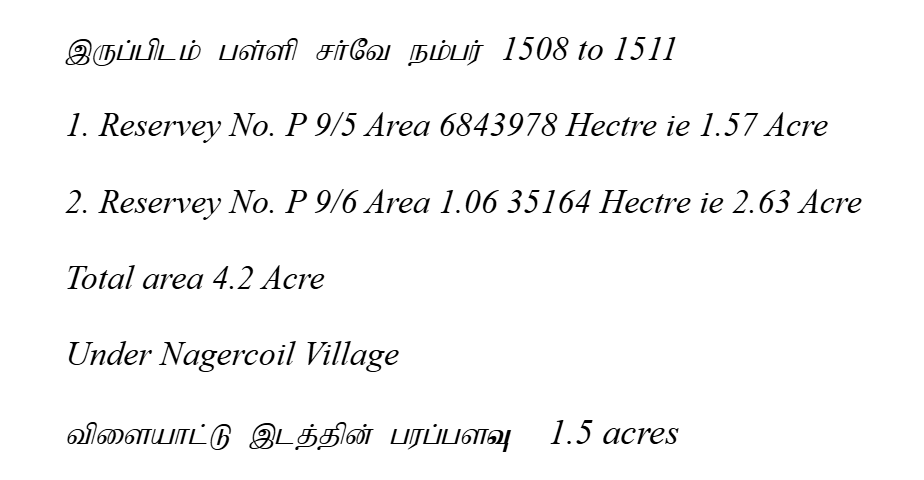
3.The Sethu Lakshmi Bayi (SLB) School is said to have been constructed in the year 1949 by the then King of Thiruvithangoor Samasthanam. It is a school functioning specifically for girl students. At present, it contains primary and high schools, both in the same campus. The school and the land appurtenant thereto, admeasuring in all 4.2 acres is situated in Rs.No.P-9/5 and 9/6, Nagercoil Village (property/property in question).
4.Both the primary and high schools are Government establishments. Over the years, the State appears to have itself encroached upon the school premises as the office of the Chief Educational Officer (CEO) and District Educational Officer (DEO) have been constructed therein, presently occupied by the aforesaid officials and their officers. The school also houses a water tank and other school facilities and infrastructure.
5.The learned counsel for the petitioner draws our attention to a document, which contains the details of buildings in the property in question, wherein an extent of 1.5 acres was originally reserved towards playground. We will refer to this document presently, and have extracted the same at paragraph 12. At the time when the writ petition was instituted, 50 cents alone remained towards playground.
6.The petitioner is aggrieved by the construction of the children hostel and District Child Welfare Office in the school campus, right where the playground was earlier. The petitioner would submit that as a policy, the State is stopped from utilizing the school premises for its own administrative use. That apart, the area of playground ought not be truncated/restricted and hence, the construction of the children hostel and District Child Welfare Office in the school compound was to be prevented.
7.The learned Additional Advocate General would, on the contrary, submit that the construction of the children’s hostel and District Child Welfare Office is specifically to enable the orphan children to be housed there, as such they may eventually attend SLB School. It is a welfare measure, which has been thought of specifically bearing in mind the orphaned female children.
8.He would also rely on G.O.Ms.No.14, School Education (MS), dated 13.01.2023, under which the Tamil Nadu Private Schools (Regulation) Rules, 2023 had been framed. Under those Rules, a minimum land requirement has been set out for various categories of schools. For a corporation school, the minimum land required is 6 grounds. Hence, according to him, the acreage for the playground in the school in question is more than adequate and the State must be permitted to proceed as proposed.
9.We have carefully heard both learned counsel and perused the material papers. Three issues arise for our consideration, firstly, as to the classification of the land in question, secondly, as to the diversion of the land earmarked for a particular purpose such as school, for its own administrative purposes, and thirdly, whether the area provided for a p