
 Back
Back





IN THE HIGH COURT OF JUDICATURE AT MADRAS
C.V.KARTHIKEYAN, R.VIJAYAKUMAR, JJ
Smt.Vijaya – Appellant
Versus
Rajkumar (Died) – Respondent
A.S.(MD)No.147 of 2019|C.M.P.(MD)No.7476 of 2019|Cross Objection (MD)No.17 of 2019
| Table of Content |
|---|
| 1. understanding the context of the partition suit initiated by the plaintiff against family members. (Para 1 , 4 , 5) |
| 2. examination of claims to properties based on ancestral vs. self-acquired status. (Para 19 , 26 , 34) |
| 3. legal clarity on property ownership and the distinction between ancestral and self-acquisition. (Para 39 , 40 , 49) |
| 4. final ruling regarding the appeal and its implications for partition claims. (Para 51 , 52) |
COMMON JUDGMENT
C.V.KARTHIKEYAN, J.
The seventh defendant in O.S.No.45 of 2008 on the file of the II Additional District and Sessions Court, Thanjavur, is the appellant herein, aggrieved by the judgment and decree dated 29.11.2018, whereby a preliminary decree was passed in the suit for division of all the suit properties except the fourth item in Part–I of Schedule “D” of the suit schedule properties.
2. The contention of the appellant is that all the properties falling under Schedule “D” ought to have been excluded from partition.
3. The plaintiffs in the said suit have filed a Cross Objection, challenging that portion of the decree by which the fourth item in Part–I of Schedule “D” was exempted from partition.
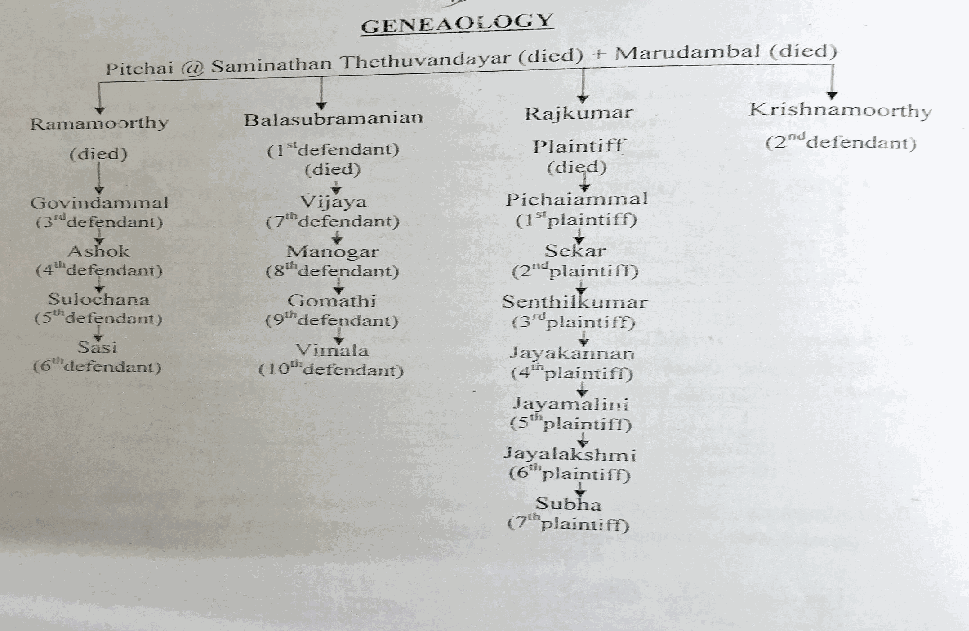
4. The suit in O.S.No.45 of 2008 had been filed by the plaintiff Rajkumar, seeking partition and separate possession of his 1/4th share in the suit schedule properties, described as A to I Schedule properties. The first defendant Balasubramanian and the second defendant Krishnamoorthy are his brothers. The defendants 3 to 6 are the widow and children of his other brother, Ramamoorthy.
5. In the plaint, it was stated that the plaintiff, the first and second defendants, and the deceased Ramamoorthy were the sons of late Pitchai @ Saminatha Thethu Vandaiyar, who died intestate on 30.06.2000, leaving behind his wife Marudhuambal and three of his sons. The eldest son, Ramamoorthy, had predeceased him on 09.08.1984. The mother, Marudhuambal, died on 01.02.2003.
6. The plaintiff claimed that the properties described in Schedules A to I belonged to the joint family consisting of the father, Pitchai @ Saminatha Thethu Vandaiyar, and his sons. It was further contended that, out of the sale proceeds of ancestral properties, additional properties had been purchased.
7. It was further contended that the father was running a tea shop in which his sons assisted him. Subsequently, the father also started a liquor shop and obtained licences in the names of third parties. He was also running an arrack shop in the name of the first defendant, Balasubramanian. It was contended that all the four sons assisted the father in the running of these businesses.
8. It was additionally stated that, in order to avoid land ceiling laws, urban ceiling laws, and for taxation purposes, the father purchased various properties in the names of each of his sons. It was, however, contended that although the properties stood in the individual names of the sons, they all constituted joint family properties.
9. The 'A' Schedule properties stand in the name of the father, Pitchai @ Saminatha Thethu Vandaiyar. The 'B' Schedule properties stand in the name of the mother, Marudhuambal. The 'C' Schedule properties stand in the name of the deceased son, Ramamoorthy. The 'D' Schedule properties stand in the name of the first defendant, Balasubramanian. The 'E' Schedule property stands in the name of the second defendant, Krishnamoorthy. The 'F' Schedule properties stand in the name of the plaintiff, Rajkumar. The 'G' Schedule properties stand in the names of Saminathan, Balasubramanian, Ramamoorthy, and Krishnamoorthy, respectively. The 'H' Schedule properties stand in the names of Saminathan, Krishnamoorthy, Rajkumar, and Ramamoorthy, respectively. The 'I' Schedule properties stand in the names of Balasubramanian and Ashok (first and fourth defendants), Saminathan, and Rajkumar, respectively.
10. It was contended that the plaintiff was entitled to an undivided 1/4th share in the suit schedule properties. It was further stated that the



An indispensable Tool for Legal Professionals, Endorsed by Various High Court and Judicial Officers
Please visit our Training & Support
Center or Contact Us for assistance

Scan Me!
India’s Legal research and Law Firm App, Download now!


For Daily Legal Updates, Join us on :



 Back to top


