


 Back


2025 Supreme(Online)(Mad) 71542
IN THE HIGH COURT OF JUDICATURE AT MADRAS
BADARAPPA – Appellant
Versus
S.G.GOPE GOWDU – Respondent
S.A.No.495 of 2000
For the Appellants/Petitioners: V.Sekar for C.R.Muralidharan
For the Respondents:G.Vigneswaran for V.Nicholas (For Respondents 1 & 2), No appearance (For Respondents 3 & 4)
In a suit for declaration of title, the plaintiff must prove his own title on the strength of his evidence; he cannot rely on the weakness of the defendants' case. Failure to do so results in dismissal.
Headnote:(A) Code of Civil Procedure, 1908 - Section 100 - Second appeal - Suit for declaration of title and injunction - Plaintiff must prove his title independently on the strength of his own evidence - He cannot rely on the weakness of the defendants' case - The principle is based on the latin maxim 'Ei qui affirmat, non ei qui negat, incumbit probatio' - Section 101 of the Indian Evidence Act, 1872 mandates that the person who desires judgment in his favour must prove the facts asserted - In a title suit, if the plaintiff fails to prove his title, the suit must be dismissed even if the defendants have no title - The plaintiff need not prove beyond reasonable doubt but must establish a high degree of probability - Only when such proof is adduced does the onus shift to the defendants - Referred to T.K. Mohammed Abubucker v. P.S.M. Ahamed Abdul Khader, (2009) 14 SCC 224. (Paras 14-15)
(B) Settlement deed - Not a document of title - A sale deed is a document of title - For a plaintiff to succeed, he must produce full set of title deeds including prior deeds to trace ownership back to its origin - Mere production of a settlement deed alone is insufficient. (Para 18)
Facts of the case:
The appellant/plaintiff filed a suit for declaration of title and injunction in respect of 1 acre 50 cents of land. He claimed that the larger extent originally belonged to two persons, Dhigganti Malle Gowdu and Kempe Gowdu, each entitled to 1 acre. Through a chain of settlements and sales from the heirs of Dhigganti Malle Gowdu, he obtained 1 acre. As to the remaining 50 cents, he claimed that it came from the share of Munia Gowdu (brother of Kempe Gowdu) which devolved to his wife Devamma, who settled it on her daughter and son-in-law, from whom the plaintiff purchased it. The respondents/defendants denied the plaintiff's title and claimed possession. The trial court and the lower appellate court dismissed the suit, holding that the plaintiff failed to prove his title. The plaintiff filed a second appeal.
Findings of Court:
The High Court upheld the concurrent findings. It held that the plaintiff had not produced any primary evidence to show that the property originally belonged jointly to the two persons he alleged. There was no proof of partition between them or that a specific share was allotted to the plaintiff's vendors' predecessor-in-title. The plaintiff relied on a settlement deed which is not a document of title. The revenue records produced by the defendants, though improperly relied upon by the courts below, do not help the plaintiff because the plaintiff failed to discharge his initial burden of proof under Section 101 of the Evidence Act. Since the basic requirements of a suit for title were not proved, the dismissal was correct.
Issues: (1) Whether the courts below erred in rejecting the suit without reference to the registered sale deeds in favour of the plaintiff, particularly when the defendants had not adduced evidence to counter the plaintiff's entitlement? (2) Whether the courts below erred in dismissing the suit for title on the ground that the plaintiff failed to establish lawful possession?
Ratio Decidendi: In a suit for declaration of title, the plaintiff must prove his title independently and cannot rely on the weakness of the defendants' case. The plaintiff must produce a complete chain of title deeds to trace ownership back to the origin. A settlement deed is not a document of title. Failure to prove the basic facts of ownership and partition results in dismissal of the suit irrespective of the defendants' evidence. Result : Second appeal dismissed. The judgment and decree of the lower courts are confirmed. Costs throughout.
JUDGMENT
The plaintiff appeals. He assails the judgment and decree of the learned Subordinate Judge at Hosur in A.S.No.150 of 1996 dated 11.12.1996 in confirming the judgment and decree of the learned District Munsif at Denkanikottai in O.S.No.692 of 1993 dated 18.03.1996. By these two judgments, the trial court as well as the lower appellate court dismissed the suit for declaration of title and for injunction presented by the appellant.
2. For the sake of convenience, the parties shall be referred to as per their ranks in the suit.
3. The case of the plaintiff is that the larger extent of the suit schedule mentioned property is to an extent of 2 acres. It originally belonged to Dhigganti Malle Gowdu and Kempe Gowdu. Dhigganti Malle Gowdu and Kempe Gowdu was entitled to 1 acre each. Dhigganti Malle Gowdu executed a settlement under a registered settlement deed dated 12.11.1948. Under this document, he gave the property to his sons (i) Doddanu @ Mallaiah, (ii) Jogiappa, (iii) Chikkunnau @ Mallaiah, (iv) Malliah, (v) S.M.Gopiah, (vi) Appoji @ Mallaiah with specific extent.
4. Doddanu @ Mallaiah did not have any children, Hence, he adopted, one, S.M.Krishnamoorthy as his son. Appoji @ Mallaiah died unmarried and issueless. The remaining sons of Dhigganti Malle Gowdu viz., Jogiappa, Chikkunnu @ Mallaiah, Malliah, S.M.Gopiah and S.M.Krishnamoorthy, the adopted son of Doddannu @ Mallaiah, executed a sale deed dated 30.03.1983 in favour of the plaintiff. Thereafter, the plaintiff took possession and enjoyment of the same.
5. The plaintiff further stated that, of the one acre, which went to the share of Kempe Gowdu, Kempe Gowdu and his brother, Munia Gowdu partitioned the property and Munia Gowdu was allotted half share in the suit schedule mentioned property. This 50 cents, which came to Munia Gowdu, fell to the share of his wife, Devamma, who executed a settlement deed on 15.06.1950 in favour of her daughter, Kenjamma and son-in-law, Somalingappa. Hence, they became the owners of 50 cents in survey No.47/4. They, in turn, sold the 50 cents in favour of the plaintiff, by way of a registered sale deed dated 30.03.1983. As the defendants denied his title and attempted to interfere with his possession, the plaintiff sought declaration of title for 1 acre 50 cents within the specified boundaries in the schedule mentioned property.
6. The defendants filed a written statement pleading that, the property belonged absolutely to Kempe Gowdu. They, being the sons and grandsons of Kempe Gowdu, have been in possession and enjoyment of the property after the death of Kempe Gowdu. They pleaded that, Malliah and Munia Gowdu, did not have any right over the property. They also pointed out that between the parties, a suit had been presented earlier in O.S.No.191 of 1983 on the file of the District Munsif Court, Hosur. They pointed out that, they had been in possession of the property by mutating the revenue records in their favour. Therefore, the plaintiff is not entitled to any relief.
7. On the basis of these pleadings, the trial court framed the following issues:
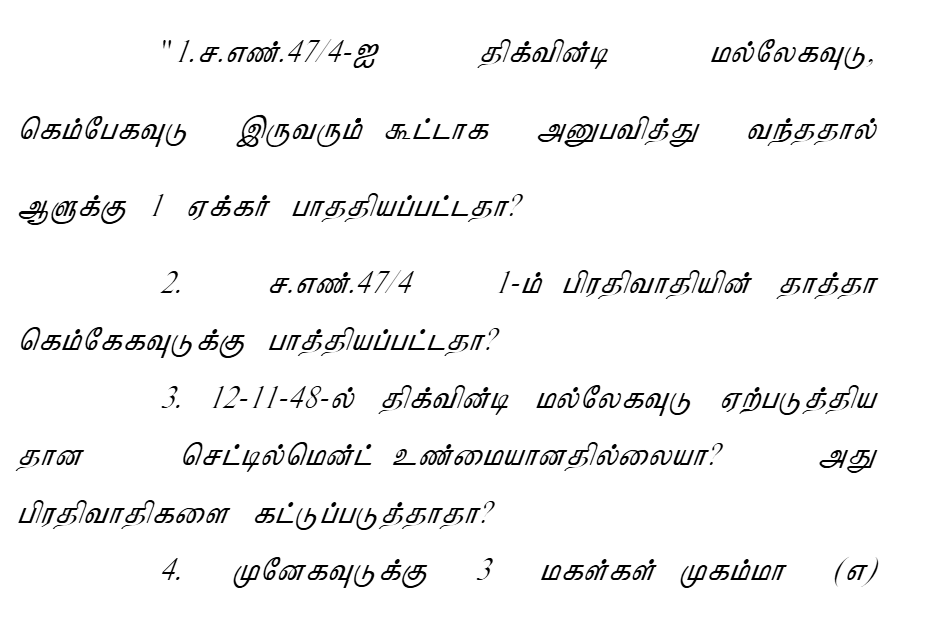
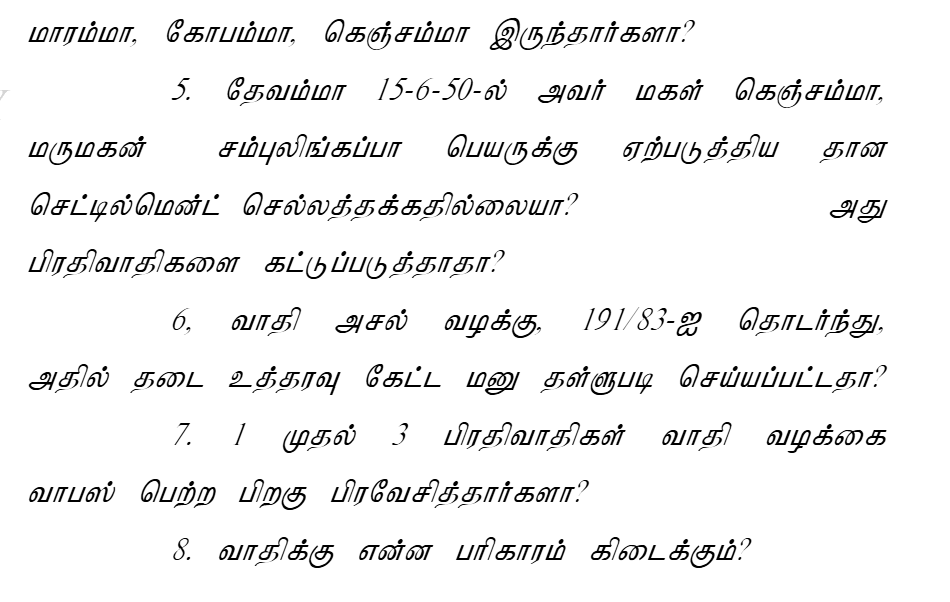
8. It held that, pending the earlier suit in O.S.No.191 of 1983, the presentation of yet another suit is abuse of process of the court. Apart from this technical objection, the trial court held that the plaintiff has not let in any evidence to show that his predecessor in title had any right over the property, whereas from Ex.B2, the revenue records, it is clear that Kempe Gowdu had been issued a patta in patta No.65 as early as on 13.02.1945. The trial court also relied upon Ex.B2, another revenue record, to come to a conclusion that the plaintiff had not proved his title over the suit property. On an appeal being filed to the learned Subordinate Judge, Hosur, he agreed with the findings of the learned Trial Judge and dismissed the appeal. Against the concurrent findings of the courts below, the present second appeal has been preferred.
9. This second appeal has been admitted by this court on 10.







