
 Back
Back





IN THE HIGH COURT OF JUDICATURE AT MADRAS
Hemant Chandangoudar, J
The Management of International Bakery Products Limited – Appellant
Versus
The Joint Director of Industrial Safety and Health – Respondent
W.P.No.33069 of 2022 | W.M.P.No.32476 of 2022
| Table of Content |
|---|
| 1. claims of continuous work as justification for permanent status. (Para 4) |
| 2. determining employer-employee relationship beyond formal arrangements. (Para 26 , 27 , 29) |
O R D E R
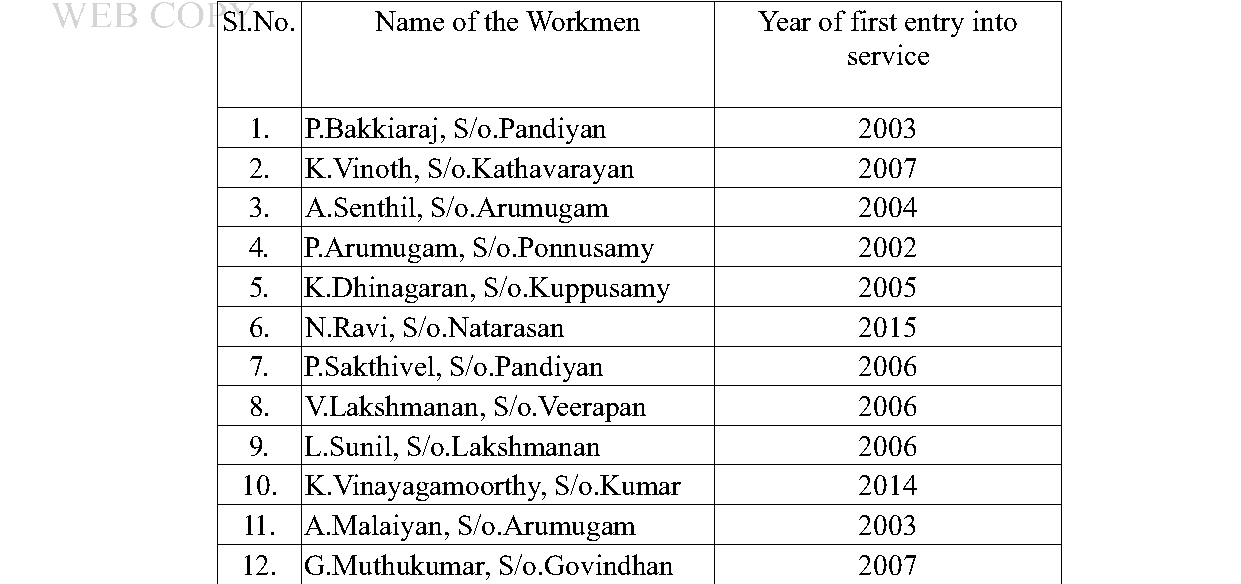
The challenge in this writ petition is to the proceedings dated 17.11.2022 issued by the first respondent, by which the prayer of the private respondents seeking permanent status was accepted, and the said private respondents were granted permanent status from the date of completion of 480 days of continuous service, computed from the date of their first entry into service. The petitioner– Management was directed to issue orders conferring permanent status on all the private respondents with effect from the date of completion of 480 days of continuous service from their respective dates of joining, i.e., their first entry into service.
2. Facts of the case :
2.1. The private respondents (R2 to R13) filed petitions before the first respondent seeking an order conferring permanent status on them in the petitioner–Management. They stated that they had been working as contract employees in the petitioner–Management for several years. Despite this, they had not been accorded permanent status and were made to work as contract employees under the labour contractors M. Gomethagan and A.K. Ayanar, without increments and for meagre wages.
2.2. The petitioner–Management appeared and stated that it is duly registered under the Contract Labour (Regulation and Abolition) Act, 1970 (hereinafter, “1970 Act” for brevity, convenience, and clarity) and has been permitted to engage contract employees under order dated 02.09.2020. The private respondents were engaged through licensed contractors and used in allied activities such as loading and unloading of maida, charging, stacking, and sugar binding. Therefore, the contract employees do not qualify as ‘workman’ as defined in Section 2(4) of the Tamil Nadu Industrial Establishments (Conferment of Permanent Status to Workmen) Act, 1981 (hereinafter “1981 Act” for brevity, convenience, and clarity). In the absence of an employer– employee relationship, the petition seeking permanent status is not maintainable either in law or on facts.
2.3. The petitioner–Management further contended that the private respondents are on the rolls of the licensed contractors; their work was supervised and controlled by the contractors; and wages were paid by the contractors. The first respondent, after considering the materials on record and referring to Section 2(l) of the Factories Act, 1948 (hereinafter “1948 Act” for brevity, convenience, and clarity), which defines “worker,” and Section 2(4) of the 1981 Act, which defines “workman,” recorded a finding that the private respondents had worked for several years in the petitioner–Management as casual or contract workers instead of being treated as regular workers, merely to deny them benefits under various Labour Laws. This amounts to unfair labour practice and exploitation. Accordingly, the first respondent allowed the petitions and conferred permanent status on the private respondents. Aggrieved by the same, the petitioner–Management has filed the present writ petition.
3. Submissions of Mr. Sanjay Mohan, learned counsel for the petitioner–Management:
3.1. The jurisdiction of the first respondent under the 1981 Act is very limited. It does not have the powers of an adjudicating authority such as the Labour Court. It has no jurisdiction to disregard an existing master–servant relationship between a licensed contractor and his employee and grant permanent status to persons who are not employees of the principal employer.
3.2. In the absence of an employer–employee relationship, and merely because the private respondents had completed 480 days of service, the first respondent could not have granted permanency. In doing so, the first respondent effectively altered the contract between the private respondents and their employer, namely, the licensed contractors. If the private responde



An indispensable Tool for Legal Professionals, Endorsed by Various High Court and Judicial Officers
Please visit our Training & Support
Center or Contact Us for assistance

Scan Me!
India’s Legal research and Law Firm App, Download now!


For Daily Legal Updates, Join us on :



 Back to top


