
 Back
Back





IN THE HIGH COURT OF JUDICATURE AT MADRAS
MR. R. SURESH KUMAR, MR. SHAMIM AHMED, JJ
Union of India, Ministry of Health and Family Welfare, The National Commission for Allied and Healthcare Profession – Appellant
Versus
Sri Rengaswamy Educational Trust – Respondent
W.A.No 3213 of 2025 | W.A.No 3277 of 2025 | W.A.No 3678 of 2025 | W.P.No 40016 of 2025
| Table of Content |
|---|
| 1. background of appeals and educational institutions (Para 1 , 3 , 4 , 5) |
| 2. provisions of the national commission act (Para 6 , 10 , 28) |
| 3. need for interim arrangements without regulations (Para 12 , 21) |
| 4. arguments for existing institutions continuing operations (Para 15 , 16 , 18) |
| 5. court's directives on applications and future permissions (Para 46 , 47) |
COMMON J U D G M E N T
(Judgment of the Court was delivered by R.SURESH KUMAR, J.)
These Intra Court Appeals have arisen out of a common impugned order dated 16.09.2025, made in W.P.Nos.28894, 32292 & 32789 of 2025. Infact, along with these writ petitions, some other writ petitions have also been heard and disposed of by the said common impugned order.
2. W.P.No.40016 of 2025 filed for the same relief, however, not tagged along with the said batch as it was filed only later on and when this writ petition came up for hearing before the learned Writ Court, it was directed to be tagged along with the present appeals and by the administrative order of the Hon’ble Chief Justice, this W.P.No.40016 of 2025 was directed to be tagged along with the present appeals to have a combined hearing and disposal. That is how these three writ appeals and one writ petition came up for hearing before us and we having heard the matter are inclined to dispose all these writ appeals and the writ petition by this common order.
3. That the writ petitioners are the Educational Institutions or its agencies (hereinafter be referred to as Educational Institutions/writ petitioners for the sake of convenience and brevity). The appellants herein are the respondents before the Writ Court i.e.,Union of India, represented by its Secretary to Government, Ministry of Health and Family Welfare. Other official respondents since are not the contesting respondents, they only be called as official respondents herein.
4. The writ petitioners/Educational Institutions have been functioning in the State imparting education in the Allied and Healthcare Professional courses. These institutions were established some years back with an approval/affiliation of the Dr.MGR Medical University, one of the official respondents herein. The courses conducted by them since are affiliated with the said University, conducting of examination and awarding of Degree and Diploma is taken care of by the said University.
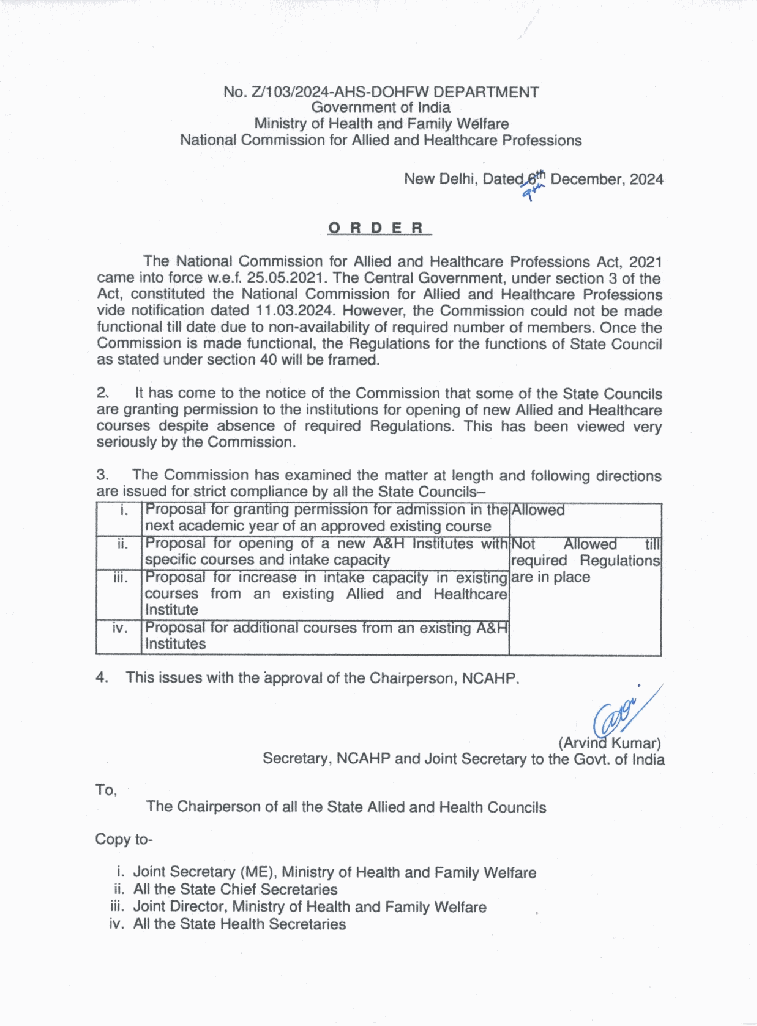
5. While that being so, the Parliament enacted a law called National Commission for Allied and Healthcare Professionals Act, 2021 (hereinafter referred to as the Act i.e., the Central Act 14 of 2021). Under Section 1 (2) of the Act, the Act would come into effect on a date appointed by the Central Government through a notification. The Central Government vide notification No.S.O.2012 (E), dated 25.05.2021 has notified the coming into force of the Act with effect from 25.05.2021. Therefore, from 25.05.2021, the Act has come into force.
6. Under the Act, a National Commission for Allied and Healthcare Profession can be constituted under Section 3. Like that, under Section 22 of the Act, a State Allied and Healthcare Council for each State could also be constituted. Chapter V of the Act deals with establishment of new Allied and Healthcare Institutions. Section 40 of the Act starting with the non-obstante clause, i.e., notwithstanding anything contained in this Act or any other law for the time being in force, makes it clear that, no person shall establish an Allied and Healthcare Institution or no Allied and Healthcare Institution shall open a new or higher course of study or training, increase its admission capacity in any course of study or training and admit a new batch of students in any unrecognised course of study or training, except with the previous permission of the State Council obtained in accordance with the provisions of the Act. Therefore, it becomes abundantly clear that no institution can be established or no existing institution can start with a new course or increase the intake without the previous p



An indispensable Tool for Legal Professionals, Endorsed by Various High Court and Judicial Officers
Please visit our Training & Support
Center or Contact Us for assistance

Scan Me!
India’s Legal research and Law Firm App, Download now!


For Daily Legal Updates, Join us on :



 Back to top


