
 Back
Back





IN THE HIGH COURT OF JUDICATURE AT MADRAS
G.K.Ilanthiraiyan, J
J. Santhanam – Appellant
Versus
Government of Tamil Nadu – Respondent
W.P.Nos.9201, 9203, 9206, 9211, 9213, 11379, 11380, 11385, 11387, 11388, 11391, 11394, 11396, 11399, 11401, 15467, 15478, 15489, 15508, 15531, 15534, 15537, 15542, 15546, 16860, 17221, 17224, 17229, 17230, 17234, 17777, 17845, 18733 to 18737, 19160, 19169, 19173, 19177, 19178, 19180, 19183, 19185, 19187, 19189, 19190, 19192, 19312, 19318, 19323, 19326, 19331, 19332, 19674, 19682, 19687, 19688, 19690, 19693, 19694, 19695, 19700, 19701, 19703, 19719, 19722, 19723, 19724, 19725, 19729, 19733, 19735, 19736, 19739, 19777, 19808, 19812, 19815, 19816, 22576, 22578, 26046, 26079, 26090, 26050, 26059, 26072, 26073, 26078, 28866, 28868, 28869, 29889, 29891, 29904, 29908, 34759, 34761, 34769, 35327, 35332, 35336, 35341 & 35342 of 2025
| Table of Content |
|---|
| 1. petitioners seek revised pay fixation based on the tamil nadu revised pay scale rules, 2009. (Para 1 , 2 , 3) |
| 2. rule 4(1)(iii) governs bunching of pay stages to grant additional increments. (Para 4 , 5) |
| 3. claim of pay anomaly and request for benefits based on statutory interpretation. (Para 6 , 7) |
| 4. additional fitment tables require prior elevation of pay bands, not applicable here. (Para 8 , 9 , 10 , 11 , 12) |
| 5. writ petitions are dismissed due to the inapplicability of rule 4 to vocational teachers. (Para 13) |
COMMON ORDER
1.These Writ Petitions have been filed challenging the order of rejection seeking fixation of pay and revised scale of pay and to pay all the consequential benefits to the petitioners by applying Rule 4 (iii) of the Tamil Nadu Revised Pay Scale Rules, 2009 . Some of the Writ Petitions have been filed seeking direction to the respondents to apply Rule 4 (1) (iii) of the Tamil Nadu Revised Pay Scale Rules, 2009 and fix their salary with effect from 01.01.2006 notionally with monetary benefits from 01.04.2023.
2. The issues involved in all these Writ Petitions are similar in nature and therefore this Court is inclined to pass a common order.
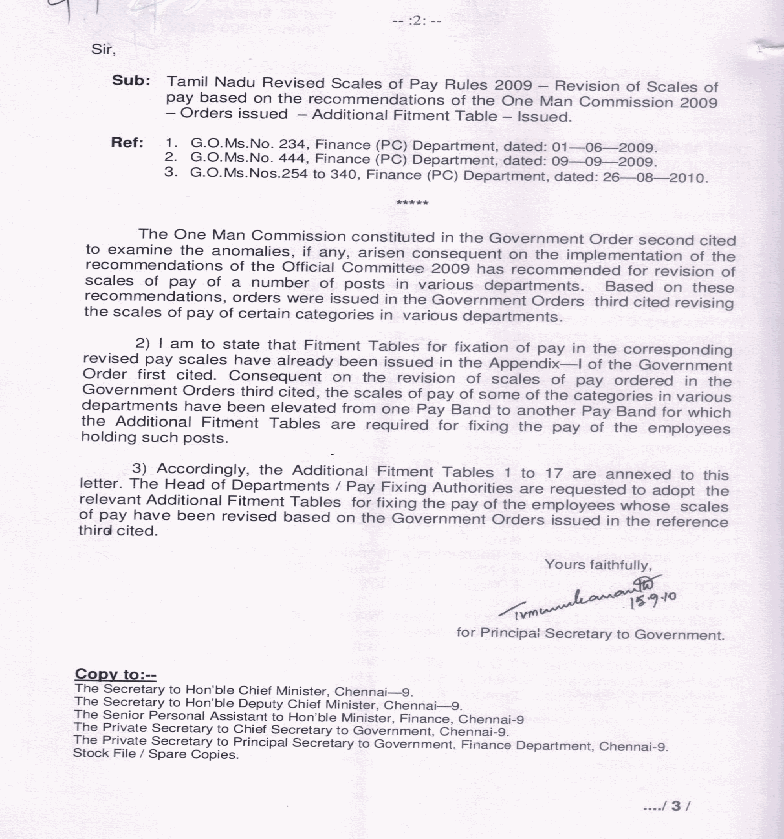
3. All the petitioners were appointed as Vocational Teachers and they were taking classes for the Higher Secondary Vocational Stream. After completion of ten years of service, they were paid selection grade scale of pay and thereafter, they retired from service. While being so, the Government of Tamil Nadu, in order to implement the sixth pay commission with effect from 01.06.2009 with monetary benefits from 01.01.2006, issued an order in G.O.No.234 Finance (Pay Cell) Department dated 01.06.2009.
4. Thereafter, the Government of Tamil Nadu issued Tamil Nadu Revision of Scales of Pay Rules, 2009 (hereinafter referred to as “the Rules”), which came into force with effect from 01.06.2009. Rule 4 of the Rules reads as follows :-
“4. Fixation of Pay in the revised pay structure:--The initial pay of a Government employee who elects to be governed by the revised pay structure from 1 January 2006 shall be fixed separately in respect of his substantive pay in the permanent post on which he holds a lien or would have had a lien if it had not been suspended and in respect of his pay in the officiating post held by him, in the following manner, namely:--
(1) In the case of all employees :--
(i) The pay in the pay band / pay scale shall be determined by multiplying the existing basic pay as on 1- 1-2006 by a factor of 1.86 and rounding off the resultant figure to the next multiple of 10.
(ii) If the minimum of the revised pay band / pay scale is more than the amount arrived at as per (i) above, the pay shall be fixed at the minimum of the revised pay band / pay scale;
(iii) Where, in the fixation of pay, the pay of Government employees drawing pay at two or more consecutive stages in the existing scale gets bunched, that is to say gets fixed, in the revised pay structure at the same stage in the pay band, then for every two stages so bunched, benefit of one increment shall be given so as to avoid bunching of more than two stages in the revised running pay bands. For this purpose, the increment will be calculated on the pay in the pay band only and grade pay should not be taken into account for the purpose of granting increments to alleviate bunching.
(iv) In the case of pay scales in Higher Administrative Grade (HAG) in the Pay Band 4, benefits of increments due to bunching shall be given taking into account all the stages in different pay scales in this grade.
(v) If by stepping up of the pay as above, the pay of a Government employee gets fixed at a stage in the revised pay band / pay scale (where applicable) which is higher than the stage in the revised pay an employee who was drawing pay at the next higher stage or stages in the same existing scale is fixed, the pay of the latter shall also be stepped up only to the extent by which it falls short of that of the former.
(vi





An indispensable Tool for Legal Professionals, Endorsed by Various High Court and Judicial Officers
Please visit our Training & Support
Center or Contact Us for assistance

Scan Me!
India’s Legal research and Law Firm App, Download now!


For Daily Legal Updates, Join us on :



 Back to top


