Back
Back





2026 Supreme(Mad) 2161
IN THE HIGH COURT OF JUDICATURE AT MADRAS
D. Bharatha Chakravarthy, J.
Chandrasekaran Kaliyannan - Petitioner
Versus
The Commissioner, Tamil Nadu Hindu Religious and Charitable Endowment - Respondent
W.P.No.7029 of 2026 & W.M.P.Nos.7658 &7659 of 2026
Decided On : 23-02-2026
For the Petitioner: M/s.Sunny Sheen for Mr.Leeban Arivalagan
For the Respondent: Mr.N.R.R.Arun Natarajan, Spl.Government Pleader, Mr.D.Ramesh Kumar, Mr.R.Rajesh Vivekananthan, Deputy Solicitor General of India.
Court emphasizes the necessity of expert involvement and statutory compliance in decisions affecting heritage conservation.
Headnote:(A) Article 226 of the Constitution of India - Writ of Certiorari - The petitioner challenges the State Level Expert Committee's approval regarding the conservation of an ancient temple. Findings reveal structural concerns due to environmental exposure, necessitating immediate conservation actions to prevent irreparable damage. (Paras 1-25)
(B) Heritage conservation - The Court emphasizes the necessity of involving experts in decisions affecting heritage structures and mandates comprehensive evaluations before any conservation work proceeds. Issues of statutory compliance under the Tamil Nadu Heritage Commission Act, 2012 are raised, ensuring adherence to legal frameworks before undertaking conservation. (Paras 10-24)
(C) Procedural correctness - The Court notes the absence of relevant experts during crucial decision-making processes, suggesting that further inspection, led by a qualified committee, is essential to determine the viability of conservation strategies accurately. The Court mandates a rigorous, expert-driven review of the temple's condition before proceeding with the conservation plan. (Paras 23, 24)
Facts of the case:
The petitioner seeks to quash an approval for construction issued by the State Level Expert Committee regarding an ancient temple faced with structural instability issues. Two conflicting reports regarding the temple's condition were analyzed, highlighting the need for a comprehensive evaluation before proceeding with any conservation efforts.
Findings of Court:
The Court recognizes the urgency to preserve a 300-year-old temple while balancing statutory compliance and expert opinions. A comprehensive re-evaluation must be conducted to ensure that no irreversible damage occurs.
Issues: The main issues revolve around the legality and necessity of the reconstruction order, statutory compliance with the Heritage Commission Act, and whether the Court should intervene given ongoing litigation regarding the temple.
Ratio Decidendi: The Court elucidates on the mandatory compliance with the Tamil Nadu Heritage Commission Act, emphasizing on expert involvement in matters of heritage structure conservation.
Result: The writ petition was disposed of with specific directives to convene a sub-committee of experts for thorough examination and to determine essential conservation actions to be taken.
| Table of Content |
|---|
| 1. challenge to the approval for temple conservation (Para 1 , 2) |
| 2. condition of the temple highlights urgent conservation needs (Para 3 , 4 , 5) |
| 3. legal compliance issues raised regarding conservation efforts (Para 10 , 11) |
| 4. court necessitates detailed expert evaluations for conservation (Para 19 , 21 , 22) |
| 5. final decision mandates expert-led review for further actions (Para 23 , 25) |
ORDER :
D. Bharatha Chakravarthy, J.
This Writ Petition is filed to seek a writ of Certiorari or any other suitable order concerning the impugned approval dated 05.09.2023, issued by the 8th respondent, the State Level Expert Committee, regarding Arulmigu Ponkaliamman Temple, Kumaramangalam, Namakkal, and to have it quashed as illegal.
2. The brief factual background of this case needs to be understood. The Arulmigu Ponkaliamman Temple in Kumaramangalam, Namakkal, is said to have been built 300 years ago. It is important to include a depiction of the temple in this judgment, which is as under:
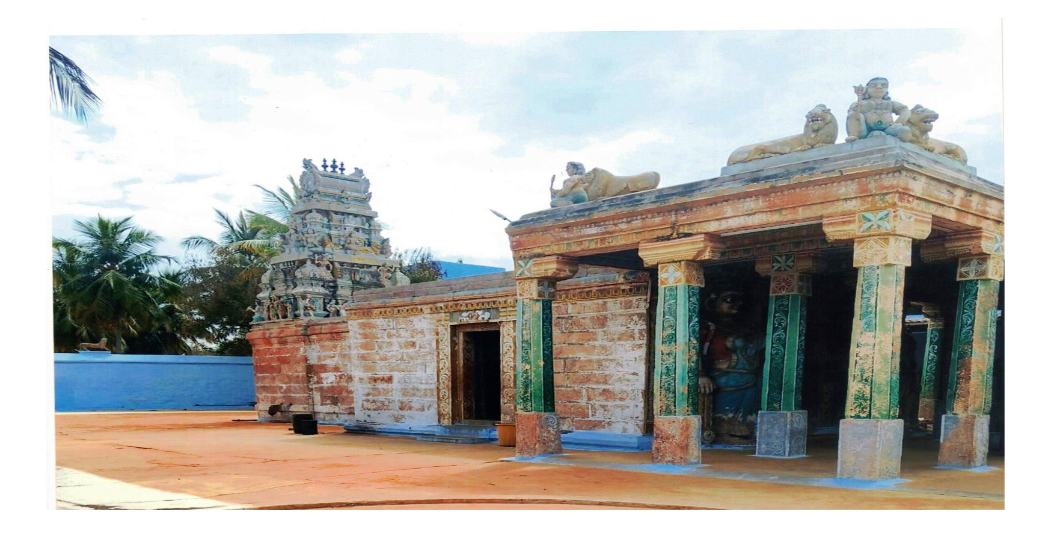
3. The above picture speaks for itself. It clearly shows that the Temple is a beautiful, ancient heritage structure, standing as a testament to the archaeological, cultural, and Bhakti heritage of this part of the world. The only goal should be to conserve the Temple. It can be seen that there is a ‘Mahamandapam’ in the front portion, built with granite stones. It is stated that the second stage, the ‘Arthamandapam’ and the ‘karuvarai,’ are built from sandstones. There is an inspection report by the Archaeological Survey of India, Government of India. After detailed inspection, the condition of the Temple is described as follows:
“On physical examination, it has been observed that the stone blocks (exterior portion of the temple), has significant degree of surface scaling and flaking. This degradation is identified as a direct result of environmental weathering, i.e., due to exposure to humidity, temperature fluctuations and atmospheric pollutants. It is critical to note that while the stones appear distressed, the core of the masonry remains structurally sound and has not yet reached a state of internal failure or deep-seated weakening. However, the surface is actively peeling, and in many sections, the stone is beginning to lose its mineral cohesion, showing early signs of "powdering"-a process where the stone minerals disintegrate into fine dust.”
4. The Conservation Strategy is mentioned as follows:
“To pause this aggressive weathering process, it is recommended to immediately take up the work of providing a sacrificial protective coat using traditional lime mortar. This treatment is essential because the stone requires a breathable barrier that can absorb the effect of environmental stress while allowing moisture within the masonry to evaporate. If this protective layer is not applied promptly, the accelerated weathering will penetrate deeper into the stone units, leading to irreversible loss of detail and eventual structural instability. The lime mortar will serve as a "skin" for the stone surface, ensuring that the natural stone beneath is shielded from direct contact with corrosive environmental elements.”
5. The Technical Recommendations made for long-term stability is mentioned as follows.
“The immediate remedial measure involves surface protection alone, however, further scientific studies are mandatory for the long-term preservation of the Ponkaliamman Temple. A comprehensive structural stability study must be commissioned to monitor the load-bearing capacity of the vertical supports and the foundation under current environmental conditions. Furthermore, it is strongly recommended that a dedicated air quality assessment be conducted in the temple vicinity. This will help identify specific airborne pollutants or high salinity levels that may be catalysing the chemical breakdown of the stone. These combined efforts protective lime plastering, stability monitoring, and environmental analysis-are vital for ensuring the temple's longevity for