
 Back
Back





IN THE HIGH COURT OF JUDICATURE AT MADRAS
G. JAYACHANDRAN, R. SAKTHIVEL, JJ.
M/s PVP Corporate Parks Pvt. Ltd. – Appellant
Versus
The Deputy Commissioner of Income Tax, Chennai – Respondent
T.C.A. No. 636 of 2016, C.M.P. No. 13244 of 2016
Decided On : 30-03-2026
| Table of Content |
|---|
| 1. factual background of the case. (Para 1 , 2 , 3) |
| 2. appellant's grounds against the assessment. (Para 4 , 5) |
| 3. substantial questions of law framed. (Para 6 , 12) |
| 4. arguments by the appellant and the revenue. (Para 7 , 8 , 9 , 10 , 11) |
| 5. observations on accounting principles. (Para 13 , 16 , 18) |
| 6. court's conclusions and established principles. (Para 19 , 20) |
| 7. final order dismissing the appeal. (Para 21) |
JUDGMENT :
G. JAYACHANDRAN, J.
1. Tax Case Appeal is filed by the Assessee on being aggrieved by the concurrent finding of the Income Tax Appellate Tribunal (ITAT), confirming the order of the Commissioner of Income Tax (Appeal)-3 preferred against the assessment order dated 29/03/2013.
2. The Appellant/Assessee, a Private Limited Company is engaged in the business of leasing and renting of amenities and buildings. For the Assessment Year 2010-2011, the Appellant filed income tax return on 06.10.2010 declaring a loss of Rs.4,88,52,174/- under the normal computation of income and a loss of Rs.1,01,69,416/- as per the books. The return was selected for scrutiny and notice under Section 143 (2) was issued on 29.08.2011. On completion of enquiry, it was found that the Assessee Company had sold its fixed asset and derived a capital profit of Rs.32,11,24,002/- as detailed below:-

3. The capital profit has been directly absorbed in its balance sheet without routing it through the Profit and Loss Account. Therefore, alleging that the book profit of the company has been under stated by direct absorption in the balance sheet and has not been routed through the Profit and Loss Account, the Assessing Officer passed an order on 29.03.2013, assessing the Income Tax, after completing the rework of the book profits under Section 115JB of the Income Tax Act, 1961 and the capital loss under normal computation as below:-
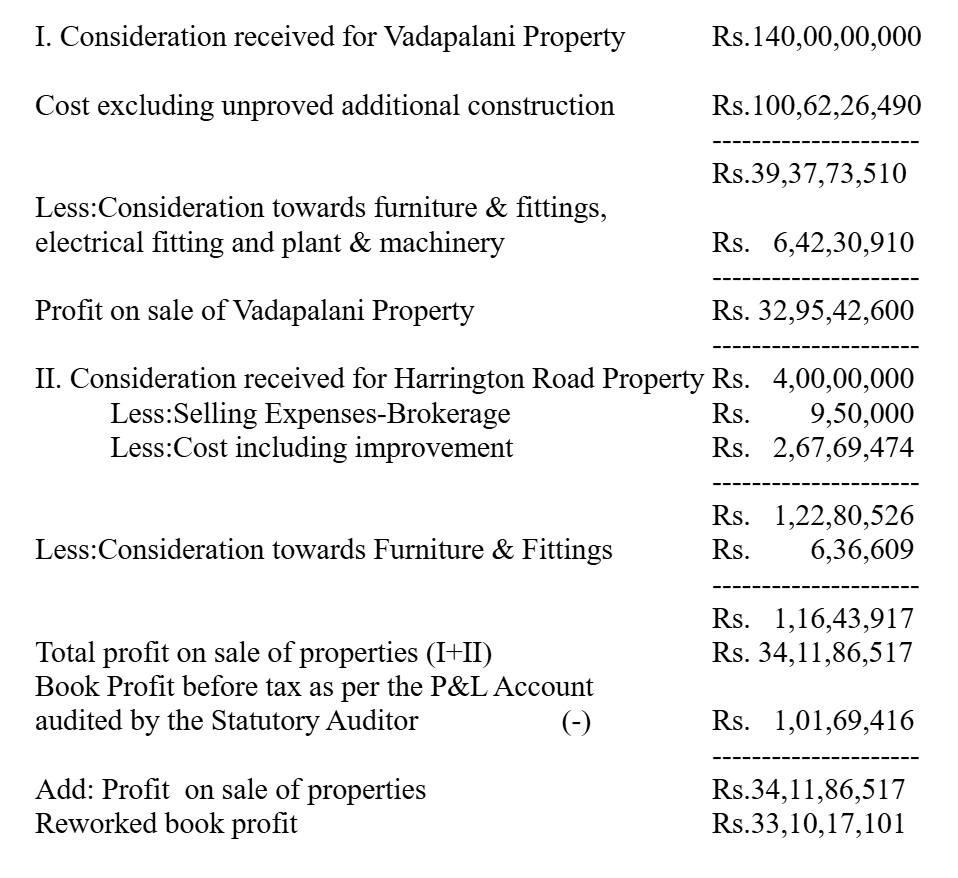
A demand notice under Section 156 of the Income Tax Act, 1961 issued to the Assessee as per the above calculation.
4. Being aggrieved, the Assessee filed Appeal before the Commissioner of Income Tax (Appeals)-3, and raised the following grounds:
“(1) The learned Assessing Officer erred in making an addition of Rs.34,11,86,517/- (being capital profits transferred directly to capital reserve (actual amount transferred being Rs.32,11,24,002/-)
(2) The learned assessing officer erred in adopting a sum of Rs.34,11,86,517/- in place of Rs.32,11,24,002/- which was actually credited to the capital reserve.
(3) The learned Assessing Officer erred in not allowing the cost of improvement of Rs.3.10 crores in the computation of book profits placing reliance on the statement recorded from the buyer of the property and telephonic conversation with the NHAI authorities without granting opportunity of cross examination requested by the appellant and contrary to the stand taken by him, by not making any disallowance in the normal computation.”
5. After considering the material placed by the Assessee and the grounds of the appeal, the Commissioner of Income Tax (Appeals)3, Chennai, dismissed the appeal vide order dated 26.02.2016 holding that the Assessing Officer has rightly recomputed book profit under Section 115 JB by bringing profit, on sale of assets to Profit and Loss Account. Thus, the additional of Rs.34,11,86,517/- was confirmed. Further appeal before the Income Tax Appellate Tribunal in I.T.A.No.497/Mds/2016 challenging the order of the CIT (Appeals) 3, dated 26.02.2016 in ITA No.104/CIT(A)-3/2013-14 passed under Section 143 (3) r/w Section 250 (6) of the Income Tax Act, 1961, came to be dismissed confirming the order of the First Appellate Authority and confirming the Assessment Order passed by the Assessing Officer.
6. This Court has admitted the appeal for hearing on framing the following Substantial Question of Law:-
(1) Whether on the facts and circumstances of the case, the Appellate Tribunal was right in law in holding that the capital profit on the sale of the Fixed Assets of the Company cannot be taken directly to the Res
Capital profits on asset sale must be routed through Profit and Loss Account to ensure correct calculation of book profits and statutory compliance under Income Tax Act.

The classification of doubtful debts as reserves under Section 115JA was improper, as the amount was a recoverable asset, not a liability, necessitating adjustment under appropriate provisions.


Disallowance under Section 14A cannot be added to compute MAT under Section 115JB of the Income Tax Act.

Book profit on sale of assets not taxable separately under block concept after section 43(6) adjustment; reversal of excess provision on Ind AS transition is non-taxable accounting restatement; bad d....



An indispensable Tool for Legal Professionals, Endorsed by Various High Court and Judicial Officers
Please visit our Training & Support
Center or Contact Us for assistance

Scan Me!
India’s Legal research and Law Firm App, Download now!


For Daily Legal Updates, Join us on :



 Back to top


