
 Back
Back





IN THE HIGH COURT OF JUDICATURE AT MADRAS
P.B.Balaji, J
Sirajudeen Sayeed – Appellant
Versus
Tamil Nadu Waqf Board – Respondent
CRP.No.877 of 2023|CMP.No.6565 of 2023
| Table of Content |
|---|
| 1. waqf board's quasi-judicial decisions must be reasoned and follow due process. (Para 1 , 3 , 4 , 5 , 18 , 19 , 20 , 34) |
| 2. requirements of waqf creation: intention to dedicate and complete divestment. (Para 6 , 12 , 15 , 17 , 25 , 26 , 27 , 28 , 29 , 30 , 31 , 32 , 33) |
| 3. limitation period for challenging waqf board orders after court-granted liberty. (Para 21 , 22 , 23 , 24) |
| 4. distinguishing private family waqf (waqf-alal-aulad) from public waqf. (Para 35 , 36 , 37 , 38 , 39 , 40 , 41 , 42 , 43) |
ORDER
1.The revision petitioner, now by legal representatives, is the plaintiff in O.S.No.23 of 2022 before the Tamil Nadu Waqf Tribunal. The plaintiff, being unsuccessful before the Waqf Board, preferred an appeal before the Waqf Tribunal. The same was dismissed by a judgment and decree dated 11.10.2022, as against which, the present Civil Revision Petition has been filed.
2.I have heard Mr.Balan Haridas, learned counsel for the revision petitioners and Mr.Haja Mohideen Gisthi, learned counsel for the 1st respondent, Mrs.A.Ajimath Begum, learned counsel for the 2nd respondent and Mr.Zaffarullah Khan, learned counsel for the 3rd respondent.
3.Mr.Balan Haridas, learned counsel for the revision petitioner would state that the subject property is a private family Trust, belonging to the plaintiff’s family and at no point of time, there was any dedication of the subject properties for any public waqf or public objects/charities. The Trust created a private family waqf, which is for the benefit of the family members only and without any jurisdiction, the Waqf Board notified the property as a public waqf and directing registration of the waqf under Section 36 of the Waqf Act, 1995.
4.My attention is invited to the writ petition filed by the plaintiff in W.P.No.262 of 2010 seeking to quash the notification dated 03.11.2009 and yet another writ petition filed by Siruvadi Mosque Waqf, represented by its Mutawalli, the 2nd defendant in the suit filed by the plaintiff in W.P.No.16916 of 2011. The writ petition filed by the 2nd respondent was allowed and the writ petition filed by the plaintiff was dismissed with liberty to the plaintiff to approach the 3rd respondent therein for appropriate relief. The respondent, by order dated 26.05.2008, however registered the plaintiff’s property as waqf property under the Waqf Act. The same was challenged by the plaintiff, under whom the present revision petitioners claim. The said writ petition was disposed of by this Court on 22.01.2009, allowing the writ petition and setting aside the registration of the properties as waqf properties. The Tamil Nadu Waqf Board was directed to hold proper enquiry, by affording sufficient opportunity to the petitioner and to pass appropriate orders, as to whether the properties are waqf properties or not, on the basis of the evidence adduced by the parties.
5.Mr.Balan Haridas, learned counsel for the petitioners, inviting my attention to the said direction issued by this Court and the impugned order passed on 03.11.2009, would state that there is absolutely no discussion made and virtually, the Resolution dated 03.11.2009 as a non-speaking order. He would also draw my attention to Section 40 of the Act, which requires a speaking order and he would therefore state that there was absolutely no merit in the conclusions arrived at, on the basis of no evidence. He would further state that unfortunately, the Tribunal, without considering any of the material aspects, has dismissed the suit filed by the plaintiff.
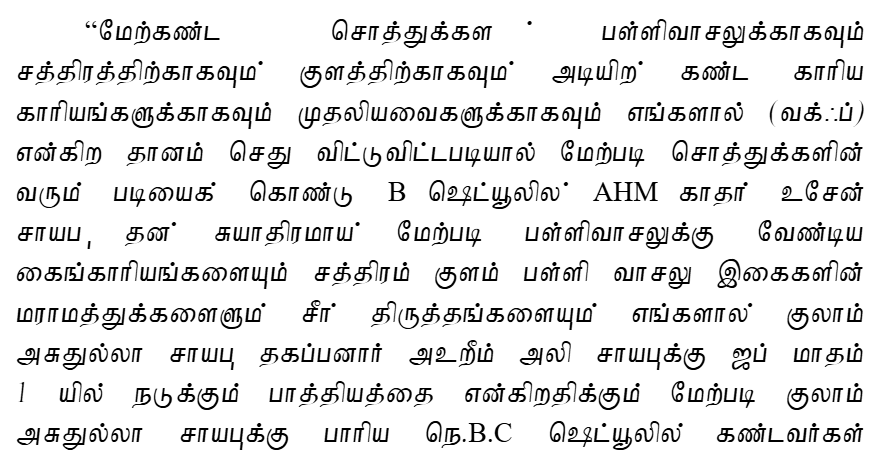
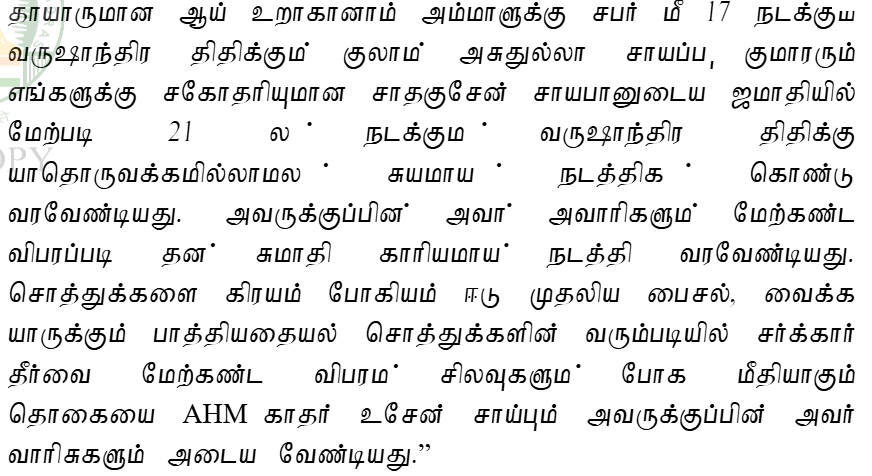
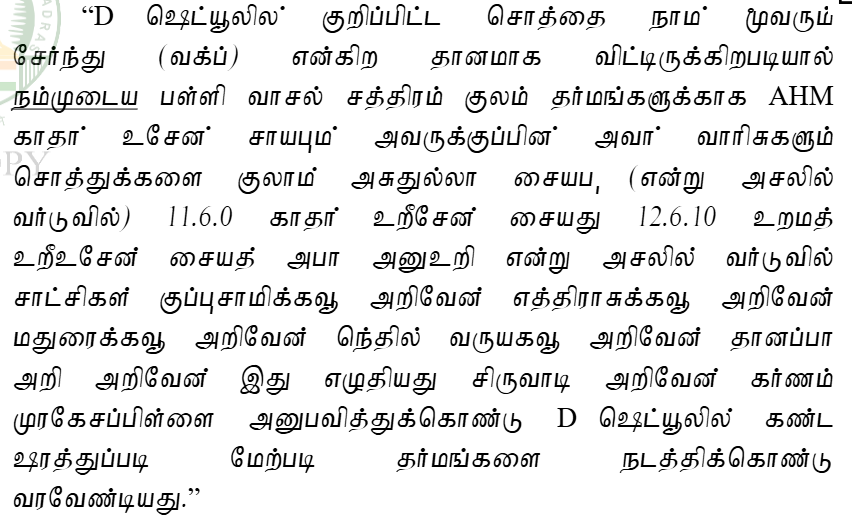
6.The learned counsel for the petitioners would further state that the entire issue revolved around a partition deed, which was marked as Ex.A1 dated 14.02.1910 and taking me through the relevant clause pertaining to ‘D’ schedule, which is the subject matter of the dispute and the clause as extracted by the Waqf Tribunal would contend that the Tribunal has omitted the word “ek;Kila” which made a world of difference and had a direct bearing on the character of t



An indispensable Tool for Legal Professionals, Endorsed by Various High Court and Judicial Officers
Please visit our Training & Support
Center or Contact Us for assistance

Scan Me!
India’s Legal research and Law Firm App, Download now!


For Daily Legal Updates, Join us on :



 Back to top


