
 Back
Back





BEFORE THE MADURAI BENCH OF MADRAS HIGH COURT
P.B. BALAJI, J.
Kanniappan (died) - Appellant
Versus
Kaliappan - Respondent
S.A.(MD)No.211 of 2022, C.M.P.(MD)Nos.2500 & 5221 of 2022
Decided On : 30-04-2026
| Table of Content |
|---|
| 1. factual backdrop and substantial questions on limitation. (Para 1 , 2 , 4) |
| 2. defendants argue article 64 applies due to dispossession. (Para 5 , 6 , 7) |
| 3. plaintiff argues composite property with encroachment. (Para 8 , 9) |
| 4. distinction between articles 64 and 65 of limitation act. (Para 10 , 11 , 12 , 13 , 14 , 15) |
| 5. commissioner report confirms encroachment within plaintiff's land. (Para 16 , 17 , 18 , 19 , 20) |
| 6. article 65 applies; title established, no adverse possession. (Para 21 , 22 , 23 , 24 , 25) |
JUDGMENT :
P.B. BALAJI, J.
The defendants are the appellants, aggrieved by the reversal findings rendered by the First Appellate Court.
2.I have heard Mr.Raguvaran Gopalan, learned Counsel appearing for the appellants / defendants and Mrs.J.Padmavathi Devi, learned Counsel appearing for the respondent / plaintiff.
3.This Second Appeal was admitted by this Court on 28.03.2022 on the following substantial questions of law:
“1) Whether the finding of the lower appellate court that the suit would fall under Article 65 of the Limitation Act and not Article 64 as it is a suit for recovery of possession based on title is correct in light of the judgment in Ramiah vs. Narayana Reddy (2004) 7 SCC 541?
2) When the suit as levied by the plaintiff vis-a-vis suit B schedule property can be termed as suit for recovery of possession based on title merely based on the prayer sought when the plaint averments taken as whole speak about prior possession of plaintiff and subsequent dispossession by defendants?”
Factual Backdrop:
4.The brief facts that are necessary to decide the Second Appeal and answer the two substantial questions of law framed by this Court at the time of admission are hereunder:
4.1.The plaintiff, claiming to be the owner of the Schedule A and B properties, sought for injunction in respect of Schedule A property and for a relief of declaration and recovery of possession in respect of Schedule B property. According to the plaintiff, the defendants without consent and knowledge of the plaintiff had entered upon the schedule B property, which belongs to the plaintiff and had also threatened to encroach even in respect of Schedule A property and in such circumstances, the reliefs above mentioned have been sought for.
4.2.The defendants filed a written statement admitting the title of the plaintiff in respect of A schedule property. However, according to the defendants, B schedule property is not belonging to the plaintiff and it has always been an integral part of the defendants' property. It is further pleaded that there is a 5 feet level difference between both Schedule A and Schedule B properties and they are separated by 5 feet in height and therefore, the claim of the plaintiff cannot be true. It is also contended by the defendants that for the last 15 years and more, trees have been grown and there are few 'Vadhamadakki' trees which have been planted only by the defendants and therefore, the claim of the plaintiff that the defendants have encroached into the plaintiff's property on 10.04.2006, when the plaintiff and his family were away from the suit property is only a figment of imagination of the plaintiff.
4.3.On the above pleadings, parties went to trial. The trial Court granted a decree in favour of the Schedule A property ie., relief of permanent injunction. However, in respect of Schedule B property, the suit was dismissed. Plaintiff alone preferred a First Appeal and the defendants accepted the verdict in respect of A schedule property and did not choose to prefer any appeal. In the First Appeal, the appellate Court reversed the findings in respect of Schedule B property and granted a decree, as against which the present Second Appeal has been filed.
Arguments of Mr.Raguvaran Gopalan, learned Counsel for the appellants:
5. Mr.Raguvaran Gopalan, learned Counsel appearing for the appellants would firstly contend that the Schedule B property is only a narrow piece of land of a width of 1.2 meters, running to a l

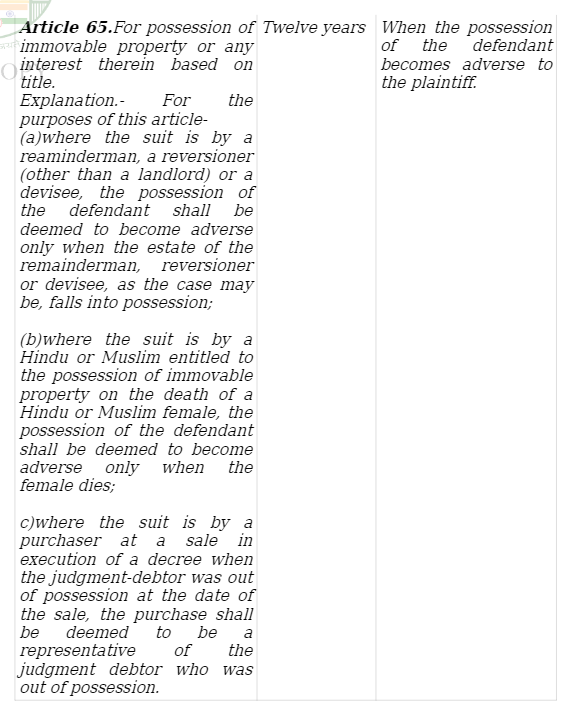
Suit for title declaration and possession governed by Article 65 Limitation Act (from adverse possession), not Article 64 (from dispossession), if title proved and no adverse possession established b....

In suits governed by Article 65 of the Limitation Act, 1963, the burden is on the defendant to prove adverse possession, and the plaintiff needs to establish title and possession. The legal position ....

(1) Adverse Possession—Mere possession cannot be deemed to be adverse possession merely on the basis of denial of another’s title over property for that would be violative of basic rights of actual o....

Point of law: Person raising plea of adverse possession must necessarily first admit the ownership of true owner of relevant property to the knowledge of that owner. In the instant case, the defendan....
Article 58 of Limitation Act prescribes limitation of three years from date when right, to sue first accrues to obtain a declaration.

In property disputes, once a plaintiff proves title, the burden shifts to the defendant to establish adverse possession; failure to do so results in the plaintiff's claim being upheld.
(1) Forfeiture of tenancy – It is defendants who had to prove forfeiture of tenancy prior to expiry of lease period.(2) Adverse Possession – By pleading adverse possession party seeks to defeat right....



An indispensable Tool for Legal Professionals, Endorsed by Various High Court and Judicial Officers
Please visit our Training & Support
Center or Contact Us for assistance

Scan Me!
India’s Legal research and Law Firm App, Download now!


For Daily Legal Updates, Join us on :



 Back to top


