
 Back
Back





IN THE HIGH COURT OF JUDICATURE AT MADRAS
V.LAKSHMINARAYANAN, J.
Rangasamy Pillai (Died) - Appellant
Vs.
Gowri Ammal - Respondent
S.A.Nos.550 & 551 of 1999
Decided On : 21-05-2026
| Table of Content |
|---|
| 1. overview of the parties' competing claims regarding property inheritance and title. (Para 1 , 2 , 3 , 4 , 5 , 6 , 7 , 8 , 9 , 10 , 11 , 12 , 13) |
| 2. liberal construction of mofussil pleadings to ensure substantive justice. (Para 29 , 30 , 31 , 32 , 33 , 34) |
| 3. non-joinder of parties under section 99 of the cpc. (Para 35 , 36 , 37) |
| 4. burden of proof in a suit for declaration of title remains on the plaintiff. (Para 39 , 40 , 41 , 42 , 43 , 44 , 45) |
| 5. evidentiary value of attestation as a presumption of knowledge and consent. (Para 55 , 56 , 57 , 58 , 59 , 60 , 61 , 62 , 63 , 64 , 65 , 66 , 67 , 68 , 69 , 70) |
| 6. admissibility of boundary recitals in documents not inter parties. (Para 75 , 76 , 77 , 78) |
| 7. revenue records as evidence of possession vs. title. (Para 79 , 80 , 81 , 82 , 83 , 84 , 85 , 86) |
| 8. final adjudication on title, possession, and relief granted. (Para 93 , 94) |
JUDGMENT :
V.LAKSHMINARAYANAN, J.
1.These two second appeals arise out of the common judgment in A.S.No.116 of 1993 and A.S.No.118 of 1993 dated 24.02.1995 in confirming the judgment and decree of the court of the District Munsif, at Panruti, in O.S.No.891 of 1989 dated 29.03.1993.
2.The two sets of appeals arise out of a single suit for declaration and injunction filed by the respondents herein.
3.For the sake of convenience, the parties shall be referred to as per their ranks in the suit.
4.O.S.No.891 of 1989 was presented for the following reliefs:-
(i) for a declaration of the plaintiffs' title to the suit properties,
(ii) for permanent injunction restraining the defendants from interfering with the plaintiffs’ peaceful possession and enjoyment; and
(iii) for costs.
Case according to the plaint:-
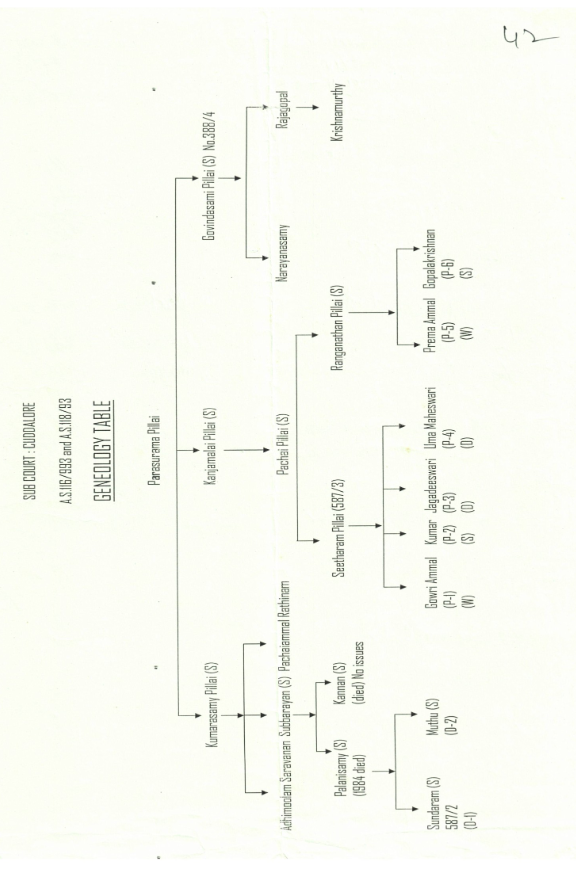
5.The plaintiffs pleaded that the suit properties are ancestral properties of two brothers, Seetharama Pillai and Ranganatha Pillai. Seetharama Pillai is the husband of the first plaintiff and the father of the plaintiffs 2 to 4. Ranganatha Pillai is the husband of the fifth plaintiff and the father of the sixth plaintiff.
6.The property devolved on the two brothers from their grandfather, Kanchamala Pillai. Kanchamala Pillai had only one son, by name, Pachai Pillai. Kanchamala Pillai died 50 years ago. Pachai Pillai died 55 years prior to the presentation of the suit. On their death, Pachai Pillai’s sons succeeded to the estate and were in possession and enjoyment of the same. They were paying kist and other revenue receipts. 10 years earlier to the suit, Seetharama Pillai passed away and soon thereafter, Ranganatha Pillai too, passed away in the year 1980.
7.The cause of action for the suit arose when the defendants, who have no right, title, or interest over the property, attempted to disturb the peaceful possession of suit property by the plaintiffs. The reason for the disturbance being that they had sought the plaintiffs to alienate the properties in their favour. As the plaintiffs refused to accede to their demand, they tried to take forcible possession of the property. Hence, a suit for the aforesaid reliefs.
8.Summons were served on the defendants. The 4th defendant filed a written statement, which was adopted by the other defendants.
Case according to written statement
9.According to the 4th defendant, the plaintiffs were never in possession and enjoyment of the property, nor have they shown on what basis they claim title to the suit properties. According to them, the suit items belonged to one, Parasurama Pillai. He had 3 issues, namely, (i) Kumarasamy Pillai, (ii) Kanchamala Pillai, and (iii) Govindsamy Pillai. Though their surnames were pillai, they were also known as udayars.
10.In a partition amongst them, the suit items were allotted to the first son, Kumarasamy Pillai. Govindaswamy Udayar was allotted S.No.588/4 and other properties were allotted to Kanchamalai Pillai. Kanchamalai Pillai mortgaged the properties allotted to him to one, Sadhasivam Reddiar. He accepted that 37 cents in S.No.588/3 belonged to the ancestor of the defendants, namely,
In mofussil litigation, courts should interpret pleadings liberally to serve substantial justice. While a plaintiff must prove title independently and cannot rely on revenue records alone, a party in....
A suit for permanent injunction requires proof of possession; if title is disputed, a declaratory suit is necessary, and failure to include necessary parties renders the suit untenable.

In a suit for declaration of title, the burden lies on the plaintiffs to substantiate ownership with clear evidence; mere possession is inadequate for claims. Title must be proven, not presumed.
In a suit for declaration of title, the burden lies on the plaintiff to establish ownership, and the courts found sufficient evidence supporting the plaintiff's claim.

An appellate court must independently assess the evidence and provide analytical, cogent reasoning when reversing a trial court's judgment. A suit for permanent injunction is maintainable without a p....
In property disputes, the burden of proof lies with the plaintiffs to substantiate their claims with valid evidence, as mere possession or revenue entries are insufficient to establish title.
The burden of proof lies on the plaintiffs to establish their ancestral title and continuous possession. Proof of genealogy and continuous possession is crucial to claim ancestral properties.
Permanent injunction cannot be granted without establishing title or possession; prior decrees do not confer title if not adjudicated.



An indispensable Tool for Legal Professionals, Endorsed by Various High Court and Judicial Officers
Please visit our Training & Support
Center or Contact Us for assistance

Scan Me!
India’s Legal research and Law Firm App, Download now!


For Daily Legal Updates, Join us on :



 Back to top


