Back
Back





2026 Supreme(Online)(Mad) 43901
IN THE HIGH COURT OF JUDICATURE AT MADRAS
N. Mala, J
Selvam Ammal – Appellant
Versus
Karuthapandi – Respondent
S.A.(MD).No.367/2007 | M.P.(MD).Nos.1/2007 | M.P.(MD).Nos.2/2007
For the Appellants/Petitioners: Ramesh @ Ramiah
For the Respondents: M.P.Senthil
When parties have led evidence, the burden of proof becomes secondary to a holistic appreciation of evidence; furthermore, additional evidence under Order 41 Rule 27 cannot be allowed at the appellate stage in the absence of foundational pleadings.
Headnote:The dispute arises under Section 100 of the Civil Procedure Code, 1908, concerning the declaration of title and permanent injunction regarding specific suit properties. The plaintiffs claimed title via a registered Sale Deed and subsequent oral partition among vendees, while the defendant disputed the existence and identity of the property, asserting title through a separate oral arrangement. The court found that when evidence is presented by both parties, the significance of the initial burden of proof diminishes, and the court must decide based on a holistic appreciation of the record, confirming the importance of admissions made by the defendant in pleadings and affidavits. The core issues involved whether a suit for declaration of title is maintainable without a commission inspection for property identification and the validity of shifting the burden of proof. Distinguishing the case on the strength of the defendant’s own admissions in the pleadings, the court held that once such evidence is available, formal requirements for property identification become secondary to the judicial determination of the contested issue. The Ratio Decidendi emphasizes that parties cannot introduce entirely new facts or theories at the appellate stage via additional evidence under Order 41 Rule 27 without foundational pleadings. The Second Appeal is dismissed, and the decree of the Lower Appellate Court in favour of the plaintiffs is confirmed.
| Table of Content |
|---|
| 1. overview of trial proceedings and the conflicting title claims. (Para 1 , 2 , 3 , 4 , 5 , 6) |
| 2. appellants and respondents' arguments regarding evidence and burden of proof. (Para 7 , 8) |
| 3. court's reasoning on evidence, admissions, and shift in burden of proof. (Para 9 , 10 , 11 , 12 , 13 , 14 , 15 , 16) |
| 4. admissibility of additional evidence without foundational pleadings. (Para 17 , 18 , 19 , 20 , 21) |
| 5. final order dismissing the appeal. (Para 22) |
JUDGMENT
(1)The second appeal is filed against the judgment and decree in A.S.No.168 of 2005, dated 25.09.2006. on the file of the learned Principal Sub Judge, Tenkasi, reversing the judgment and decree dated 18.01.2005, passed by the learned Additional District Munsif, Tenkasi, made in O.S.No.355/2003.
(2)For the sake of convenience, the parties are referred to, as per their ranking before the Trial Court.
Facts in brief:-
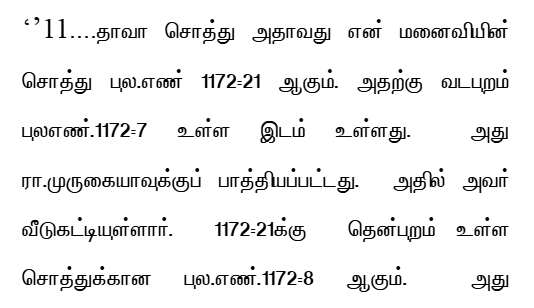
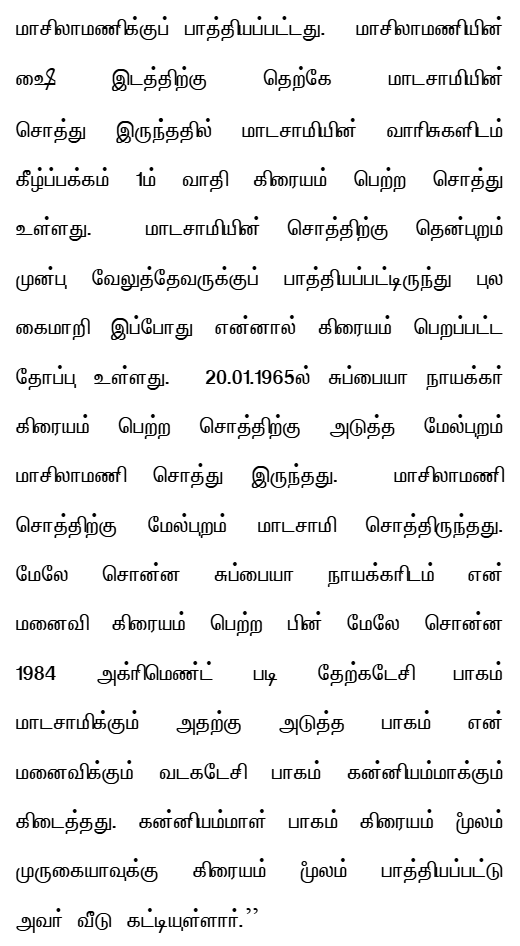
(3)The plaintiffs case is that the suit property originally belonged to one Mohideen Pillai Dharaganar and that it was purchased from him under a registered Sale Deed on 30.04.1947, by Madasamy S/o.Oorkavalakudumban, Oorkavalan Kudumban S/o Muthuveeran Kudumban, Oorkavalakudumban S/o.Veeraiya Perumal. The 2nd plaintiff is the daughter of Oorkavalakudumban S/o.Muthuveeran Kudumban who was one of the purchasers in the aforesaid Sale Deed. According to the plaintiffs, the property was orally partitioned among the aforesaid persons, and Masilamani and his two brothers Velu and Susai. The plaintiffs contended that Masilamani and his two brothers were not included in the Sale Deed since they had gone to Kerala at the time. However, in the oral partition, they were included in which the Northern most portion of the suit 1st item property was allotted to Oorkavalan Kudumban, S/o.Veeraiya Perumal, the portion to the south of the said property was allotted to the father of the 2nd plaintiff and shown as suit 2nd item property, the portion to the south of the suit 2nd item property was allotted to Masilamani and his two brothers and shown as suit 3rd item property and since Masilamani and his brothers were residing in Kerala, the plaintiffs claimed to be in enjoyment of the property. The property to the south of the suit 3rd item, was allotted to Madasamy and the western portion was purchased by the 1st plaintiff on 01.03.2001 and the same was shown as suit 4th item. On the basis of the registered Sale Deed dated 30.04.1947 and the subsequent oral partition, the plaintiffs claimed title to the suit property. The plaintiffs contended that the property purchased by the defendant was not connected to the suit property and therefore, the defendant had no right, title or interest in the suit property. Since the defendant interfered with the plaintiffs’ possession, the plaintiffs filed the suit for declaration and permanent injunction.
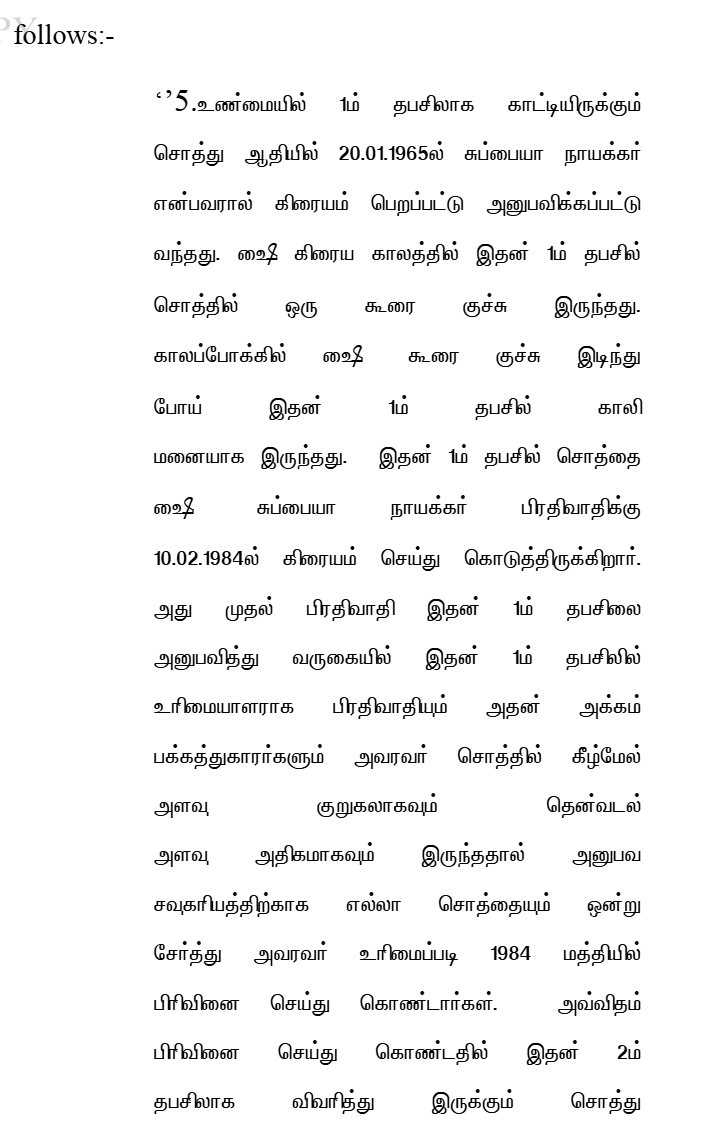
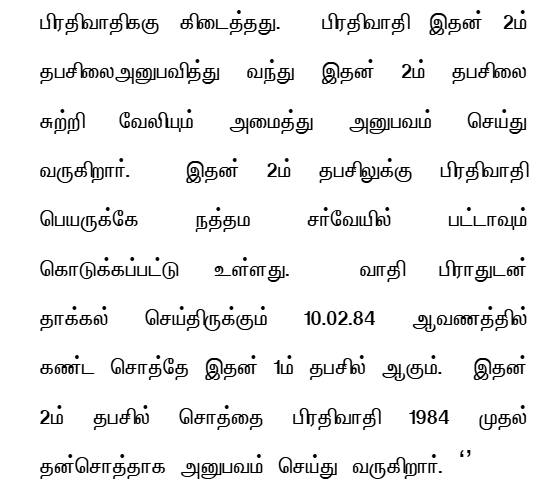
(4)The defendant denied the existence of the plaint schedule property on ground. The defendant denied the Sale Deed dated 30.04.1947 and the subsequent oral partition pleaded by the plaintiffs. The defendant contended that the property purchased by the defendant and the plaint schedule property were different. The defendant further contended that the 1st schedule item in the written statement originally belonged to one Subbiah Naicker and from him, the defendant purchased the same on 10.02.1984. The defendant contended that since there were discrepancies in the north-south and east-west measurements of the properties, the defendant and her neighbours clubbed their entire properties and orally divided the same as per their shares. In the said oral division, the defendant was allotted the 2nd item property mentioned in her written statement. The defendant contended that the plaintiffs had no right over the plaint 2nd and 3rd items and the property claimed by the plaintiffs did not exist on ground. The defendant therefore, prayed for the dismissal of the suit.
(5)Before the Trial Court, the plaintiffs examined two witnesses and marked six