
 Back
Back





IN THE HIGH COURT OF JUDICATURE AT MADRAS
N.Mala, J
Varghese – Appellant
Versus
Amalapushpam – Respondent
S.A.(MD).No.651 of 2010
| Table of Content |
|---|
| 1. overview of facts, procedural history, and initial claims of parties in a specific performance suit. (Para 1 , 2 , 3 , 4 , 5 , 6 , 7 , 8) |
| 2. framing of substantial questions of law regarding validity of agreements and the burden of proof. (Para 9 , 10 , 11 , 12 , 13) |
| 3. establishing execution of documents and the adverse inference resulting from a party's failure to testify. (Para 14 , 15 , 16 , 17 , 18 , 19 , 20 , 21 , 22 , 23 , 24) |
| 4. criteria for proving 'bona fide purchase for value without notice' in property litigation. (Para 25 , 26 , 27) |
| 5. final judicial determination granting the relief of specific performance. (Para 28 , 29) |
.JUDGMENT
(1)The second appeal is filed against the judgment and decree in A.S.No.156 of 2004, dated 31.03.2010, on the file of the learned District Judge, Kanyakumari District at Nagercoil, confirming the judgment and decree of the learned Sub Judge, Padmanabhapuram, made in O.S.No.82 of 2001, dated 08.06.2004.
(2)The parties will be referred to as per their ranking in the Trial Court.
(3)The unsuccessful plaintiff before the Courts below, is the appellant herein. The suit property is the land in S.No.447/6, measuring around 10 cents in Keezhkulam Village, Vilavangode Taluk, Kanniyakumari District.
Facts in Brief:-
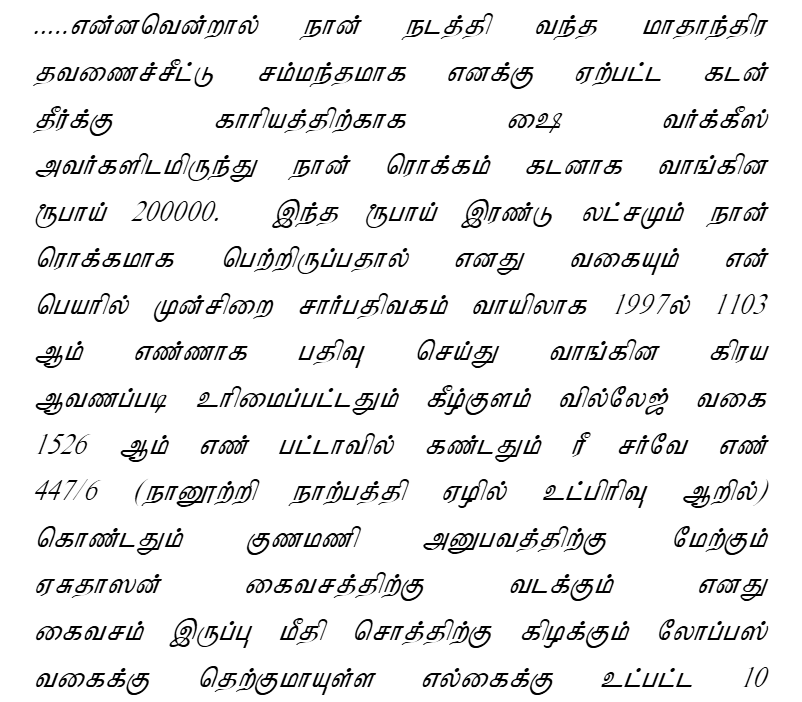
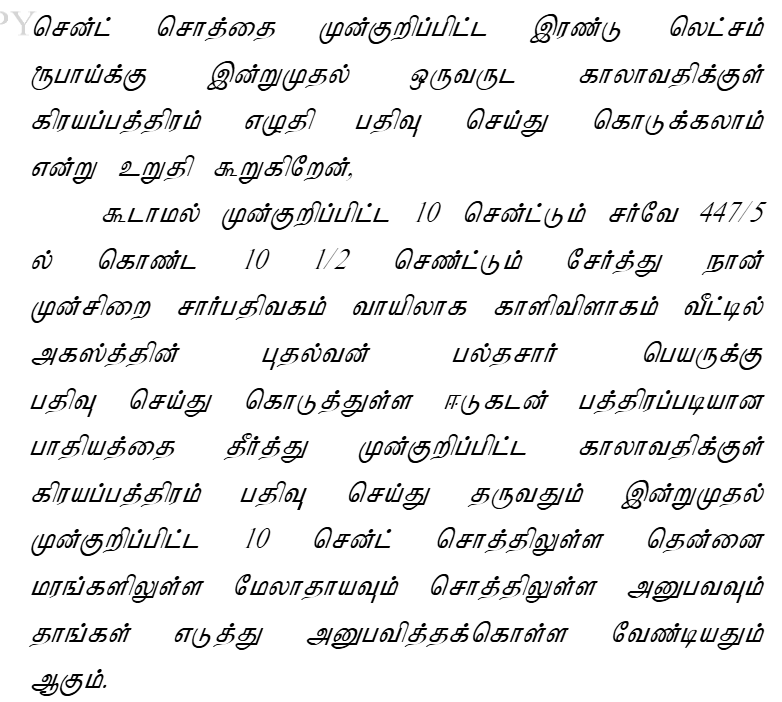
(4)The facts of the case are that the plaintiff entered into an Agreement of Sale with the 1st defendant under Ex.A1 on 04.08.2000 for sale of the suit property in S.No.447/6, Keezhkulam Village, Vilavankode Taluk, Kanniyakumari District, measuring 10 cents, for a sale consideration of Rs.2 lakhs. The plaintiff claims to have been put into possession pursuant to the Sale Agreement, since he had paid the entire sale consideration. However, as there was a mortgage in favour of the 2nd defendant by the 1st defendant, the Sale Deed was agreed to be executed within a year. Since the 1st defendant failed to execute the Sale Deed, in terms of the Sale Agreement, the plaintiff filed the suit for the relief of specific performance.
(5)The 1st defendant filed a separate written statement and the defendants 2 and 3 filed a joint written statement.
(6)The 1st defendant, is the owner of the property and defendants 2 and 3 are the subsequent purchasers. All the three defendants in one voice stated that the suit Sale Agreement was a fabricated document and that, no consideration passed under the same. They also contended that possession was not given to the plaintiff as pleaded by him. The defendants further contended that the 1st defendant executed a Mortgage Deed, in respect of 27 cents, in S.Nos.447, 447/6 in favour of the 2nd defendant and pursuant thereto, handed over possession of the entire extent of 27 cents to the 2nd defendant. Thereafter, the property was sold by the 1st defendant to the defendants 2 and 3, under two Sale Deeds dated 23.04.2001. After recovering possession of the suit property from the 2nd defendant, the 1st defendant put the 3rd defendant in possession of the property in S.No.447/5. The defendants contended that the sale in favour of the defendants 2 and 3 was bona fide and for valuable consideration. The defendants also contended that the original title documents were also handed over to them by the 1st defendant. The defendants therefore submitted that there were no merits in the suit and hence, the same deserved to be dismissed.
(7)The Trial Court, on appreciation of entire evidence on record, found that the Suit Sale Agreement was a forged document and that the defendants 2 and 3 were bona fide purchasers for value. The Trial Court further found that the legal notice sent by the plaintiff, was received by the 1st defendant only on 24.04.2001, and prior to that, on 23.04.2001 itself, the 1st defendant had executed the Sale Deeds in favour of the defendants 2 and 3. The Trial Court found that the legal notice was issued fraudulently and only after the sale in favour of the defendants 2 and 3 by the 1st defendant. The Trial Court also found that the 1st defendant



An indispensable Tool for Legal Professionals, Endorsed by Various High Court and Judicial Officers
Please visit our Training & Support
Center or Contact Us for assistance

Scan Me!
India’s Legal research and Law Firm App, Download now!


For Daily Legal Updates, Join us on :



 Back to top


