
 Back
Back





IN THE HIGH COURT OF JUDICATURE AT MADRAS
K. Murali Shankar, J
Subbaiyan – Appellant
Versus
Rajalakshmi – Respondent
S.A.(MD)No.37 of 2024
| Table of Content |
|---|
| 1. plaintiff claims specific performance of sale agreement for property. (Para 1 , 2 , 4) |
| 2. defendant asserts inconsistent and mutually destructive pleas invalidating agreement. (Para 5 , 15 , 16 , 17) |
| 3. high court jurisdiction in second appeal requires substantial question of law. (Para 10 , 11 , 12 , 47) |
| 4. evidence confirms agreement validity and rejection of defendant's claims. (Para 19 , 20 , 21 , 22 , 23 , 24) |
| 5. unregistered agreement admissible to prove contract for specific performance. (Para 25 , 26 , 27 , 28) |
| 6. limitation starts from date of refusal of performance. (Para 29 , 30 , 31 , 32 , 33 , 34 , 35 , 36) |
| 7. ready and willingness requirement mitigated by payment and possession. (Para 37 , 38 , 39 , 40 , 41 , 42 , 43) |
| 8. specific performance granted due to conduct and evidence alignment. (Para 44 , 45 , 46 , 48) |
JUDGMENT
1.The Second Appeal is directed against the judgment and decree made in A.S.No.43 of 2021 dated 21.07.2023 on the file of the IIIrd Additional District Court, Thanjavur @ Pattukkottai, confirming the judgment and decree passed in O.S.No.305 of 2015 dated 08.10.2021 on the file of the Subordinate Court, Pattukkottai.
2. The appellant is the defendant. The respondent / plaintiff filed the suit in O.S.No.305 of 2015 before the Subordinate Court, Pattukkottai, claiming the relief of specific performance of the agreement dated 06.08.2002 or in alternative refund of the advance amount with interest and costs.
3. For the sake of convenience and brevity, the parties hereinafter will be referred to as per their status / ranking in the trial Court.
4. The case of the plaintiff, in brief, is as follows:
(a) The plaintiff and the defendant are relatives and belong to the same Village. The defendant offered to sell the suit property and the plaintiff agreed to purchase the same and both of them entered into a sale agreement on 06.08.2002 fixing the sale price at Rs.1,68,000/-. The plaintiff has paid the entire sale consideration of Rs.1,68,000/- on the date of agreement itself. The defendant had handed over the possession of the suit property on the same date and also agreed to execute a sale deed when demanded by the plaintiff. The plaintiff has been in possession and enjoyment of the suit property from the date of agreement and she has always been ready and willing to perform her part of the contract.
(b) Since the defendant was evading to execute the sale deed, the plaintiff issued a legal notice dated 17.10.2013, for which, the defendant sent a reply notice dated 25.10.2013 denying the execution of the sale agreement and the receipt of money. Hence, the plaintiff was constrained to file the above suit claiming specific performance or in alternative refund of the advance amount.
5. The defence of the defendant, in short, is as follows:
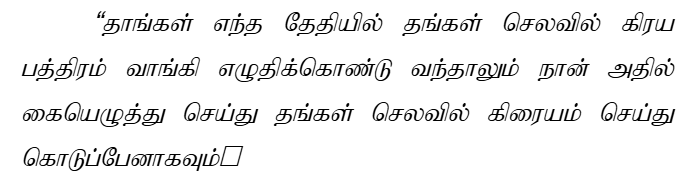
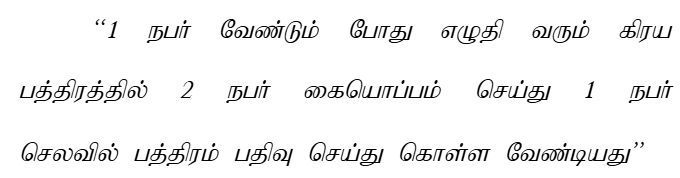
(a) The defendant has never executed the sale agreement nor received any amount from the plaintiff. The defendant approached the plaintiff's husband Appulingam in the year 2002 and obtained a loan of Rs.50,000/- to meet out the medical expenses of his sister Padmavathi. At the time of lending loan, the plaintiff's husband obtained signatures of the defendant in blank unfilled stamp papers, unfilled plain papers and unfilled promissory note as security for the loan. The defendant paid the monthly interest without any default by adjusting the coconut price and in the month of June 2013, the defendant paid the loan amount of Rs.50,000/- and requested the plaintiff's husband to return all the unfilled blank signed papers but he was delaying to return the same. The defendant stopped selling coconuts to the plaintiff's husband and hence, he enraged. Taking advantage of the signatures obtained from the defendant in blank stamp papers, the plaintiff's husband had created the unregistered suit sale agreement.
(b) The contention of the plaintiff that she has always been ready and willing to perform her part of the contract is false and untenable. The correct name of the defendant is




An indispensable Tool for Legal Professionals, Endorsed by Various High Court and Judicial Officers
Please visit our Training & Support
Center or Contact Us for assistance

Scan Me!
India’s Legal research and Law Firm App, Download now!


For Daily Legal Updates, Join us on :



 Back to top


