Back
Back





2026 Supreme(Online)(Mad) 62696
IN THE HIGH COURT OF JUDICATURE AT MADRAS
G. Jayachandran, N. Mala, JJ
Shen Long Bio-Tech (India) Private Limited – Appellant
Versus
Commissioner of GST and Central Excise, Chennai North Commissionerate – Respondent
C.M.A.No.1711 of 2021
For the Appellants/Petitioners: N. Murali
For the Respondents: S. Gurumoorthy, G. Meganathan
In service tax refund cases requiring mandatory supporting documentation, the statutory limitation period for filing claims commences from the date of issuance of such documentation, rather than the date of the governing legislation, to ensure the relief provided by the statute is not defeated by technical delays.
Headnote:(A) Finance Act, 2017 - Section 104 - Service tax - Refund - Limitation - Commencement of period - Whether limitation period for refund claim commences from date of assent or date of ancillary certificate - Held, limitation period shall be reckoned from the date of receipt of mandatory certificate from service provider as application is incomplete without said certificate. (Paras 3, 4, 8, 9, 10)
(B) Interpretation of Statutes - Object and purpose - Relief - Appellate authorities must avoid narrow technical approach that defeats the substantial objective of tax exemption provisions. (Paras 4, 5, 10)
Facts of the case:
The appellant challenged an order rejecting a refund of tax paid on long-term industrial plot leases. The refund claim was denied on the grounds that it was filed beyond the statutory limitation period, which was calculated from the date of the legislative assent. The appellant contended that the delay was unavoidable as they were awaiting a mandatory verification certificate from the service provider, which was a prerequisite for the refund application.
Findings of Court:
The court observed that the documentation from the service provider was essential to substantiate the refund claim. Consequently, the court held that the limitation period cannot be mechanically calculated from the date of the legislation's assent but must logically begin from the date when the necessary documentation was obtained by the claimant.
Issues: The central issue was whether the refund application was barred by the limitation period and the correct starting point for calculating this period under the statutory framework.
Ratio Decidendi: The court reasoned that when a statute requires supporting documentation to process a refund, the limitation period for filing such a claim must be considered to commence only upon the issuance of said documentation, thereby preventing a rigid interpretation that would frustrate the legislative intent to provide tax relief.
Result: Appeal allowed.
| Table of Content |
|---|
| 1. statutory retrospective tax exemption under finance act 2017. (Para 1 , 2 , 3 , 4) |
| 2. questions of law regarding refund claim limitation periods. (Para 5 , 6 , 7) |
| 3. limitation period for refunds begins upon receipt of mandatory certification. (Para 8 , 9 , 10) |
| 4. formal order allowing the appeal and directing refund processing. (Para 11) |
JUDGMENT
The order of the Tribunal rejecting the refund claim made by the assessee pursuant to the Finance Act, 2017, which was given retrospective effect, is now before this Court by way of challenge in the present Civil Miscellaneous Appeal.
2. The short point involved in this case is if the petitioner is entitled to the benefit of the Notification No.41/2016 dated 22.09.2016 issued by the Ministry of Finance, Government of India, in the interest of public, exempting taxable services provided by State Government Industrial Development Corporations/ Undertakings to industrial units by way of granting long-term lease of industrial plots from so much of service tax leviable thereon under Section 66B of the said Act. The Finance Act, 2017 got assent of the President and came into force from 01.04.2017.
3. Section 104 has been inserted in Finance Act, 2017 reads as below:
(1) Notwithstanding anything contained in section 66, as it stood prior to the 1st day of July, 2012, or in section 66B, no service tax, leviable on one time upfront amount (premium, salami, cost, price, development charge or by whatever name called) in respect of taxable service provided or agreed to be provided by a State Government industrial development corporation or undertaking to industrial units by way of grant of long term lease of thirty years or more of industrial plots, shall be levied or collected during the period commencing from the 1st day of June, 2007 and ending with the 21st day of September, 2016 (both days inclusive).
(2) Refund shall be made of all such service tax which has been collected, but which would not have been so collected, had sub-section (1) been in force at all material times.
(3) Notwithstanding anything contained in this Chapter, an application for claim of refund of service tax shall be made within a period of six months from the date on which the Finance Bill, 2017 receives the assent of the President.
4. Section 104(1) of Finance Act, 2017, got amended and given retrospective effect to extend the exemption granted; sub-Section (2) of Section 104 pertains to refund to be granted to the service tax already paid and Sub- section 104(3) of the Finance Act, 2017 enables the taxpayer to seek a refund within six months from the date of assent to the Act.
5. At the time of admitting the appeal, the following substantial questions of law were framed for consideration:-
(i)Whether the Appellate Tribunal in the facts and circumstances of this case was correct in dismissing the appeal in rejecting the claim of refund application?
(ii)Whether the Appellate Tribunal was correct in applying the statutory provisions for rejecting the refund claim when the refund claim is through the Finance Act, 2017?
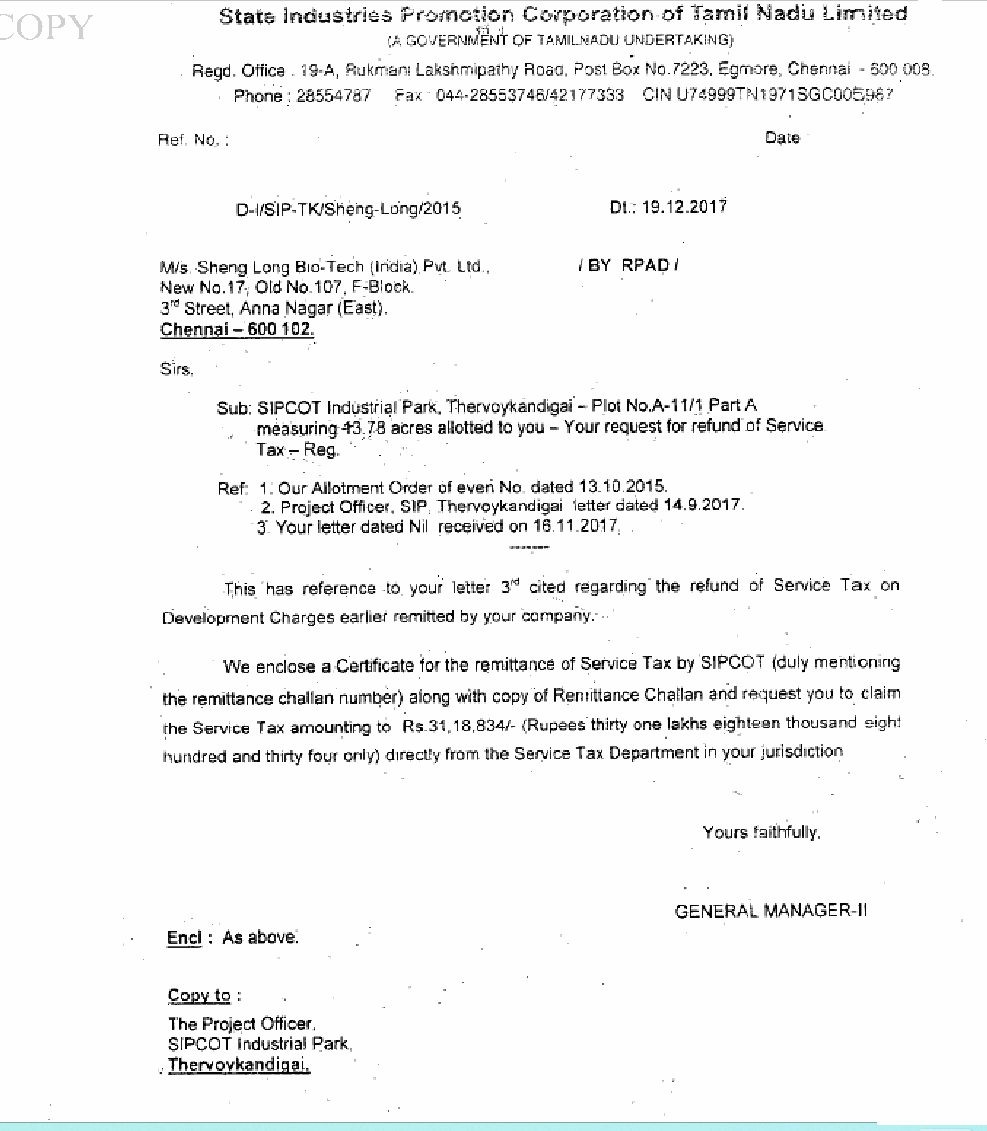
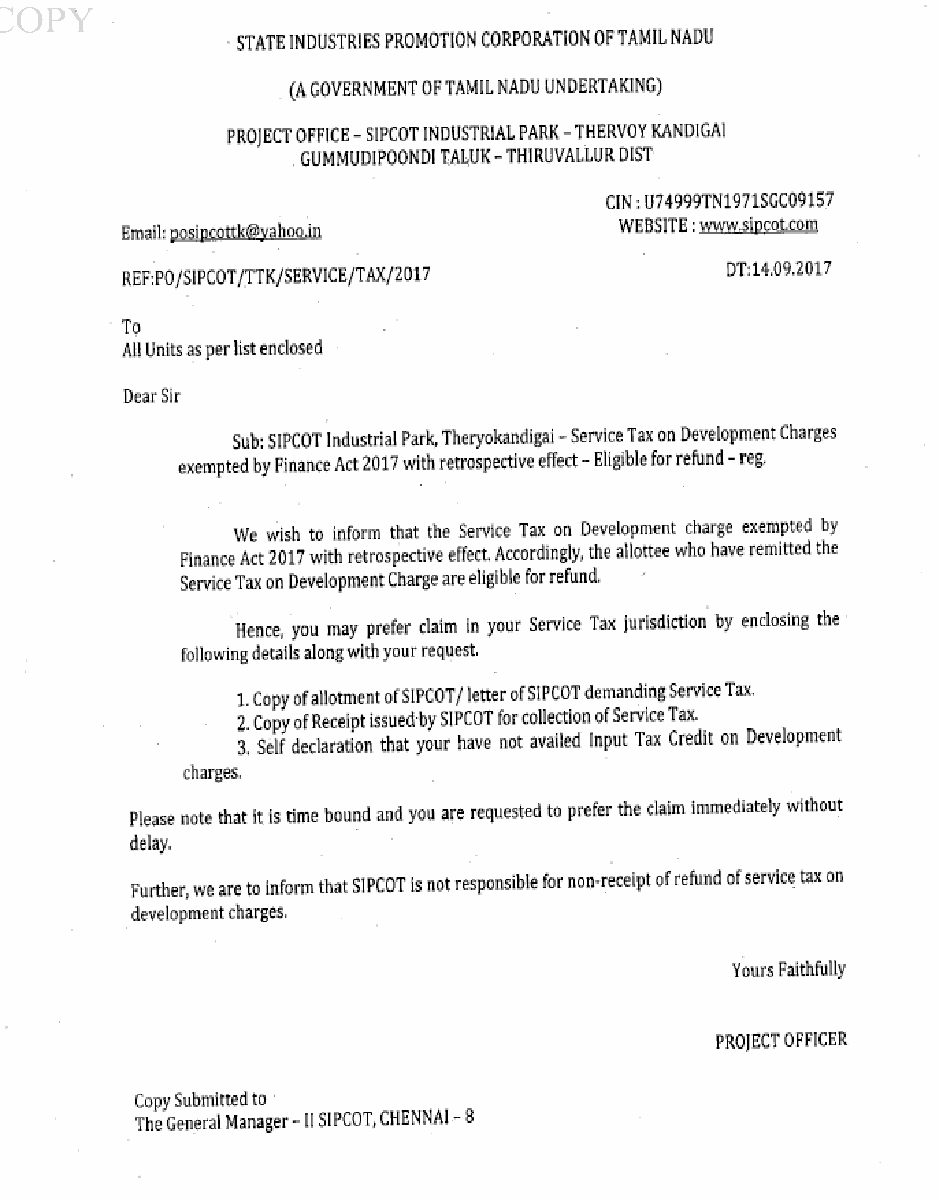
(iii)Whether the Appellate Tribunal is justified in rejecting the claim of refund after observing that even from the letter dated 14.09.2017 of the SIPCOT still the claim is barred by limitation. Whereas, it is not so and the claim is within the period of limitation?
(iv)Whether the Appellate Tribunal is correct in adopting the technicalities and narrow approach when the intention/object of the Government itself is to encourage the development of Industries allotted by Industrial undertakings/Corporation?
(v)Whether the Appellate Tribunal was correct in dismissing the appeal even if the period of limitation is calculated from, the date of assent of the President which is only the minimal delay of four months and 26 days?
6. The assent to the Act was granted on 31.03.2017 and the refund claim made by the appellant on 26.02.2018, which was found to be beyond six- months period, was rejected by the responde