


 Back
Back





2025 Supreme(Online)(MP) 1392
HIGH COURT OF MADHYA PRADESH
JUSTICE VIVEK JAIN, J
Chandramani Hirkane – Appellant
Versus
The State Of Madhya Pradesh – Respondent
WP 9950/2025
Sushil Kumar Mishra,Advocate General
Transfer orders issued with the approval of a competent authority are valid even if signed by a subordinate, provided the authority retains control over the decision-making process.
Headnote:(A) M.P. Rajya Mandi Board Service Regulation, 1998 - Clause 25 - Transfer Order - The petitioner challenged a transfer order from Seoni to Jabalpur, asserting it was issued without jurisdiction. The authority to transfer lies with the Managing Director, yet the order was signed by the Dy. Director (Establishment). (Paras 3-4)
(B) Delegation of Authority - The court discussed the principle of 'delegatus non potest delegare' and referenced the Constitution Bench ruling in Union of India & another Vs. P.K. Roy, clarifying that if an authority retains control over decisions made by a delegate, the order is valid. (Paras 8-10)
Facts of the case:
The petitioner was transferred and relieved from Seoni to Jabalpur, subsequently filing a petition claiming the order was without jurisdiction. The Dy. Director signed the order but stated it was approved by the Managing Director. (Paras 1-6)
Findings of Court:
The court found the transfer order valid as it was issued under the approval of the Managing Director, thus dismissing the petition. (Paras 10-12)
Issues: Whether the transfer order issued by the Dy. Director with the approval of the Managing Director was valid.
Ratio Decidendi: The court ruled that as long as the authority retains control over the delegated decision, the order remains valid.
Result: Petition dismissed.
ORDER
By way of the present petition challenge is made to the transfer order Annexure P/2 dated 31.01.2025 whereby the petitioner has been transferred from Seoni to Jabalpur.
2. It is not in dispute that after passing of the said transfer order the petitioner has been relieved on 11.02.2025 and he has even joined at Jabalpur on 17.02.2025 and one month after fully executing the transfer order the present petition has ben filed.
3. Learned counsel for the petitioner submits that the petitioner executed the transfer order as he was ignorant about the position that the order is utterly without jurisdiction and since the order is without jurisdiction it can be challenged at any stage. It is contended that as per clause 25 of M.P. Rajya Mandi Board Service Regulation -1998 the competence of transfer of any member of service to any place in Madhya Pradesh lies with the Managing Director in the following manner:-
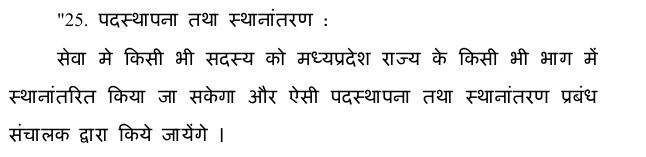
4. It is further contended that there is circular of Managing Director whereby delegation of powers have been made and as per the said delegation of powers, as per Clause 6 of schedule A, the competence to transfer officers and employees lies with the Managing Director and the Chairman, therefore, the impugned transfer order having been passed under the signature of Dy. Director (Establishment) of the Board is utterly without jurisdiction.
5. Per contra, the order is supported by learned counsel for the State.
6. The ground of contention raised by the petitioner is that the order ought to have ben issued by the Managing Director and it is issued by the Dy. Director (Establishment) of the Board which is stated to be without jurisdiction, though it is not disputed that the Dy. Director (Establishment) is located in the office of Managing Director.
7. The order Annexure P/2 dated 31.01.2025 mentions in clear terms that the order is issued under approval of the Managing Director and note to that effect is appended on the order Annexure P/2. Learned counsel for the petitioner has relied on the judgment of the coordinate Benches of this Court in W.P. No. 14545/2019 and W.P. No. 2856/2017 to submit that the order should be passed by the authority so nominated and named in the rules and it cannot be issued by any subordinate authority even with the approval of the competent authority and therefore, the order should be held to be without jurisdiction.
8. The issue whether an order passed with the approval of competent authority can be said to be the order passed by the said authority and can be said to be an order authorized or unauthorized was subjected to consideration before the Constitution Bench of the Supreme Court in the case of Union of India & another Vs. P.K. Roy and others, reported in AIR 1968 SC 850 and Constitution Bench held in the following terms:-
"10.............
The principle of the maxim “delegates non protest delegare” has therefore no application to the present case. The maxim deals with the extent to which a statutory authority may permit another to exercise a discretion entrusted by the statute to itself. It is true that delegation in its general sense does not imply a parting with statutory powers by the authority which grants the delegation, but points rather to the conferring of an authority to do things which otherwise that administrative authority would have to do for itself. If, however, the administrative authority named in the statute has and retains in its hands general control over the activities of the person to whom it has entrusted in part the exercise of its statutory power and the control exercised by the administrative authority is of a substantial degree, there is in the eye of law no “delegation” at all and the maxim “delegatus non potest delegare” does not apply [See Fowler (John) & Co. (Leeds) v. Duncan [[1941] Ch 450] ]. In other words, if a statutory authority empowers a delegate to undertake preparatory work and to take an initial decision in matters entrusted to it but retains in its own hands th












