
 Back
Back





IN THE HIGH COURT OF MADHYA PRADESH AT JABALPUR
VIVEK AGARWAL, RAMKUMAR CHOUBEY, JJ
THE STATE OF MADHYA PRADESH – Appellant
Versus
SHASHIKANT JOGI – Respondent
CRIMINAL APPEAL No. 6751 of 2023
| Table of Content |
|---|
| 1. state's appeal regarding conviction and sentencing. (Para 1 , 2) |
| 2. interpretation of pocso act provisions in relation to ipc. (Para 3 , 4 , 5 , 6) |
| 3. court's dismissal of appeal due to incorrect application. (Para 7) |
| 4. imposition of costs for improper filing and required enquiry. (Para 8 , 9) |
| 5. call for enquiry into the actions of the responsible officials. (Para 10 , 11) |
ORDER
Per: Justice Vivek Agarwal
This Criminal Appeal is filed by the State being aggrieved of the judgment dated 24.01.2023 passed by learned Special Judge ( POCSO Act ), Tikamgarh (M.P.) in Special Case No. 27 of 2022, whereby learned trial Court has convicted and sentenced the accused Shashikant Jogi (respondent herein) as under:
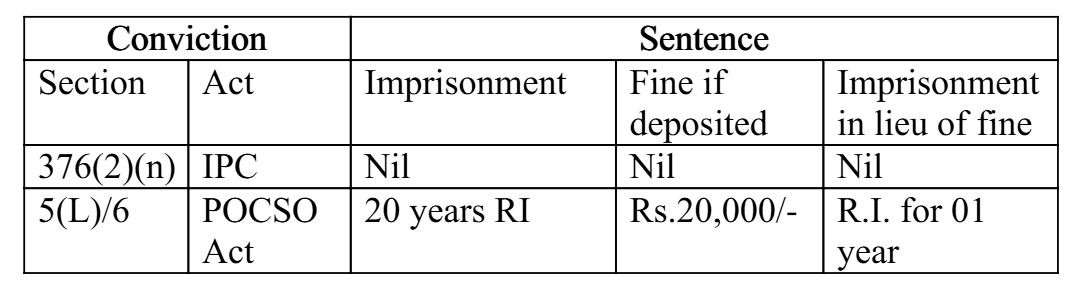
2. Learned Government Advocate for the State submits that the accused has been sentenced only under Section 5(L)/6 of POCSO Act and has been directed to under go rigorous imprisonment for a period of 20 years and fine of Rs.20,000/- with default stipulations of one year rigorous imprisonment.
3. It is further submitted that, the appeal of the State is only on the ground that, once conviction was recorded under Section 376(2)(N) IPC, then there was no reason for the trial Court to not have sentenced the accused under Section 376(2)(N) of IPC.
4. When this Court drew attention of learned Government Advocate towards the Provisions of contained in Section 42 of the POCSO Act , 2012, which it appears was not gone through by the counsel who prepared this memo of Appeal on behalf of the State before preparing the memo of appeal, then it is evident that Section 42 of the POCSO Act , 2012 reads as under:
"42. Alternate punishment.—
Where an act or omission constitutes an offence punishable under this Act and also under sections 166A, 354A, 354B, 354C, 354D, 370, 370A, 375, 376, 376A, 376C, 376D, 376E or section 509 of the Indian Penal Code (45 of 1860), then, notwithstanding anything contained in any law for the time being in force, the offender found guilty of such offence shall be liable to punishment only under this Act or under the Indian Penal Code as provides for punishment which is greater in degree."
5. When these provisions are taken into consideration, then it is evident that, statute itself provides that notwithstanding anything contained in any law for the time being in force, the offender found guilty of such offence shall be liable to punishment only under this Act or under the Indian Penal Code as provides for punishment which is greater in degree.
6. Section 376(2)(N) of IPC provides that, a person who commits rape repeatedly on the same woman, shall be punished with rigorous imprisonment for a term which shall not be less than ten years, but which may extend to imprisonment for life, which shall mean imprisonment for the remainder of that person's natural life, and shall also be liable to fine, whereas Section 6 of the POCSO Act , 2012 provides for punishment with rigorous imprisonment for a term which shall not be less than twenty years, but which may extend to imprisonment for life, which shall mean imprisonment for the remainder of the natural life of that person and shall also be liable to file, or with death.
7. Thus, it is evident that, punishment prescribed under Section 6 of POCSO Act or offence under Section 5(L) of the POCSO Act is higher in degree, then the one prescribed under Section 376(2)(N) of IPC, therefore, when provisions contained in Section 42 of POCSO Act which deals with alternate punishment is taken into consideration, it is apparent that, learned counsel who prepared the memo of appeal, did not bother to even go through the basic provisions of the POCSO Act and mechanically prepared the appeal, therefore, appeal having been filed without application of mind deserves to fail and is dismissed.
8. For bothering the system without there being any justification, cost of Rs.20,000/- is imposed on the State to be paid to the High Court Legal Services Committee for the utilization of such c



An indispensable Tool for Legal Professionals, Endorsed by Various High Court and Judicial Officers
Please visit our Training & Support
Center or Contact Us for assistance

Scan Me!
India’s Legal research and Law Firm App, Download now!


For Daily Legal Updates, Join us on :



 Back to top


