


1. Compassionate appointment cancelled because petitioner’s wife is already in government employment. (Para 1 , 2 , 3 , 4 )

 Back
Back





IN THE HIGH COURT OF MADHYA PRADESH AT GWALIOR
ASHISH SHROTI, J.
Shuvam Sharma – Petitioner
Versus
The State Of Madhya Pradesh And Others – Respondents
Writ Petition No. 43944 of 2025
Decided On : 07-01-2026
1. Compassionate appointment cancelled because petitioner’s wife is already in government employment. (Para 1 , 2 , 3 , 4 )
2. Petitioner: wife not a family member of deceased employee. Respondents: daughter-in-law is family member; bar applies. (Para 5 , 6 , 7 )
3. Writ petition dismissed; cancellation of compassionate appointment upheld. (Para 21 )
Compassionate appointment is not a right or alternate recruitment but a compassion to help the family tide over sudden financial crisis caused by death of the sole bread earner. (Para 12 , 13 , 14 )
Yes, under the policy dated 29.09.2014, Clause 2.3 includes daughter-in-law as a dependent family member eligible for compassionate appointment. (Para 9 , 10 , 11 )
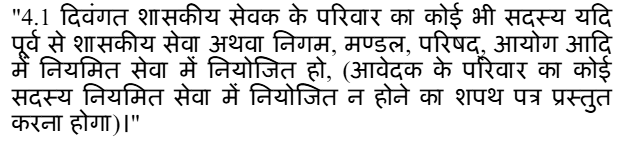
Yes, under Clause 4.1 of the policy, if any eligible member of the deceased family is in government service, no other member is entitled to compassionate appointment. (Para 19 , 20 )
No, compassionate appointment is granted to enable the family to tide over the sudden crisis, and cannot be decided based on hypothetical future situations. (Para 18 )
ORDER :
ASHISH SHROTI, J.
The petitioner is aggrieved by order, dated 19.09.2025 (Annexure P/1) whereby, the compassionate appointment granted to him vide order, dated 10.09.2025, has been cancelled with immediate effect on the ground that his wife is already in the Government employment. He has, therefore, prayed for setting aside of the order, dated 19.09.2025, with a further direction to restore the order, dated 10.09.2025, with consequential benefits.
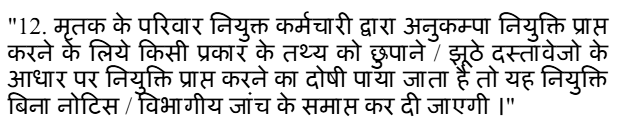
[2]. The facts necessary for decision of this case are that the petitioner's father late Shri Kamesh Prasad Sharma was working as Madhyamik Shikshak. He expired on 07.02.2024. Upon his death, the petitioner applied for grant of compassionate appointment. The petitioner's application was favourably considered and vide order, dated 10.09.2025 (Annexure P/2), he was given compassionate appointment on the post of Assistant Grade-III in Women & Child Development Department, Ashoknagar. The appointment given to the petitioner was subject to various conditions incorporated in the appointment order. Clause 12 thereof being relevant for decision of this case are reproduced hereunder:
[3]. After issuance of appointment order, it appears that the petitioner did not submit joining on the post and instead informed the respondents that his wife Smt. Manisha Dubey (Sharma) is presently working as Peon in the Office of Sports & Youth Welfare Department, Ashoknagar (M.P.). The respondents accordingly enquired about the same from District Sports Officer, Ashoknagar who informed vide memo, dated 12.09.2025, that petitioner's wife is working as Peon in the office since 13.07.2017.
[4]. Taking cognizance of the aforesaid information, a show cause notice was issued to the petitioner on 12.09.2025 (Annexure P/4) alleging that he has suppressed material information about employment of his wife who is in Government job. He was, therefore, asked to submit his explanation, failing which, ex-parte action shall be taken against him. In response, the petitioner submitted his explanation on 16.09.2025 (Annexure P/5) whereby, he accepted the factum of employment of his wife. He, however, submitted that the information regarding her employment was not disclosed by him because of lack of knowledge regarding such disclosure. He also submitted that the non-disclosure of employment of his wife is not intentional and is bona-fide. He, therefore, requested for dropping the proceedings. After considering the reply submitted by the petitioner, the impugned order, dated 19.09.2025 (Annexure P/1), came to be passed whereby the compassionate appointment granted to the petitioner on 10.09.2025 has been cancelled with immediate effect. Challenging this order, the petitioner has filed the present writ petition.
[5]. Learned counsel for the petitioner challenged the impugned order on the ground that cancellation of petitioner's compassionate appointment on the ground of employment of his wife is ex-facie illegal inasmuch as the petitioner's wife is not one of the family members of deceased employee. It is his submission that under the policy, the petitioner was only required to disclose the information about family members of the deceased employee which he has duly done. Learned counsel also pointed-out that the petitioner's wife is taking care of his maternal family wherein her mentally challenged brother is totally dependent upon her. The salary received by the petitioner's wife is spent on his brother and, therefore, she is not in a position to financially help the petitioner's family. Learned counsel also placed heavy reliance upon Coordinate Bench judgment of this Court in the case of Vivek Kumar Chouhan Vs. State of M.P. & Ors. reported in 2014(2) MPLJ 694 to say that the petitioner's wife cannot be termed as a member of family of deceased employee and on the ground of her employment, petitioner's compassionate appointment could not have been cancelled.
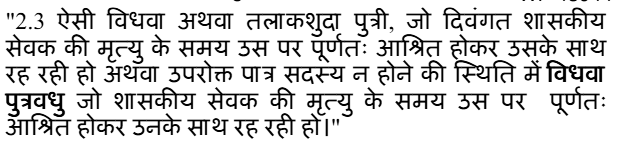
[6]. In the context of provisions of Clause 2.3 of the policy dated 29.
AI



An indispensable Tool for Legal Professionals, Endorsed by Various High Court and Judicial Officers
Please visit our Training & Support
Center or Contact Us for assistance

Scan Me!
India’s Legal research and Law Firm App, Download now!


For Daily Legal Updates, Join us on :



 Back to top