


1. Bank initiated SARFAESI proceedings for recovery of loan and took possession of secured assets; DRT/DRAT set aside possession. (Para 2 )

 Back
Back





IN THE HIGH COURT OF MADHYA PRADESH AT GWALIOR
ANAND PATHAK, PUSHPENDRA YADAV, JJ.
UCO Bank – Petitioner
Versus
M/S Asha Oil Industries And Others – Respondents
Writ Petition No.31051 of 2025
Decided On : 28-01-2026
1. Bank initiated SARFAESI proceedings for recovery of loan and took possession of secured assets; DRT/DRAT set aside possession. (Para 2 )
2. Bank argued Section 14 not mandatory; borrower argued possession without Section 14 illegal. (Para 4 , 5 , 6 , 7 , 8 , 9 , 10 )
3. Petition allowed; impugned DRT and DRAT orders set aside; Bank may proceed in accordance with law. (Para 28 , 29 , 30 )
No, the secured creditor can take possession under Section 13(4) and Rule 8 without Section 14 assistance; Section 14 is only for when assistance is needed. (Para 13 , 18 , 19 , 21 , 23 , 26 )
No, only requirement is notice under Section 13(2) and 13(4); absence of borrower does not make possession forcible. (Para 18 , 20 )
No, the Act does not recognize such dichotomy; the authorized officer can take actual possession directly. (Para 22 )
To enable secured creditors to enforce security interest without court intervention, avoiding procedural delays. (Para 14 , 24 , 25 )
ORDER :
Anand Pathak, J.
1. The instant Writ Petition under Article 226(1) of the Constitution of India is filed seeking following reliefs:-
“I. That the present writ petition may kindly be allowed.
II. That, the impugned orders dated 14.05.2025 and 28.09.2021 passed by the learned Debts Recovery Appellate Tribunal, Allahabad in Regular Appeal No.15/2022 titled as Uco Bank-V-M/s. Asha Oil Mills & Ors. and Debts Recovery Tribunal, Jabalpur in S.A. No.217/2019 titled as M/s. Asha Oil Mills & Ors. V. UCO Bank respectively may kindly be quashed and set aside.
III. That, the directions issued by Learned Tribunal and Appellate Tribunal in the impugned orders to the petitioner bank to return money deposited by auction purchaser may kindly be quashed, being contrary to the rules.
IV. That, the directions issued by learned DRT and thereafter by learned DRAT in the impugned orders to restore physical possession of the subject properties including the movable stock and machineries to the respondents may kindly be quashed, being impracticable to perform.
V. That, the respondents may kindly be directed to pay the expenses of present proceedings and other legal proceedings and VI. Any other relief/ direction/ order which this Hon'ble Court deems fit in the interest of justice.”
2. Precisely stated facts of the case are that petitioner/ UCO Bank is a Government of India undertaking which is established under Banking Companies (Acquisition and Transfer of Undertakings) Act, 1970. Respondent No.1 is a proprietorship concern acting through its proprietor Shri Pradeep Shivhare and respondent No.2- Smt. Poonam Shivhare. They availed the Cash Credit (Hypothecation) Limit to the extent of Rs.05 crores from the petitioner/ Bank from time to time. As a security of loan, respondents mortgaged their immovable properties comprising of Plot No.63 Malanpur Industrial Area, Bhind Road, District Bhind, M.P. (Mortgage property no.1) and plot no.58, Laxmibail Colony, Gwalior (M.P.) (Mortgaged property no.2). Respondents failed to comply with various terms of loan agreements and defaulted. Therefore, Loan Account of respondents was classified by the petitioner/ Bank as Non-Performing Assets (NPA) w.e.f. 31/10/2018 in accordance with the guidelines issued by the Reserve Bank of India from time to time. Chain of events precipitated filing of this petition.
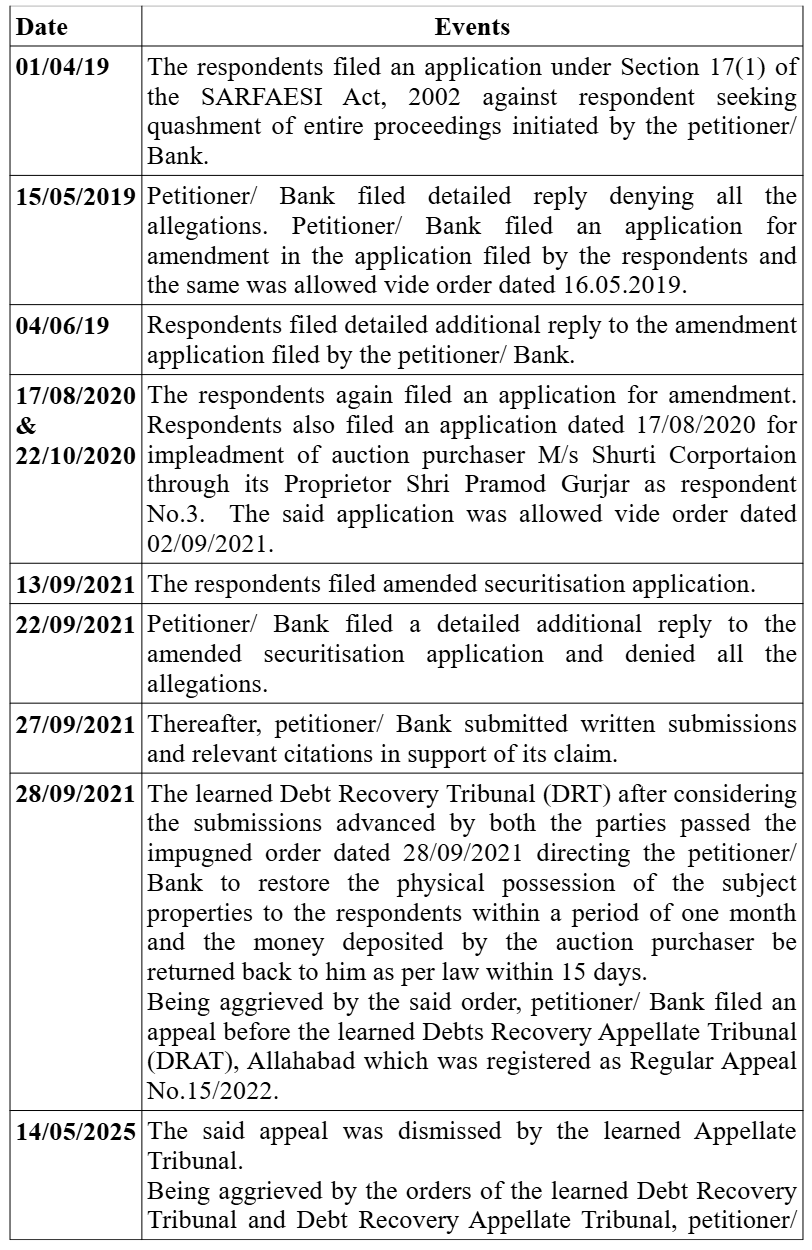
3. Following list of dates and events are worth consideration and the same are as under:-

4. It is the submission of learned counsel for the petitioner/ Bank that learned Debt Recovery Tribunal, Jabalpur (DRT) as well as learned Debt Recovery Appellate Tribunal (DRAT), Allahabad caused illegality in passing the impugned orders. According to learned counsel, Tribunals below erred in giving conclusion that once notice under Rule 8 (1) of the (Securitisation and Reconstruction of Financial Assets and Enforcement of Security Interest Act, 2002) (hereinafter referred as “SARFAESI Act”) is issued, affixed and delivered then there is obligation on part of the Bank either to resort Section 14 proceedings of the SARFAESI Act before taking physical possession or the borrower/ mortgagor/ guarantor should be present there for handing over peaceful possession.
5. According to learned counsel, said approach is erroneous. As submitted, it is not required that secured creditor has to approach Chief Metropolitan Magistrate (CMM)/ District Magistrate (DM) for taking possession from the borrower necessarily. Scheme of SARFAESI Act specially Section 13(4) provides that in case of failure of borrower to discharge his liability in full within the period specified in sub-section (2) of the SARFAESI Act, the secured creditor may take recourse to take possession of the secured assets of the borrowers.
6. Similarly, Section 14 of the SARFAESI Act contemplates that if possession of any secured asset is required to be taken by the secured creditor then secured creditor may approach CMM/ DM. Role of these authorities is to assist secured creditor in
AI



An indispensable Tool for Legal Professionals, Endorsed by Various High Court and Judicial Officers
Please visit our Training & Support
Center or Contact Us for assistance

Scan Me!
India’s Legal research and Law Firm App, Download now!


For Daily Legal Updates, Join us on :



 Back to top