


1. Appeal by State against acquittal under Section 306 IPC for abetment of suicide — deceased allegedly consumed poison after marital harassment and in-laws' refusal to send wife back. (Para 2 , 3 )

 Back
Back





IN THE HIGH COURT OF MADHYA PRADESH AT JABALPUR
Rajendra Kumar Vani, J.
The State Of Madhya Pradesh – Petitioner
Versus
Nisar Mohd And Others – Respondent
Criminal Appeal No. 2236 of 2016
Decided On : 15-01-2026
ORDER :
Rajendra Kumar Vani, J.
This appeal under Section 378 of Cr.P.C. has been filed by the State assailing the judgment and order of acquittal dated 10.08.2015 passed in S.T. No.49/2011(State of M.P. vs. Nisar Mohd. and others) by the learned Second Additional Sessions Judge, Chhattarpur (M.P.) whereby respondents/accused have been acquitted of the offence under Section 306 of IPC.
2. As per the prosecution case, the deceased Wasim was married to Shaheen in the year 2008 at Manihari Mohalla, Chhattarpur. After the marriage, the in-laws of the deceased used to frequently visit his house to take Shaheen with them; however, the deceased did not permit her to leave the matrimonial home. On 15.10.2009, the brother of Shaheen, namely Riyaz, took her to Chhatarpur on the pretext of attending his engagement ceremony, but thereafter did not send her back to the matrimonial home of the deceased. Subsequently, Shaheen filed a maintenance petition against the deceased and also initiated other legal proceedings. It is further alleged that whenever the deceased went to his in-laws’ house to bring Shaheen back, she was not sent with him. On 14.10.2010, deceased Wasim reached the house of his in-laws at Chhattarpur and committed suicide by consuming a poisonous substance. Upon receipt of information, a Marg intimation was registered and an inquest was conducted under Section 174 of the Code of Criminal Procedure.
3. During the course of investigation, dead body of the deceased was duly identified and a Panchnama was prepared. The postmortem examination of the deceased was conducted, wherein the doctor opined that the cause of death was consumption of poisonous substance. On lodging of the FIR, the criminal law was triggered and set in motion.
4 . After completion of the investigation, a charge sheet was submitted in the competent court, which on its turn committed the case to the court of session where the respondents/accused were tried.
5 . The learned Trial Judge on the basis of the averments made against the accused in the charge sheet framed charge punishable under Section 306 of IPC. The respondents abjured their guilt. They took the plea that they have been falsely implicated in the matter and they claimed to be tried.
6. The prosecution, in order to bring home the charges examined as many as 15 witnesses, which are Munnilal (PW-1), Dr. S.K.Gupta (PW-2), Maharaj Singh (PW-3), Naeem Soudagar (PW-4), Rahil Soudagar (PW-5), Smt. Fajlun Nisha (PW-6), Ramavtar Chorasiya (PW-7), Mod. Nawab (PW-8), Naseem Soudagar (PW-9), Gopal Das (PW-10), Dr. B.M. Chourasiya (PW-11), Praveen Kumar Singh (PW-12), J.D. Verma (PW-13), A.K. Poranik (PW-14) and Ashok Valmiki (PW-15) and placed Ex.P/1 to P/31, documents on record.
7. The learned Trial Court after appreciating and marshalling the evidence came to hold that the allegations levelled against the accused are not found to be proved and eventually acquitted the accused persons/respondents of the charges under Section 306 of IPC. Hence, this appeal.
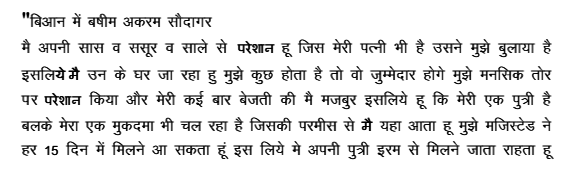
8. It is submitted by the learned counsel for the present appellant/State that the learned trial Court has erroneously acquitted the respondents/accused persons, despite the prosecution having adduced cogent and reliable evidence. From the prosecution evidence on record, it is clearly revealed that the accused persons exerted immense pressure upon the deceased and did not allow him to reside peacefully with his wife. As a result of such continuous harassment and pressure, the deceased was compelled to commit suicide. In this regard, document Ex.P/16, which is a suicide note, was seized by the police. Keeping in view the suicide note, coupled with the statements of the prosecution witnesses, the offence under Section 306 of the IPC is clearly made out against the accused persons. The suicide note was written by the deceased himself, which in fact stands duly substantiated by the evidence of handwriting expert, K.K. Puranik (PW-14). Hence, the acquittal of the accuse

AI



An indispensable Tool for Legal Professionals, Endorsed by Various High Court and Judicial Officers
Please visit our Training & Support
Center or Contact Us for assistance

Scan Me!
India’s Legal research and Law Firm App, Download now!


For Daily Legal Updates, Join us on :



 Back to top