Back


2025 Supreme(Online)(NCLT) 6556
IN THE NATIONAL COMPANY LAW TRIBUNAL NEW DELHI BENCH (COURT-V)
SHRI MAHENDRA KHANDELWAL, SMT. ANU JAGMOHAN SINGH, JJ
MODERN SOLAR PRIVATE LIMITED – Appellant
Versus
CLARO ENERGY PRIVATE LIMITED – Respondent
I.A. (CO. ACT) NO.: 49/ND/2024 | T.P. (CO. ACT) NO.: 53/PB/2022
Funds treated as investment do not qualify as financial debt under Insolvency and Bankruptcy Code, asserting the importance of time value of money.
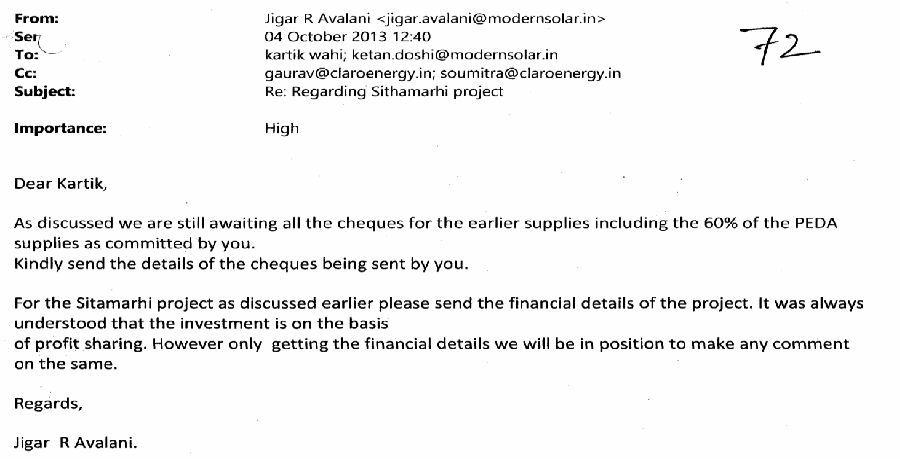
Headnote:(A) Insolvency and Bankruptcy Code, 2016 - Section 5(8) - Financial Debt - The Applicant contended that funds advanced to the Corporate Debtor were a loan, while the Respondent asserted it was an investment - Emails and previous acknowledgements show that it was treated as an investment with potential profit - No enforceable loan agreement or terms established - Court ruled that the alleged amount did not meet the criteria for financial debt as defined under Section 5(8). (Paras 9, 11, 15)
(B) Judicial interpretation - The tribunal emphasized the difference between winding-up proceedings and insolvency resolution - Debt of a financial character must exhibit the time value of money - Historical acknowledgments of investment without corresponding debt characteristics governed the tribunal's decision. (Paras 10, 12, 14)
Facts of the case:
The Financial Creditor advanced Rs. 20,00,000 to the Corporate Debtor, which was asserted to be a loan but claimed by the Corporate Debtor as a profit-sharing investment. Subsequent dishonour of cheques and lack of enforceable loan agreements formed the basis for proceedings under the Code.
Findings of Court:
The Tribunal found that the funds were treated as an investment rather than a loan and did not classify as financial debt.
Issues: The primary issue was whether the amount constituted financial debt under Section 5(8) of the Insolvency and Bankruptcy Code.
Ratio Decidendi: The tribunal maintained that the historical context of the transactions indicated investment rather than a loan, negating claims of financial debt under the Code.
Result: The application under Section 7 of the Code dismissed, with no order as to costs.
| Table of Content |
|---|
| 1. application procedure and relevance of financial debt. (Para 1 , 4 , 6) |
| 2. arguments surrounding the nature of the transaction. (Para 5 , 9) |
| 3. court's examination of financial qualifications. (Para 10 , 11) |
| 4. final ruling based on precedent regarding investments. (Para 14 , 15) |
ORDER
1. The instant interlocutory Application has been filed in accordance with Rule 11 of National Company Law Tribunal Rules, 2016 seeking directions for treating the instant Application pari-materia to the Petition under Section 7 of the Insolvency & Bankruptcy Code, 2016 (hereinafter referred to as ‘Code’).
2. The prayers sought by the Applicant in the instant Application are mentioned hereinbelow—
a. The present application under Rule 11 of the National Company Law Tribunal Rules, 2016 be allowed and that the instant I.A. be treated as an application under Section 7 of the Code;
b. Initiation of CIRP against the Corporate Debtor in lieu of the financial debt amounting to Rs.48,04,054.79/- inclusive of interest @18% p.a.
3. The Applicant had initially filed Company Petition bearing no. Co. Pet. 39/2016 under Sections 433 (e), 434 and 439 before Hon’ble Delhi High Court seeking winding-up of the Respondent/Corporate Debtor. Vide order dated 07.10.2022, the Hon’ble High Court transferred the said Petition to this Adjudicating Authority in terms of Section 39 of the Insolvency and Bankruptcy Code (Second Amendment) Act, 2018. Thereafter, vide order dated 21.04.2023, Applicant was directed to file appropriate Application under Section 7 or Section 9 of the Code. In compliance with the said direction, the Applicant has filed the present Application under Rule 11 of the National Company Law Tribunal Rules, 2016, as Section 7 Application in transferred Company Petition.
Case of the Applicant/Financial Creditor
4. The relevant facts necessary for adjudication, as submitted by the Applicant are extracted below:
4.1. Around February 2013, the Corporate Debtor/Respondent approached the Financial Creditor/Applicant for the supply of goods and products, as it was proposing to bid for a project of the Public Health Engineering Department (PHED), Government of Bihar, in the Sitamarhi District of Bihar. The Corporate Debtor subsequently won the bid and was awarded the contract for the said project. Accordingly, an implied agreement was entered into between the Financial Creditor and the Corporate Debtor for the supply of goods and services required for execution of the project and other related works.
4.2. On 02.03.2013 and 19.03.2013, the Financial Creditor, through two separate RTGS transfers, cumulatively paid a sum of INR 20,00,000.00 (Rupees Twenty Lakhs Only) to the Corporate Debtor as an advance loan to enable commencement of the project work. After prolonged delay and non-execution of the project, the Financial Creditor demanded refund of the said advance loan amount of INR 20,00,000.00 (Rupees Twenty Lakhs Only).
4.3. Vide email dated 03.10.2013, the Corporate Debtor admitted that it would try its best to repay the said “corporate loan” to the Financial Creditor at the earliest. Subsequently, vide another email dated 06.02.2014, the Corporate Debtor again admitted the outstanding amount and assured repayment of the same. The said email also enclosed a calculation sheet wherein the Corporate Debtor acknowledged the RTGS transfers dated 02.03.2013 and 19.03.2013, aggregating to INR 20,00,000.00, as a “loan” carrying interest @18% per annum, repayable by 01.03.2014. In furtherance of such acknowledgment, on 22.02.2014, the Corporate Debtor issued cheque bearing No. 092527 for INR 20,00,000.00 in favor of the Financial Creditor towards repayment of the said loan. Subsequently, on 20.05.2014, the said cheque was dishonored by the bank due to “insufficient funds” as per Return Memo No. I.D. 821.
4.4. On 21.09.2015, the Financial Creditor issued a statutory notice bearing No. JD/15-16/232 under Section 434 of the Companies Act, 1956 , demanding repayment o