2026 Supreme(Online)(NCLT) 3130
NATIONAL COMPANY LAW TRIBUNAL
Vinay Goel, Judicial Member
Kunnel Engineers and Contractors Private Limited – Appellant
Versus
Nest Realtors India Private Limited – Respondent
CP(IBC)/5/KOB/2026
Advocates:
For the Appellants/Petitioners:Mr. Akhil Suresh, Advocate
For the Respondents:Mr. Shankar P Panicker, Advocate
A settlement agreement that terminates the original contract and substitutes the liability with a new arrangement results in novation under Section 62 of the Contract Act, extinguishing the original operational debt, and such debt cannot be revived for proceedings under Section 9 of the IBC.
Headnote:(A) Insolvency and Bankruptcy Code, 2016 - Sections 4, 5(20), 5(21), 8, 9, 14 and 65 - Indian Contract Act, 1872 - Sections 62 and 63 - Limitation Act, 1963 - Section 18 - A petition under Section 9 of IBC for initiation of CIRP against a corporate debtor on the basis of an operational debt arising from a construction contract - The original operational debt stood extinguished by novation under Section 62 of the Contract Act when the parties entered into a settlement agreement that terminated the original contract and substituted it with a new arrangement involving allotment of apartments - The settlement agreement specifically recorded that the earlier operational liability stood fully extinguished, thereby creating a new jural relationship - The subsequent breach by the corporate debtor gives rise to remedies under the settlement agreement (specific performance, damages, recovery) and not revival of the original operational debt - Issuance of two separate demand notices under Section 8 with materially different particulars regarding the nature and amount of debt indicates uncertainty in the claim and is a relevant factor against maintainability - The IBC is not a debt recovery legislation but a mechanism for revival of corporate debtors, and cannot be used as a substitute for ordinary execution or recovery proceedings - Where the creditor itself issues multiple statutory notices with inconsistent particulars, the same invites adverse inference - Non-production of the foundational construction contract permits an adverse inference - Accounting treatment in financial statements, where the larger amount is shown as an asset/advance rather than operational receivable, supplements the defence of novation. (Paras 11-26)
(B) Insolvency and Bankruptcy Code, 2016 - Section 9 - Pre-existing dispute - Existence of a genuine pre-existing dispute is a ground to defeat a petition under Section 9 - The failure of a settlement arrangement cannot retrospectively be converted into a pre-existing dispute - However, where the original debt has been novated and substituted, the new claim cannot be enforced under the IBC as an operational debt. (Paras 11, 14, 16-18)
(C) Insolvency and Bankruptcy Code, 2016 - Section 8 - Demand notice - A demand notice under Section 8 is the foundation for initiating proceedings under Section 9 - It is not an empty ritual - When a creditor issues more than one statutory notice with materially different particulars regarding the amount claimed, date of default, characterization of debt, and basis of limitation, such inconsistencies have a bearing on maintainability - The second notice cannot be regarded as a continuation of the first notice if it contains substantial changes and does not mention withdrawal of the earlier notice. (Paras 20-24)
Facts of the case:
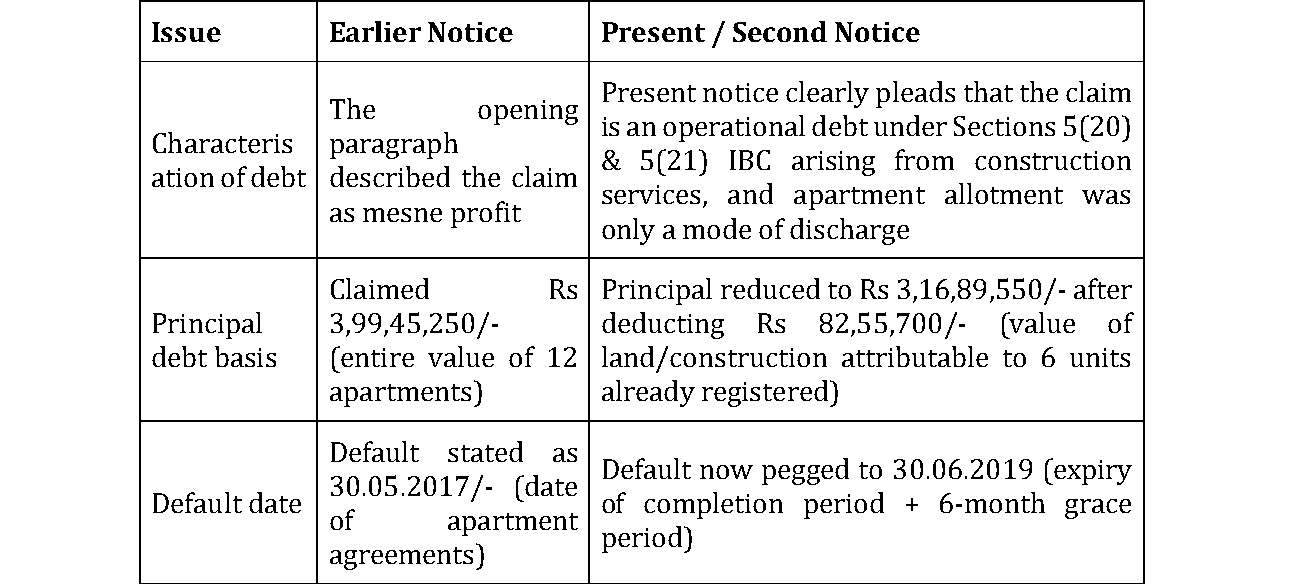
The operational creditor filed a petition under Section 9 of the IBC for initiating CIRP against the corporate debtor, claiming a total amount of Rs.8,84,30,997/- as on 31.01.2026. The claim arose from civil construction works executed by the operational creditor in the corporate debtor's project under a construction contract dated 16.04.2010. A settlement sheet dated 15.12.2015 and an agreement dated 21.01.2016 quantified the outstanding dues at Rs.5,61,53,894/-. The settlement agreement specifically terminated the original contract and provided for discharge of the liability through allotment of two villas and twelve apartments. While undivided shares of land for six apartments were registered, the corporate debtor failed to complete construction and hand over possession. The operational creditor issued two demand notices under Section 8 dated 30.12.2025 and 04.02.2026, which contained materially different particulars regarding the nature and basis of the claim. The corporate debtor contended that the original operational debt stood extinguished by novation, the claim was barred by limitation, and there existed a pre-existing dispute.
Findings of Court:
The Adjudicating Authority held that the settlement agreement dated 21.01.2016 amounted to novation under Section 62 of the Indian Contract Act, as it specifically recorded the termination of the earlier contract and the extinguishment of all previous obligations. The original operational debt lost its independent character and enforceability. The subsequent breach by the corporate debtor gives rise to remedies under the settlement agreement, not revival of the original operational debt. The issuance of two materially different demand notices indicated uncertainty in the claim and invited adverse inference. The IBC is not a debt recovery mechanism, and the petition was dismissed.
Issues: The main issues were whether the settlement agreement between the parties resulted in novation of the original construction contract, thereby extinguishing the operational debt, and whether the subsequent breach of the settlement could revive the original operational debt for the purpose of Section 9 of the IBC.
Ratio Decidendi: The court ruled that where parties enter into a settlement agreement that expressly terminates the original contract and substitutes the liability with a new arrangement, the original debt stands extinguished by novation under Section 62 of the Contract Act. The substituted arrangement creates a new jural relationship, and any subsequent breach gives rise to remedies under the new contract (specific performance, damages, recovery) rather than revival of the original debt. Such a claim cannot be enforced under the IBC as an operational debt. Additionally, issuing multiple demand notices with materially inconsistent particulars regarding the nature and amount of debt is a relevant factor against maintainability under Section 9. Result : Petition dismissed and disposed of accordingly, with no order as to costs. Order delivered on: 25.05.2026
| Table of Content |
|---|
| 1. petitioner's claim for cirp under section 9 of ibc (Para 1 , 2 , 3) |
| 2. corporate debtor's objections on petition maintainability (Para 4) |
| 3. petitioner's rebuttal of corporate debtor's objections (Para 5) |
| 4. court's analysis of facts and core legal question (Para 6 , 7 , 8 , 9 , 10 , 11 , 12) |
| 5. novation of contract under section 62 indian contract act (Para 13 , 14 , 15 , 16 , 17 , 18 , 19) |
| 6. effect of conflicting demand notices on section 9 petition (Para 20 , 21 , 22 , 23 , 24 , 25) |
| 7. dismissal of petition as misuse of ibc mechanism (Para 26 , 27 , 28 , 29 , 30 , 31 , 32) |
O R D E R
1. This petition has been filed by Kunnel Engineers and Contractors Private Limited (hereinafter referred as the ”Operational Creditor” or “Petitioner”) on 16.06.2025 under Section 9 of the Insolvency and Bankruptcy Code, 2016 (hereinafter referred to as the “Code” or “IBC”), for initiating the Corporate Insolvency Resolution Process (hereinafter referred to as “CIRP”), declaring moratorium and for appointment of Interim Resolution Professional (hereinafter referred to as “IRP”), against the Corporate Debtor M/s Nest Realties India Private Limited.
2. The total amount claimed to be in default as per Part-IV of the petition is Rs.8,84,30,997/-(Rupees Eight Crore Eighty Four Lakh Thirty Thousand Nine Hundred and Ninety Seven only) as of 31.01.2026
3. Brief facts of the case as stated in the petition are as follows: -
a) The Petitioner is a construction company engaged in infrastructure and residential projects for several decades. The Corporate Debtor had engaged the Petitioner for execution of civil construction works in its Orchid Park project at Kottayam under a Construction Contract dated 16.04.2010. Pursuant thereto, the Petitioner executed substantial works and raised running account bills, escalation claims and other contractual claims. Due to persistent non-payment by the Corporate Debtor, substantial dues accumulated between the parties.
b) Thereafter, under a Settlement Sheet dated 15.12.2015, the total value of work executed was quantified at Rs. 26,21,33,155/-, and after adjustments and deductions, the Corporate Debtor acknowledged a balance amount of Rs. 5,61,53,894/- payable to the Petitioner, which was further reaffirmed through an Agreement dated 21.01.2016. Out of the admitted dues, Rs. 1,21,23,662/- was adjusted towards two villas in another project, while the remaining liability was proposed to be settled through allotment of twelve apartments in the Orchid Park project valued at Rs. 3,99,45,250/- after the Corporate Debtor failed to discharge the dues in cash.
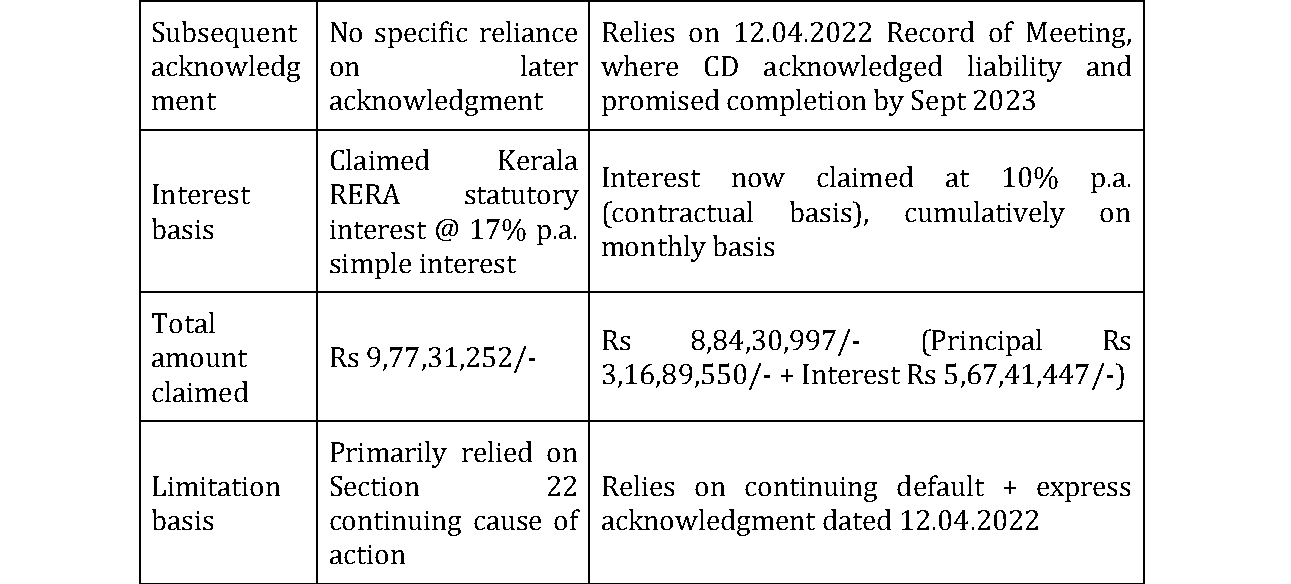
c) Pursuant to the settlement arrived at between the parties, allotment letters, agreements for sale of undivided share of land and construction agreements were executed in respect of twelve apartments in the Corporate Debtor’s project. Although the undivided share of land relating to six apartments was registered in favour of the Operational Creditor, the Corporate Debtor failed to complete the construction and hand over possession within the agreed period, resulting in failure of the settlement mechanism. After adjusting the value of the registered land and amounts already accounted for, a principal sum of Rs. 3,16,89,550/- remains due and payable. Along with contractual interest calculated at 10% per annum with monthly compounding amounting to Rs. 5,67,41,447/-, the total outstanding liability as on 31.01.2026 comes to Rs. 8,84,30,997/-.
d) The Petitioner stated that the Corporate Debtor has remained in continuous default since 30.06.2019, being the extended date fixed for completion and handover of the apartments. Subsequently, in a meeting held on 12.04.2022, the Corporate Debtor issued a written acknowledgment assuring completion by September 2023, thereby extending limitation under Section 18 of the Limitation Act, 1963. Owing to prolonged non- payment of the admitted dues, the Operational Creditor suffered severe financial distress, leading to issuance of a
Click Here to Read the rest of this document

 Back
Back















