Back
Back





2025 Supreme(Online)(NGT) 214
NATIONAL GREEN TRIBUNAL NEW DELHI (PRINCIPAL BENCH)
Hon’ble Mr. Justice Prakash Shrivastava, CJ, Hon’ble Mr. Justice Arun Kumar Tyagi, J, Hon’ble Dr. A. Senthil Vel, J
Mr. Rafhat Naeem Siddiqui – Appellant
Versus
State of Uttar Pradesh – Respondent
Original Application No. 359/2022
For the Appellants/Petitioners:
For the Respondents:Mr. Gigi. C. George, Advocate; Mr. Pradeep Misra, Advocate; Mr. Daleep Dhyani, Advocate; Mr. Rahul Khurana, Advocate; Ms. Veena Bansal, Advocate
Top-soil excavation for brick making is mining under the EIA Notification, 2006 and requires prior EC; blanket exemptions for manual digging under state rules are unconstitutional; guidance and safeguards on soil conservation and ash utilization are required, with polluter pays principles guiding relief and compensation.
Headnote:(A) Legal framework and references - EIA Notification, 2006 - Schedule I, Part A (1A) - mining of soil falls within the remit of mining and requires prior environmental clearance; Environment (Protection) Act, 1986 - regulatory regime for environmental clearances and monitoring; National Green Tribunal Act, 2010 - relief, restoration and polluter pays principles (Sections 15 and 20). - Appendix IX to the EIA Notification, 2006 (as amended) - exemptions for certain activities; Judicial and statutory cautions on blanket exemptions (noting developments in Patna High Court and Supreme Court jurisprudence cited in the order). - Uttar Pradesh Minor Mineral (Concession) Rules, 1963 (as amended 2014) and Rules, 2021 - Rule 3 - manual digging/extraction of ordinary earth/clay for bricks not to be treated as mining, with depth cap; later discussions recognize that such exemptions do not extend to the environmental clearance regime under EP Act/EC requirements. - National Green Tribunal, 2010 - judiciary’s exposure to ‘polluter pays’ principle and environmental compensation; MoEF&CC/CPCB-UPPCB directions and guidelines pertaining to brick kilns, soil conservation, fly ash utilization and related monitoring obligations. - Core issues framed by the Tribunal: (i) whether excavation of top soil for brick making amounts to mining and requires EC; (ii) whether brick kilns must procure fly ash for brick making; (iii) whether soil conservation measures are required to protect agricultural land.
Facts of the case:
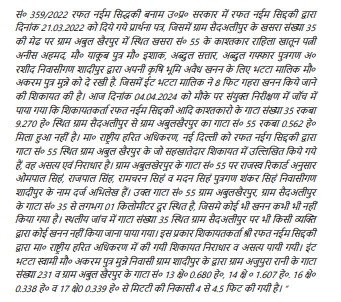
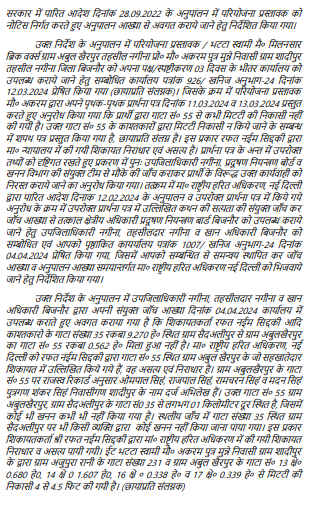
- The applicant alleged that excavation of soil by a brick kiln near his agricultural land caused damage and hindered cultivation; Joint Committee found soil excavation adjacent to the applicant’s land (Khasra Nos. 12, 15 adjacent to 35) with depths up to about 4.5 feet and noted impact on surrounding lands; the land bearing the applicant’s crops (paddy and sugarcane) faced cultivation difficulties due to soil loss. The oral proceedings and subsequent reports reflect disputes over the location and extent of excavation and responsibility for remediation; the unit claimed permissions and compliance; CTO/CTE status and non-operation periods are discussed.
Findings of Court:
- The Tribunal recognized the environmental questions involved and directed consideration of (i) whether soil excavation constitutes mining and requires EC; (ii) whether brick kilns must procure fly ash; (iii) whether measures are needed to conserve soil and restore land. - It held that excavation of soil for brick making amounts to mining under entry 1A of the Schedule to the EIA Notification, 2006 and requires prior environmental clearance (para 28). It noted that while the main activity of brick making is not listed as requiring EC, the ancillary excavation of soil falls under mining and requires EC (paras 29-30). - The Tribunal found that blanket exemptions for manual digging under UP Minor Mineral Rules (Rule 3) are arbitrary and may offend equal protection principles, since they do not specify the quantum of soil extraction nor provide restoration/compensation mechanisms (paras 25-26). - It relied on the National Green Tribunal’s statutory framework (polluter pays) to assign environmental compensation liability to responsible parties, while observing that impleadment of some polluters may be necessary for enforcement (paras 62-66). - The Tribunal directed MoEF&CC to issue an order clarifying the legal position regarding EC for soil mining by brick kilns; it directed CPCB to issue guidelines on soil conservation and restoration, and to explore fly ash utilization and related conditions in CTO/CTE approvals; it also directed UPPCB to initiate action for environmental compensation against specific entities and to ensure CTO compliance for brick kilns (paras 42-43, 74-76).
Issues: - Question No. (i): whether excavation of top soil for brick making by brick kilns amounts to mining and requires environmental clearance. - Question No. (ii): whether brick kilns are mandatorily required to procure fly ash from coal-based industries in the area for brick making. - Question No. (iii): whether measures are required to be taken for conservation of soil for agricultural purposes by prohibiting excavation of top soil for brick making.
Ratio Decidendi: - The excavation of top soil for brick making is now considered mining under entry 1A of the Schedule to the EIA Notification, 2006 and requires prior EC, as stated: "Question No. (i) is answered in the affirmative that now excavation of soil for brick making by the brick kilns amounts to mining under entry 1A of the Schedule of the EIA Notification dated 14th September, 2006 and requires prior environmental clearance." (Para 28) - The main activity of brick making itself is not enumerated in the Schedule for EC, but the accompanying soil excavation is, leading to a nuanced position that supports EC for the mining activity even if the primary activity is otherwise not listed (Paras 29-30). - Exemption provisions in state rules for manual excavation are not a shield against the EP Act/EIA regime and can be violative of equal protection principles, thereby necessitating judicial review and potential reformation (Paras 25-26). - The court affirms the polluter pays principle within the NGT framework and directs remedial action including environmental compensation and restoration, to be pursued against responsible parties in accordance with law (Paras 62-66).
Result: - The original application is disposed of with directions to: (i) MoEF&CC to issue an order clarifying EC applicability for soil mining by brick kilns; (ii) CPCB to issue soil-conservation/restoration guidelines and to consider ash-utilization directives; (iii) CPCB to assess ash utilization by brick kilns and issue requisite directions for CTO/CTE conditions; (iv) UPPCB to initiate environmental compensation actions against identified parties; (v) ensure CTO compliance and monitoring; and (vi) district authorities to enforce environmental norms and CTO requirements (Paras 74-76). Parties: - Applicant (private individual) vs State authority, Central agency(ies), district administration, and project proponent. Dissent/Concurrence: - No dissenting opinions are recorded in the judgment.
| Table of Content |
|---|
| 1. dispute origin and procedural initiation. (Para 1 , 2 , 3 , 4) |
| 2. tribunal frames issues; initiates further action. (Para 5 , 6 , 7) |
| 3. parties' responses; hearing notes; issues framed. (Para 8 , 9 , 10 , 11) |
| 4. exemption frameworks and higher court precedents on ec. (Para 12 , 13 , 14 , 15 , 16 , 17 , 18 , 19 , 20 , 21 , 22 , 23 , 24) |
| 5. arbitrariness of exemptions; mining vs. ec authority. (Para 25 , 26 , 27 , 28) |
| 6. main activity vs ancillary soil excavation; fly ash considerations. (Para 29 , 30 , 31 , 32 , 33 , 34) |
| 7. fly ash utilisation and future regulatory direction. (Para 35 , 36 , 37 , 38) |
| 8. soil conservation measures and restoration requirements. (Para 39 , 40 , 41 , 42 , 43) |
| 9. evidence of excavation; mapping and factual disputes. (Para 44 , 45 , 46) |
| 10. documentation and reporting integrity concerns. (Para 47 , 48 , 49 , 50 , 51) |
| 11. adjacent land excavations; discrepancies in land mapping. (Para 52 , 53 , 54 , 55 , 56) |
| 12. judicial critique and demand for accountability. (Para 57 , 58 , 59 , 60) |
| 13. polluter pays doctrine and environmental compensation. (Para 61 , 62 , 63 , 64 , 65) |
| 14. disposal of application; compliance directions and final orders. (Para 66 , 67 , 68 , 69 , 70 , 71 , 72 , 73 , 74 , 75 , 76) |
JUDGMENT
By Hon’ble Mr. Justice Arun Kumar Tyagi, Judicial Member
1. Mr. Rafhat Naeem Siddiqui, Advocate resident of village Ajupura Rani, Block and Tehsil Nagina, District Bijnor has sent present letter petition which has been treated and registered as original application.
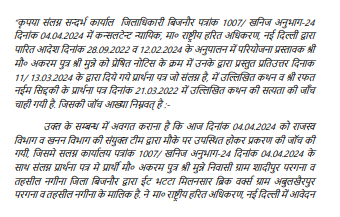
2. The applicant has submitted that the applicant and Saira Begum wife of Naimuddin and Nadeem Ahmed, residents of village Ajupura Rani, Block and Tehsil Nagina, District Bijnor are cultivating land comprised in Khasra no. 35 min situated at village Said Alipur, Block and Tehsil Nagina, District Bijnor. Khasra no. 55 situated in village Abbul Khairpur, which shares the boundary with Khasra no. 35 is being cultivated by Rahila Khatoon wife of Anees Ahmed, Maqbool Hussain son of Anees Ahmed residents of village Ajupura Rani, Block and Tehsil Nagina, District Bijnor and Mansubul Hasan son of Anees Ahmed, Mohd. Yaqub, Mohd. Ishaq and A.Sattar and A. Gaffar sons of A. Rashid and Shiv Charan Singh son of Budh and Arvind son of Bhudev Singh all residents of village Shadipur, Block and Tehsil Nagina, District Bijnor who have given the same to brick-kiln owner Mohd. Akram son of Munne for mining. Mohd. Akram has mined soil upto the depth of 8 feet with JCB. Illegal mining has been done in land measuring 1‰ meters wide, 25 meters long and 08 feet deep abutting Khasra no. 35 min on the eastern side. Due to mining beyond permissible limits, land comprised in Khasra no. 35 min has become uncultivable and the applicant is facing difficulties in cultivating paddy and sugarcane crops despite filling of sand to reclaim the same.
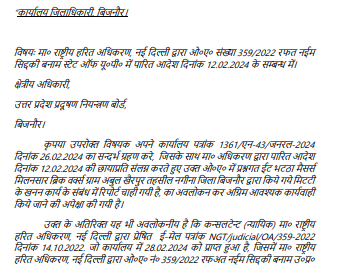
3. Vide order dated 23rd May, 2022 this Tribunal constituted a Joint Committee comprising of the Uttar Pradesh Pollution Control Board (UPPCB) and District Magistrate, Bijnor and directed the Joint Committee to look into the grievances of the applicant and take requisite action by following due process of law and file factual and action taken report particularly with reference to loss of top soil from agricultural field, ambient air quality, impact on flora and fauna and compliance with directions in order dated 17th February, 2021 passed by this Tribunal in O.A. No. 1016/2019 titled as Utkarsh Panwar Vs. Central Pollution Control Board and others within two months.
4. In compliance thereof, report of the Joint Committee was filed vide email dated 25th August, 2022. The relevant part of the report of the Joint Committee (at Pages 3 to 18 of the paper book) reads as under:- “X X X X X
2. Action taken by the Joint Committee:
In compliance of Hon’ble NGT order dated 23/05/2022 a Joint Committee was constituted by District Magistrate, District Bijnor vide office order No.-384/N-43/General-2022 dated 08-07-2022 (annexed as Annexure-1),