Back
Back





2025 Supreme(Online)(NGT) 1735
NATIONAL GREEN TRIBUNAL BHOPAL (CENTRAL ZONE BENCH)
MR. SHEO KUMAR SINGH, J, DR. AFROZ AHMAD, ACJ
Mr. Rashid Noor Khan – Appellant
Versus
Indore Municipal Corporation – Respondent
Original Application No. 57/2024(CZ)
For the Appellants/Petitioners: Mr. Harshwardhan Tiwari, Adv.
For the Respondents: Mr. Prashant M. Harne, Adv., Mr. Mehul Bhardwaj, Adv., Mr. Yadvendra Yadav, Adv., Ms. Parul Bhadoria, Adv., Mr. Sajeev Kumar Sharma, Adv.
The court emphasized the necessity of regulatory compliance in environmental protection, particularly regarding Ramsar sites, reiterating the Public Trust Doctrine and the State's responsibility to ensure access to clean water as a fundamental right.
Headnote:(A) Environment (Protection) Act, 1986 - Wetland (Conservation & Management) Rules, 2017 - Encroachment and permanent construction over the Sirpur Wetland, a Ramsar site, by Indore Municipal Corporation violating legal provisions due to construction within Full Tank Level (FTL) and without proper scientific study - Constructions adversely affecting ecology, natural hydrology and biodiversity of the area. (Paras 1, 6, 10)
(B) The concept of Public Trust Doctrine as it applies to wetland conservation and the responsibility of the State to protect and manage natural resources and prevent pollution. (Para 70)
(C) The statutory obligation under Article 21 of the Constitution for access to clean water and the right to a healthy environment consistent with legal standards. (Paras 60, 66)
Facts of the case:
This application pertains to the construction activities by a local corporate body on a designated Ramsar site, claiming compliance with environmental legislation. Respondent authorities failed to act against these violations despite being notified. The applicant raised concerns regarding the adverse environmental impacts of these constructions.
Findings of Court:
The court directed compliance with established environmental rules, removal of encroachments, and assertive measures for maintaining the ecological integrity of the wetland.
Issues: The court addressed issues of illegal construction within FTL, non-compliance with wetland management rules, and the need for sustainable sewage management around the Sirpur Wetland.
Ratio Decidendi: The court reaffirmed the binding obligations of local bodies to uphold environmental laws and the necessity of sustainable practices for the preservation of natural habitats, emphasizing preventive measures to avert pollution and protect water ecosystems.
Result: The court ordered the removal of encroachments and directed the concerned authorities to strictly enforce environmental laws regarding the wetland. The original application was disposed of with recommended actions for compliance.
| Table of Content |
|---|
| 1. encroachment on ramsar wetland violates environmental laws. (Para 1 , 4 , 5) |
| 2. the court ordered a committee for site assessment and reporting. (Para 3 , 7 , 9 , 10) |
| 3. municipal corporation's duty to manage sewage for ecosystem health. (Para 11 , 18 , 20 , 21) |
| 4. importance of etps/stps in controlling water pollution. (Para 12 , 13 , 14 , 15) |
| 5. directives issued for protecting wetlands and managing environment. (Para 106 , 107 , 112 , 114) |
JUDGMENT
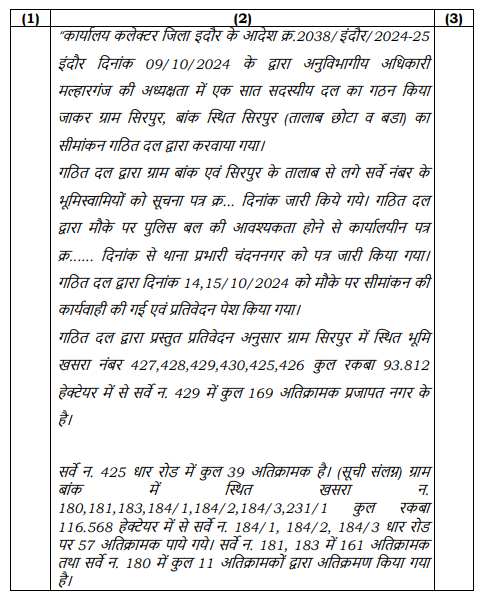
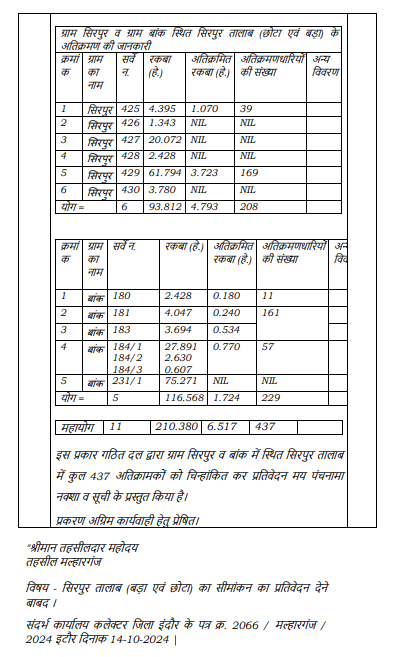
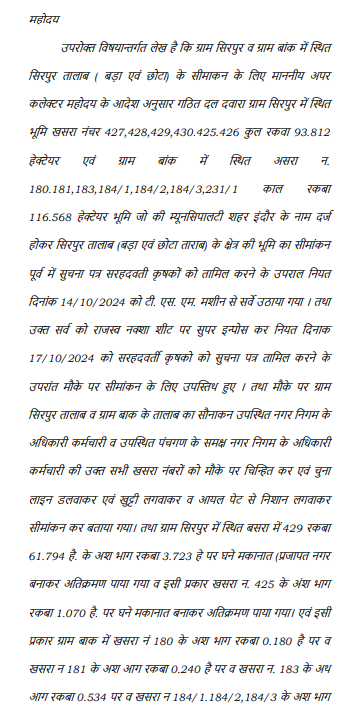
1. Issue raised in this application is encroachment and permanent construction over the Sirpur Wetland, a Ramur site, Indore (M.P.) by the Indore Municipal Corporation, in violation of provisions of Environment (Protection) Act, 1986 and Wetland (Conservation & Management) Rules, 2017. The Sirpur Wetland is recognized as a Ramsar site on August 3, 2022. The said construction comes under the Full Tank Level (FTL) and the construction is taking place within 50 meters of FTL level. For the said construction at first the concrete wall is raised and thereafter the concrete pillars are raised which are adversely affecting the Wetland site and its, ecology and bio-diversity. Such constructions over the wetland site will also disturb the flood water, Rain water drains, natural valleys, buffer area, agriculture etc. which will be severely affected. It will also affect the natural sloing matter and natural hydrology of the area. A letter was addressed to the competent authorities/respondents but no action has been taken by the respondents. Thus, the present application.
2. The matter was taken up by this Tribunal on 14.03.2024 and a committee consisting representative of the Collector, Indore, State Wetland Authority, Environment Planning and Coordination Organization, M.P. and State Pollution Control Board, M.P., was constituted with direction to submit the factual and action taken report.
3. Notices were also issued to the respondents to submit their reply. Reply by the respondent has been filed. Report of the Joint Committee, action taken report by the State PCB and the report by the Indore Municipal Corporation with additional documents filed by the applicant are on record. Heard the Learned Counsel for the parties and perused the record.
4. Submission of the learned counsel for the applicant are that Sirpur Lake was created by the Holkars of Indore State in the early 20th century. The potential of the lake as a significant bird habitat was recognized by the Holkars of Indore. It is a home to many avian species and attracts migratory birds, including ruddy shelduck, which migrates from Mongolia and Siberia for wintering at Sirpur. A total of around 130 species are listed in the book, The Birds of Sirpur, which has been increased to 189 species of birds, belonging to 55 families. The lake was recognized by Bird Life International as one of the 19 important bird areas (IBAs) of Madhya Pradesh in 2015. The total area of the lake and its surrounding protected region is 800 acres (around 3.6 square kilometers) and falls under the jurisdiction of the Indore by 2022 Municipal Corporation. The wetland has been designated as a Ramsar site under the Ramsar Convention in 2022.
5. The Sirpur Wetland is a National Heritage of International Importance as it is also a Ramsar site under the Ramsar Convention International Treaty for the Conservation and Sustainable Use of Wetlands which intends to preserve wetlands and advance sustainable utilization of its natural resources and Lake is surrounded by farms and forests and was situated away from the hustle and bustle of the city. Sirpur Lake gets its water from three channels, of which Sukhniwas Lake (now in the premises and custody of the RR Centre for Advanced Technology) is the prominent one. Sirpur Lake is inhabited by 189 species of birds, belonging to 55 families. It is arguably one of the only remaining birdwatching sites where water birds can be recorded within city limits. The urban lake and wetland are also home to several specie