Back
Back





2025 Supreme(Online)(Pat) 1345
PATNA HIGH COURT
HONOURABLE MR. CHANDRA SHEKHAR JHA, J
AMITABH KUMAR – Appellant
Versus
THE STATE OF BIHAR THROUGH ECONOMIC OFFENCE UNIT, PATNA BIHAR – Respondent
CRIMINAL MISCELLANEOUS No.49461 of 2023 | Special Case No. 353 of 2017 | EOU P.S. Case No. 17 of 2017
For the Appellants/Petitioners: Mr. Y.V. Giri, Sr. Adv, Mr. Hemant Kumar, Adv, Mrs. Shristi Singh, Adv
For the Respondents: Mr. Vishwanath Pd. Sinha, APP, Mr. Rana Vikram Singh, Adv
Exoneration in departmental proceedings does not abort subsequent criminal investigations filed on similar corruption charges; the differing standards of proof essential for criminal liability prevail.
Headnote:(A) Prevention of Corruption Act, 1988 - Section 13(1)(e) - Nature of proceedings - Criminal proceedings related to corruption charges not necessarily reliant on outcome of departmental proceedings, particularly when exoneration lacks consideration of relevant evidence - A case established under FIR regarding disproportionate assets against the petitioner during a specified check period. (Paras 3, 9, 23, 39)
(B) Standard of proof - Distinction between the standards of proof in departmental inquiries versus criminal proceedings established, emphasizing higher standards required in criminal contexts compared to the preponderance of probabilities applicable in departmental investigations. (Paras 25, 31)
(C) Authority of findings - Prior findings in departmental investigations not binding on subsequent criminal prosecutions - Legal principles affirming this necessity discussed. (Paras 25, 39)
Facts of the case:
The petitioner was a Motor Vehicle Inspector accused of amassing disproportionate assets exceeding legitimate income over a check period, resulting in an FIR and subsequent trial.
Findings of Court:
The court found that the departmental inquiries did not adequately consider all evidential materials and therefore upheld the continuance of criminal proceedings despite the prior exoneration of the petitioner.
Issues: The main issues included the sufficiency of departmental exoneration as grounds to quash subsequent criminal proceedings and the implications of differing standards of proof.
Ratio Decidendi: The court ruled that exoneration in departmental proceedings does not automatically negate criminal proceedings, particularly where significant evidentiary disparities exist between the two proceedings, emphasizing that the standards of proof differ.
Result: Quashing petition dismissed.
| Table of Content |
|---|
| 1. presentation of case and background facts. (Para 1 , 2 , 3) |
| 2. arguments by petitioner highlighting flaws in prosecution. (Para 4 , 5 , 6 , 7 , 8 , 9 , 10 , 11 , 12) |
| 3. arguments by e.o.u. regarding basis for arrest. (Para 13 , 14 , 15 , 16 , 17 , 18) |
| 4. counterarguments and case law regarding the validity of prosecution. (Para 19 , 20 , 21 , 22) |
| 5. judicial determination of issues surrounding exoneration. (Para 23 , 24 , 25 , 26 , 27 , 28 , 29 , 30 , 31 , 32 , 34) |
| 6. analysis of departmental proceedings concerning criminal prosecution. (Para 35 , 36 , 37 , 38) |
| 7. final decision on the petition for quashing. (Para 39 , 40 , 41) |
CAV JUDGMENT
Date : 14-07-2025
Heard learned senior counsel for the petitioner and learned counsel for the respondents.
2. The present petition has been preferred under Section 482 of the Code of Criminal Procedure (in short Cr.P.C.) to quash the order dated 17.03.2023 passed in Special Case No. 353 of 2017, arising out of EOU P.S. Case No. 17 of 2017, where learned Special Judge Vigilance, Patna, took cognizance for the offence punishable under Section 13 (1)(e) of the Prevention of Corruption Act, 1988 .
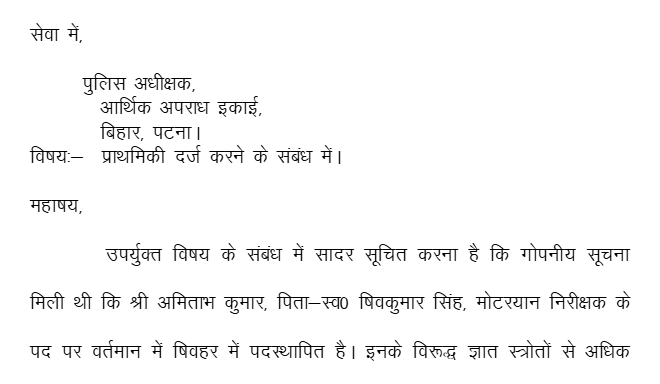
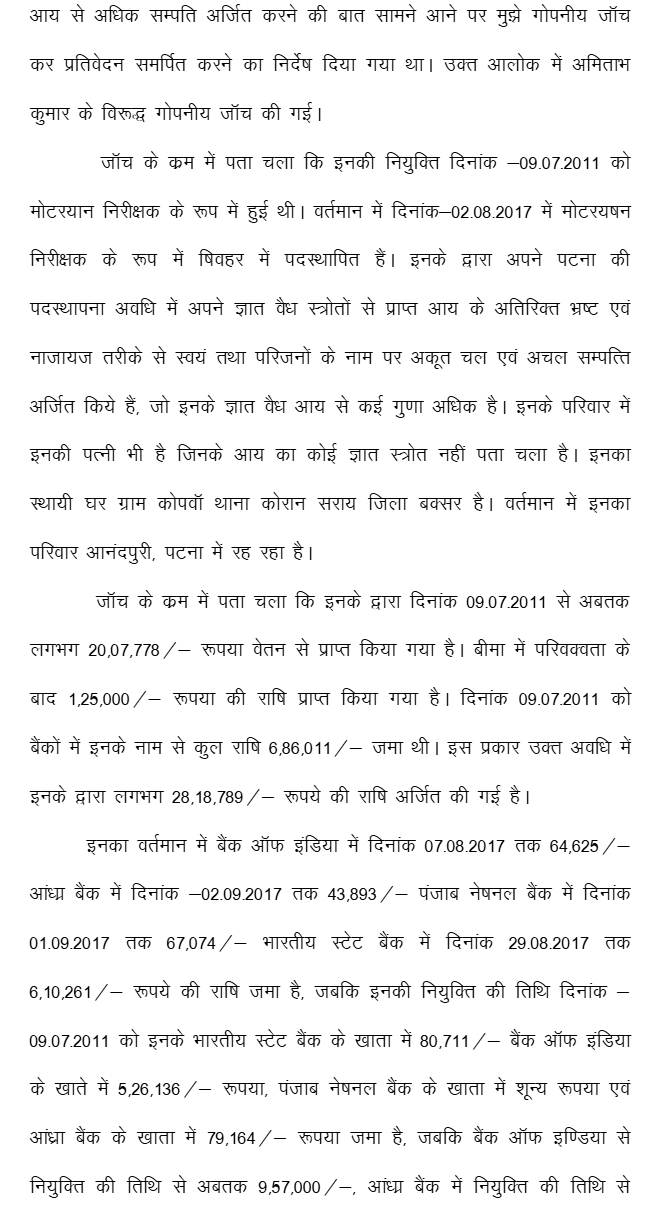
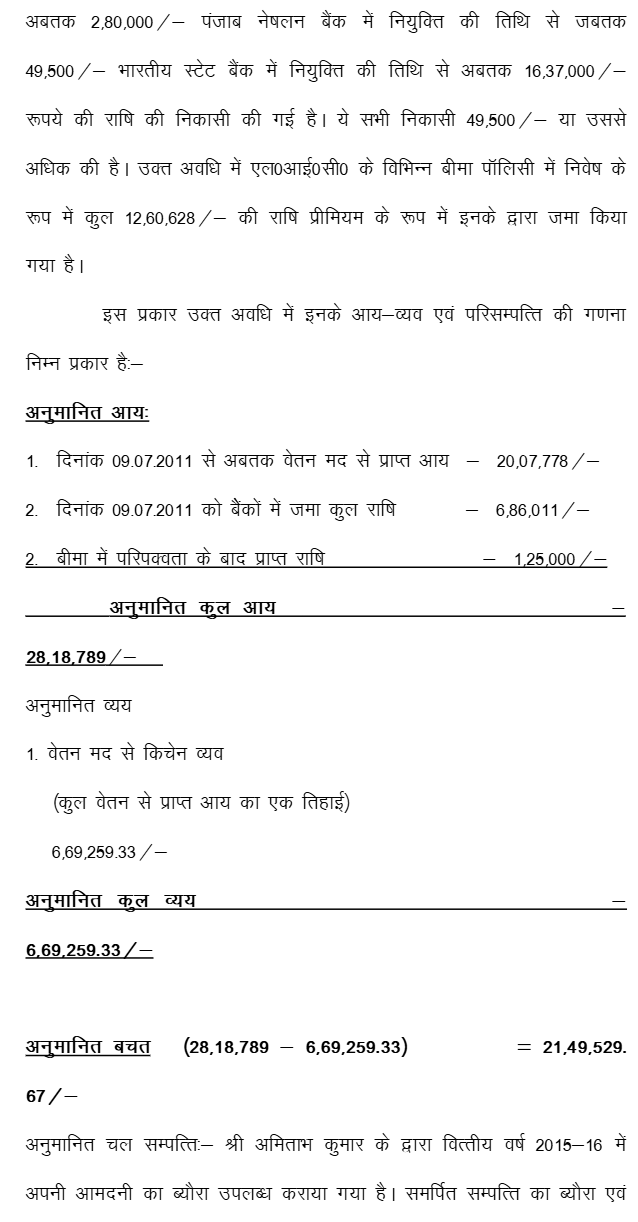
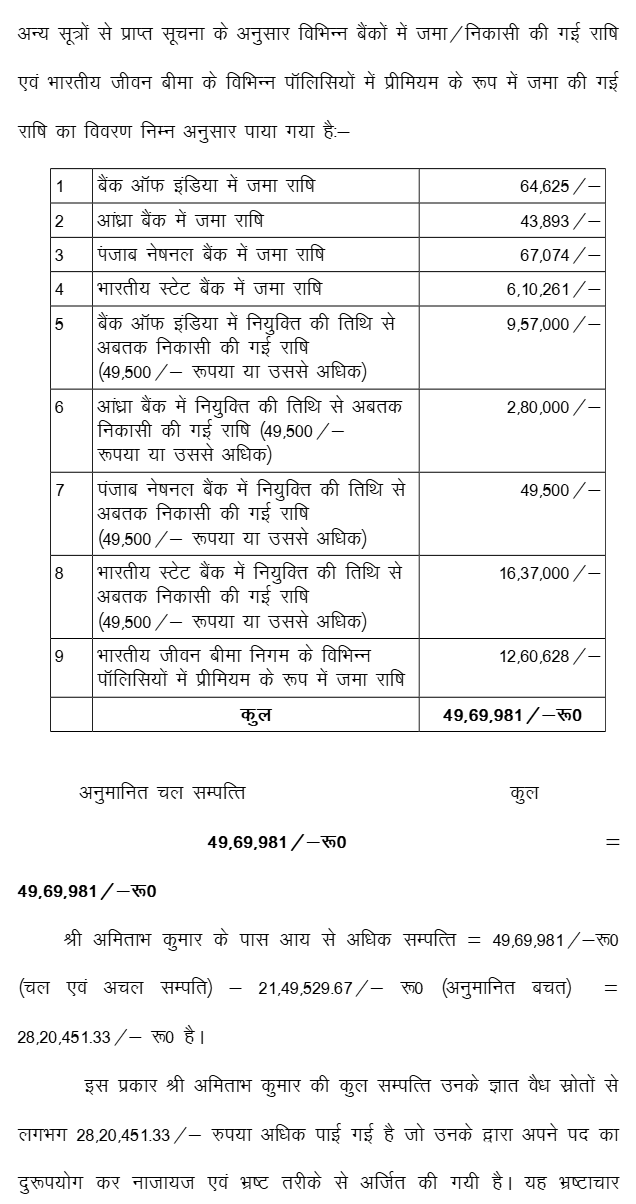
3. The prosecution story as it appears from the written report of Dy.S.P cum Investigating Officer, Economic Offence Unit, Patna, is that upon secret information received by the informant, it came to light that petitioner Amitabh Kumar, who is at present a Motor Vehicle Inspector (in short MVI) and posted at Shoehar, has embezzled huge amounts of money and assets illegally by misusing his post and power, when he was posted as MVI in Patna. The investigating period (check period) of this case is from 09.07.2011 to 17.11.2017. It is further alleged that, during the course of prima-facie investigation, the informant discovered that the total legitimate income of the petitioner, Amitabh Kumar, amounted to Rs. 28,18,789/-, whereas his total expenditure was assessed at Rs. 6,69,259/-. It has also been alleged in the FIR that the cumulative value of his movable and immovable assets stood at Rs. 49,69,981/-. It was further alleged in the FIR that during the tenure of his services from 09.07.2011 to 17.11.2017, he was involved in illegal means and practices to acquire assets disproportionately to their valid sources of income to the tune of Rs. 28,20,451/-. Consequently, the present case was instituted.
Argument on behalf of petitioner
4. Mr. Y.V. Giri, learned senior counsel, appearing on behalf of the petitioner submitted that the prosecution filed the FIR without conducting any preliminary inquiry, and if the Economic Offences Unit (EOU) had conducted such an inquiry, it would have been evident that no Disproportionate Assets (DA) case was made out against the petitioner. It is also submitted that the FIR appears to be lodged falsely to justify the prosecution's actions and to shield their misconduct, resulting in charge-sheet submission without material evidence. It is also submitted that the petitioner was unnecessarily implicated, and the investigation was not conducted properly. The Investigating Officer (I.O.) ignored several key facts that would have established the petitioner’s innocence. It is submitted that income from valid sources, including the petitioner’s and his wife’s earnings, was also not adequately considered.
5. Mr. Giri, further submitted that I.O. incorrectly calculated the petitioner’s income as only Rs. 33,15,293/-, whereas the petitioner had earned Rs. 46,10,409/- from salary, rental, and agricultural sources, as evident from his income tax returns. Similarly, the I.O. deliberately excluded the documented income of the petitioner’s wife. It is further submitted that the prosecution wrongly considered household goods and ancestral ornaments from the petitioner’s house as self-acquired property. However, no immovable property was acquired by the petitioner or his wife during the check period, and all assets were ancestral and jointly held by family. It is submitted that the pe