
 Back
Back





IN THE HIGH COURT OF JUDICATURE FOR RAJASTHAN AT JODHPUR
Bipin Gupta, Munnuri Laxman, JJ
Rodu Lal S/o Shri Devi Lal Dangi – Appellant
Versus
The State Of Rajasthan – Respondent
D.B. Civil Writ Petition No. 11737/2024
Certainly. Based on the provided legal document, here are the key legal points:
The court has held that exclusion of contractual employees appointed through placement agencies from the scope of the Rajasthan Contractual Hiring to Civil Posts Rules, 2022, violates the principle of equality under Article 14 of the Constitution, as it discriminates based on the mode of appointment rather than the nature of the job or duties performed (!) (!) .
The Rules of 2022 are intended as welfare legislation aimed at regulating contractual employment engaged for specific schemes or projects. The primary objective is to bring unregulated contractual employment under a formal regulatory framework, regardless of whether the appointment was made directly by the government or through a placement agency, provided the appointment meets certain conditions (!) (!) .
The essential conditions for coverage under Rule 3 of the Rules of 2022 include: the post must be created by the Administrative Department with the concurrence of the Finance Department; the appointment must be made after inviting applications through a public advertisement; and the individual must be working on a contract basis at the commencement of these rules (!) (!) .
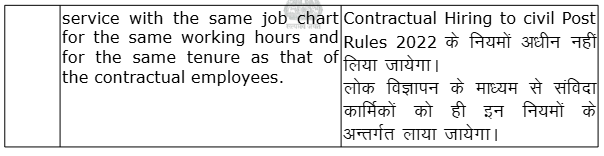
The court emphasizes that the mode of appointment—whether through direct government action or via a placement agency—should not be a basis for discrimination if the appointment fulfills the criteria outlined in Rule 3. When these conditions are met, contractual employees appointed through placement agencies are entitled to the benefits under the Rules (!) (!) .
The interpretation of Rule 3 should be harmonious, meaning that employees appointed through placement agencies after complying with the stipulated conditions, including public advertisement, are to be included within the scope of the Rules (!) .
The court has directed that individual cases of contractual employees appointed prior to the enforcement of Rules 2022 should be considered on a case-by-case basis. If their appointment aligns with the conditions specified in Rule 3, they should be extended the benefits of the Rules (!) (!) .
The Rules are meant to regulate existing contractual employment and do not create a right to regularization. The appointment orders are contractual and do not confer any claim for regularization or permanent status (!) (!) .
The legislation aims at preventing back-door employment practices and ensuring fair employment opportunities, transparency, and equality among contractual employees, whether appointed directly or through agencies, as long as the conditions of the Rules are fulfilled (!) (!) .
The court’s overall stance is that any discriminatory interpretation or application of the Rules that excludes employees fulfilling the prescribed conditions undermines the legislative intent and violates constitutional principles of equality (!) (!) .
The decision underscores that the employment of contractual personnel under welfare schemes should be transparent, fair, and equitable, aligning with principles of justice and the constitutional mandate for equality (!) (!) .
Would you like a summary of the legal implications or assistance in drafting a legal opinion based on these points?
Order
Reserved on 05/08/2025
Pronounced on 26/08/2025
Per Mr. Bipin Gupta, J:
1. By way of these writ petitions, a common issue has been raised by the petitioners, therefore, with the consent of all the parties, all the petitions are heard together and are being disposed of by this common order.
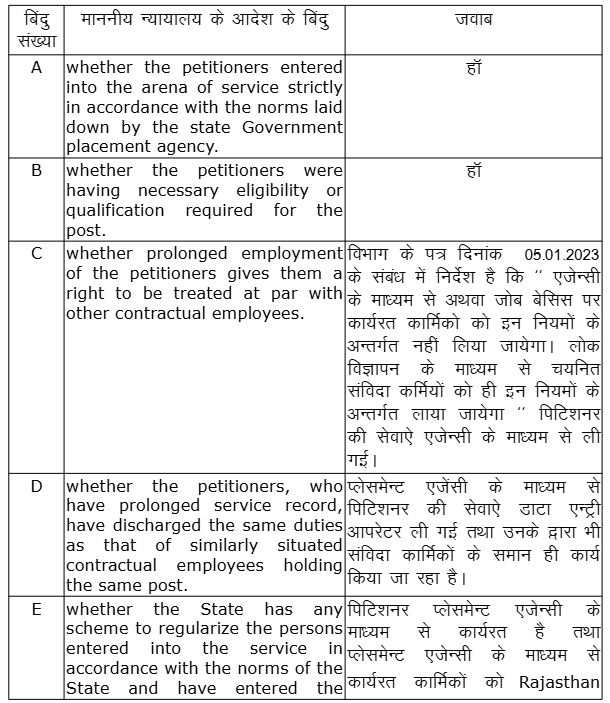
2. Brief facts as stated in a bunch of writ petitions being led by D.B. Civil Writ Petition No.11737/2024 are that the petitioners are individuals who joined the services as “Data Entry Operator/ Computer Operator” through placement agencies under the Mahatma Gandhi National Rural Employment Guarantee Act Scheme (hereinafter referred to as ‘MGNREGA Scheme’) against posts created under schemes by Administrative Department with the concurrence of Finance Department. The respondent State thereafter promulgated the law governing the contractual employees in order to regulate the services and thus for the said purpose, a notification was issued on 11.01.2022, whereby, the rules namely Rajasthan Contractual Hiring to Civil Posts Rules, 2022 (hereinafter referred to as the ‘Rules of 2022’) were promulgated.
3. The case of the petitioners, at the outset, is that having been appointed on contractual basis under government schemes, the petitioners must be declared as covered under the Rules of 2022 by harmoniously reading Rule 3 of the Rules of 2022 or in alternate, Rule 3 of the Rules of 2022 may be declared as ultra vires as being violative of the principle of equality enshrined under Article 14 of the Constitution of India . The respondent Authorities have arbitrarily and without any intelligible differentia has discriminated between the contractual employees working under schemes having been appointed through two different modes, i.e., one by the Government directly on contractual basis and another through placement agency, on contractual basis.
4. Learned counsel for the petitioners submitted that the mode of appointment cannot be a ground to deny benefit of the Rules of 2022 as framed by the respondents. Counsel further submitted that the petitioners carry out the same nature of work and duties therefore they are at parity with the contractual employees who have been working under the scheme on contractual basis employed directly through the Government.
5. Learned counsel for the petitioners further submit that as per Rule 3 of the Rules of 2022, per se there is no distinction between the employees appointed on contractual basis either through a placement agency or directly through Government. Further, the said Rule provides that the same shall be applicable only to the posts created by the Administrative Department with the concurrence of the Finance Department and that the selection to the said posts ought to have been made on the contractual basis only after inviting applications through public advertisement. Learned counsel for the petitioners thus submitted that the petitioners have been selected and appointed to the posts created by the Administrative Department with the concurrence of Finance Department and the said selection was duly made by way of inviting applications through public advertisement. Therefore, the petitioners are covered under Rule 3 of the Rules of 2022.
6. Learned counsel for the petitioners, in the alternate, submitted that if the petitioners are found not covered under the ambit of Rule 3 of the Rules of 2022, and the said benefits are only applicable to the individuals who have been selected by the Government directly through public advertisement and not to those who have been appointed through any inter-mediate employer, i.e. a placement agency, then in that circumstances, Rule 3 of the Rules of 2022 may be declared as ultra vires and violative of Article 14 of the Constitution of India and against the objectives laid down in the Preamble to the Rules of 2022.
7. Learned counsel for the petitioners while referring to the Preamble to the Rules of 2022 submitted that the Departmental Schemes/Projects/Central Sponsor



An indispensable Tool for Legal Professionals, Endorsed by Various High Court and Judicial Officers
Please visit our Training & Support
Center or Contact Us for assistance

Scan Me!
India’s Legal research and Law Firm App, Download now!


For Daily Legal Updates, Join us on :



 Back to top


