
 Back
Back





HIGH COURT OF RAJASTHAN - RAJASTHAN HIGH COURT PRINCIPAL SEAT JODHPUR
RAMCHANDRA SINGH JHALA, J
Mahendra Kumar Kochar – Appellant
Versus
Surendra Kumar Kochar – Respondent
Civil First Appeal No. 436 / 2007
Judgment
28/02/2018
The instant first appeal has been filed by the appellant-defendant against the judgment and decree dated 25.1.2007 passed by the Court of Additional District and Sessions Judge, Fast Track No.3, Bikaner (hereinafter referred to as ‘the learned court below’) in Civil Original Suit No.253/2005 whereby the learned court below passed a preliminary decree of partition in favour of respondent-plaintiff.
Brief facts of the case are that the respondent-plaintiff filed a suit for partition of his residential house situated at Kochran Chowk, Bikaner. The respondent-plaintiff stated in the plaint that the said residential house is a property of joint ownership of parties, which was purchased by them through a registered sale deed dated 18.6.1979 in consideration of Rs.48000/-. In the North side of the said house, a bara of Chhagan Lal Kochar, South side house of Moolchand Kochar and in the East side a room of Rikhab Chand Kochar and in West side of the said plot a lane are situated. It was stated that after purchasing the said house both the parties have repaired and maintained the house while bearing the expenditure jointly. It was stated that since the appellant- defendant was the elder brother, therefore, the original sale deed was kept by him on the consent of the respondent-plaintiff. It was further averred that on personal bonafide necessity, the respondent-plaintiff requested the appellant-defendant for partition of the property but in vain. It was stated that in this regard a notice dated 7.4.2003 was also sent to the appellant- defendant but the appellant-defendant specifically refused to do so on 21.4.2003. The respondent-plaintiff prayed that a decree of partition of the suit property may be passed and exclusive possession of the half share of the property be ordered to be given to him.
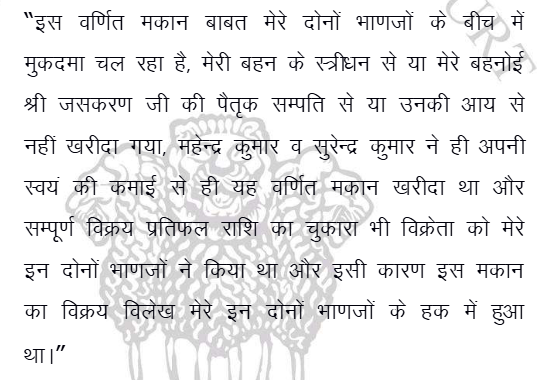
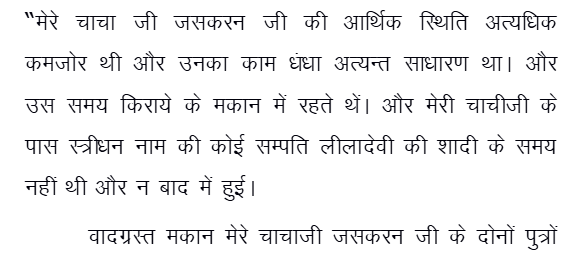
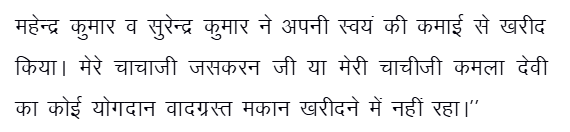
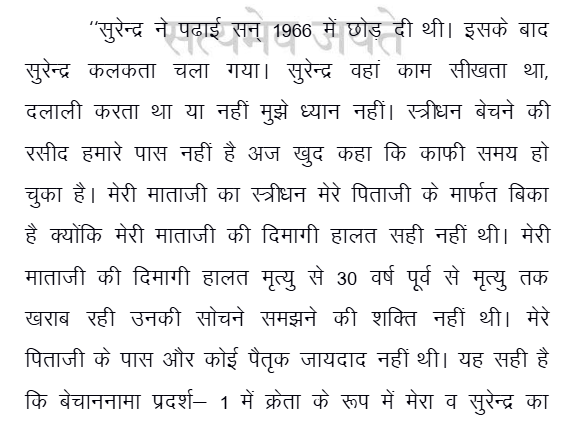
The appellant-defendant filed written statement and denied all the contents of the plaint. It was stated that the property in question was purchased by his father Shri Jaskaran Kochar out of the money received after selling “Stridhan” of his mother as well as by taking some lone to purchase the property. It was stated that the property was purchased by Shri Jaskaran Kochar who was the Karta of the Joint Hindu Family and the property was also purchased for use and occupation of the members of the joint Hindu family. It was stated that the respondent-plaintiff had no means to purchase the said property at that time. It was stated that as a matter of fact, with the view to keep harmony in the family Shri Jaskaran got entered the name of respondent-plaintiff in the sale deed. It was stated that apart from the parties to the suit, there are three sons and six daughters of Shri Jaskaran and, therefore, all the heirs are having 1/11 share in the property and, therefore, the property cannot be partitioned.
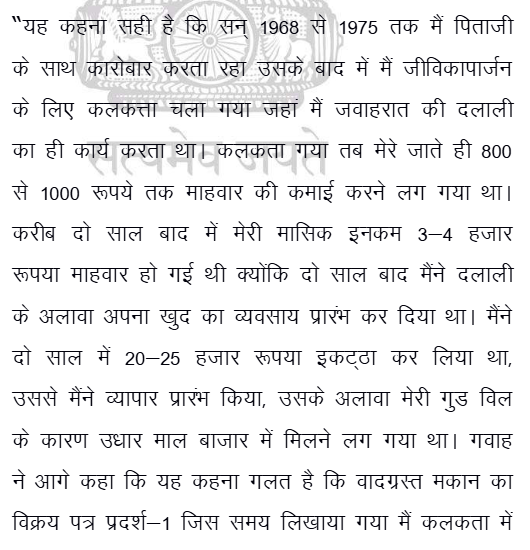
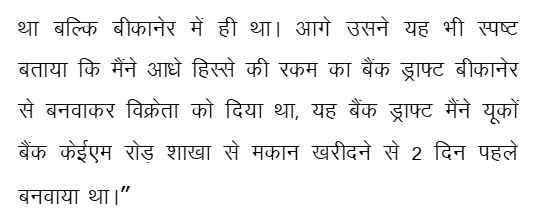
In rejoinder, the respondent-plaintiff submitted his additional plea. It was stated that the “Stridhan” of his mother was sold by his father Shri Jaskaran long back. It was stated that after completing his studies in the year 1968, the respondent- plaintiff started supporting the business activities of his father and thereafter, in the year 1976, he went to Calcutta for business. It was stated that he never remained unemployed after completion of his studies and, therefore, he had sufficient means to pay the consideration of the property. It was stated that the other siblings were having no interest and right in the property and, therefore, they are not necessary party to the suit.
On the basis of pleadings of the parties, the learned court below framed the following issues:-
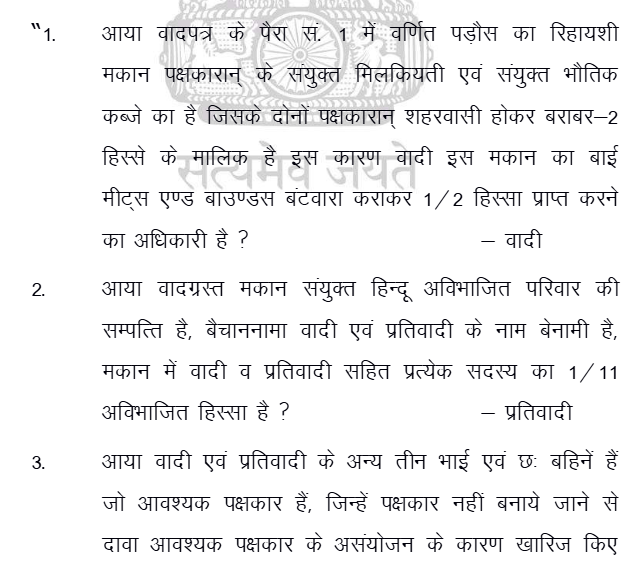
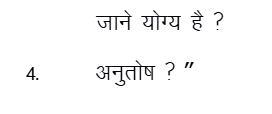
The learned court below decided the issue No.1 in favour of respondent-plaintiff and issues No.2 and 3 against the appellant-defendant and passed a decree on dated 25.1.2007 in favour of respondent-plaintiff holding that respondent-plaintiff is entitled to half share of the property in question and directed the commissioner to make a report of partition of the suit



An indispensable Tool for Legal Professionals, Endorsed by Various High Court and Judicial Officers
Please visit our Training & Support
Center or Contact Us for assistance

Scan Me!
India’s Legal research and Law Firm App, Download now!


For Daily Legal Updates, Join us on :



 Back to top


