Back
Back





2025 Supreme(Online)(SCDRC) 6995
STATE CONSUMER DISPUTES REDRESSAL COMMISSION
Mr. Justice Ajai Kumar Srivastava, CJ, Mrs. Sudha Upadhyay, J
Smt. Kasturi Devi – Appellant
Versus
Sri Ram Life Insurance Co. and another – Respondent
First Appeal No. SC/9/A/431/2023
For the Appellants/Petitioners: Smt. Kasturi Devi
For the Respondents: Sri Ram Life Insurance Co. and another
Timely filing of appeals is essential; adequate justification for delay is discretionary and must be demonstrated.
Headnote:Relevant laws under the Consumer Protection Act mandate timely filing of appeals and revisions. The appellant's failure to adequately explain the delay of days is at issue. The court emphasizes examining diligence and bona fides; thus, condonation of delay is at the court's discretion (Paragraphs 9, 12). The core issue entails the justification for delay in filing special appeals, where the need for sufficient cause has been scrutinized, affirming that each case must demonstrate a justified claim for delay to proceed (Paragraphs 9, 12). Consequently, as insufficient cause was exhibited, the appeal is dismissed.
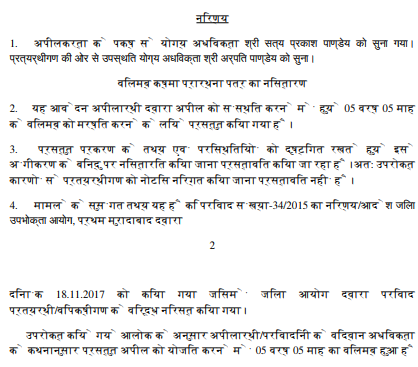
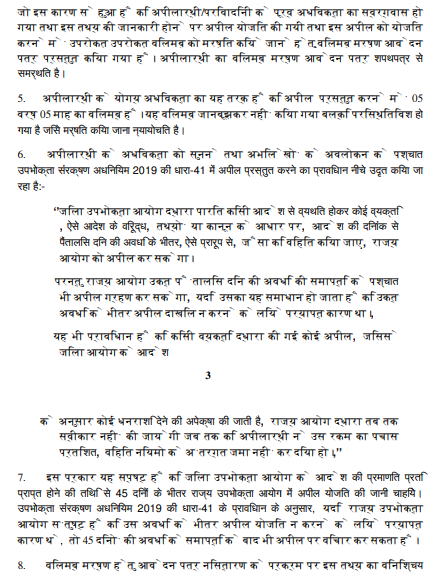

We hold that in each and every case the Court has to examine " whether delay in filing the special appeal leave petitions stands properly explained. This is the basic test which needs to be applied. The true guide is whether the petitioner has acted with reasonable diligence in the prosecution of his appeal/petition."

while deciding the application filed, for condonation of delay, the " Court has to keep in mind that the special periods of limitation have been prescribed under the Consumer Protection Act , for filing appeals and revisions in consumer matters and that the object of expeditions adjudication of the consumer disputes will get defeated, if the highly belated appeals and revision petitions are entertained".
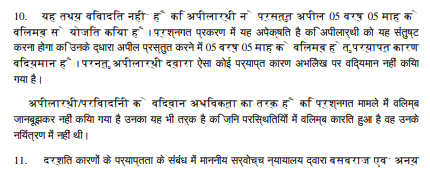

"9. Sufficient cause is the cause for which Defendant could not be blamed for his absence. The meaning of the word "sufficient" is "adequate" or "enough"... inasmuch as may be necessary to answer the purpose intended. Therefore, the word"sufficient" embraces no more than that which provides a platitude, which when the act done suffices to accomplish the purpose intended in the facts and circumstances existing in a case, duly examined from the view point of a reasonable standard of a cautious man. In this context, "sufficient cause" means that the party should not have acted in a negligent manner or there was a want of bona fide on its part in view of the facts and circumstances of a case or it cannot be alleged that the party has "not acted diligently" or "remained inactive". However, the facts and circumstances of each case must afford sufficient ground to enable the court concerned to exercise discretion for the reason that whenever the Court exercises discretion, it has to be exercised judiciously. The applicant must satisfy the Court that he was prevented by any "sufficient cause" from prosecuting his case, and unless a satisfactory application is furnished, the court should not allow the application for condonation of delay. The court has to examine whether the mistake is bona fide or was merely a device to cover an ulterior purpose."

"12......... we are not satisfied with the cause shown to justify the delay of days. Day to day delay has not been explained. 590/601 Hon'ble Supreme Court in a recent judgment of Anshul Aggawal vs. New Okhla Industrial Development Authority , IV ( CPJ 2011) 63 ( SC) has held that while deciding the application filed for condonation of delay, the Court has to keep in mind that special period of limitation has been prescribed under the Consumer Protection Act, , for filing appeals and revisions in consumer 1986 matters and the object of expeditious adjudication of the consumer disputes, will get defeated if the appeals and revisions, which are highly belated are entertained."
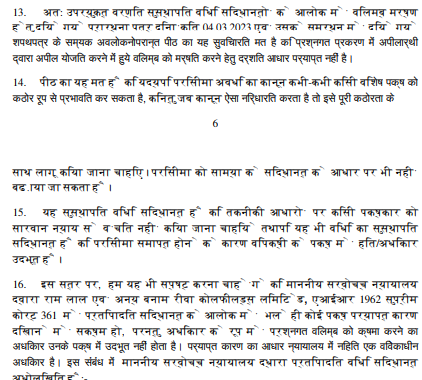
It is, however, necessary to emphasize that even after " sufficient cause has been shown a party is not entitled to the condonation of delay in question as a matter of right. The proof of a sufficient cause is a discretionary jurisdiction vested in the Court by S5. If sufficient cause is not proved nothing further has to be done; the application for condonation has to be dismissed on that ground alone. If sufficient cause is shown then the Court has to enquire whether in its discretion it should condone the delay. This aspect of the matter naturally introduces the consideration of all relevant facts and it is at this stage that diligence of the party or its bona fides may fall for consideration; but the scope of the enquiry while exercising the discretionary power after sufficient cause is shown would naturally be limited only to such facts as the Court may regard as relevant."