
 Back
Back





HIGH COURT OF SIKKIM
Bhaskar Raj Pradhan, J
National Insurance Company Limited – Appellant
Versus
Dhanesh Gupta – Respondent
MAC App. No. 03 of 2025
| Table of Content |
|---|
| 1. establishing liability for rash and negligent driving in motor accident claims. (Para 1 , 2 , 3 , 4 , 5 , 6 , 7 , 8) |
| 2. calculation of pecuniary damages, specifically regarding functional disability and loss of future earnings. (Para 9 , 10 , 12 , 13 , 14 , 15 , 16 , 17 , 18 , 19 , 20 , 21 , 22 , 23 , 24 , 25 , 26 , 27 , 42 , 44) |
| 3. assessment of just compensation under non-pecuniary heads and overall award determination. (Para 11 , 28 , 29 , 30 , 31 , 32 , 33 , 34 , 35 , 36 , 37 , 38 , 39 , 40 , 41 , 43 , 45 , 46) |
JUDGMENT
Bhaskar Raj Pradhan, J.
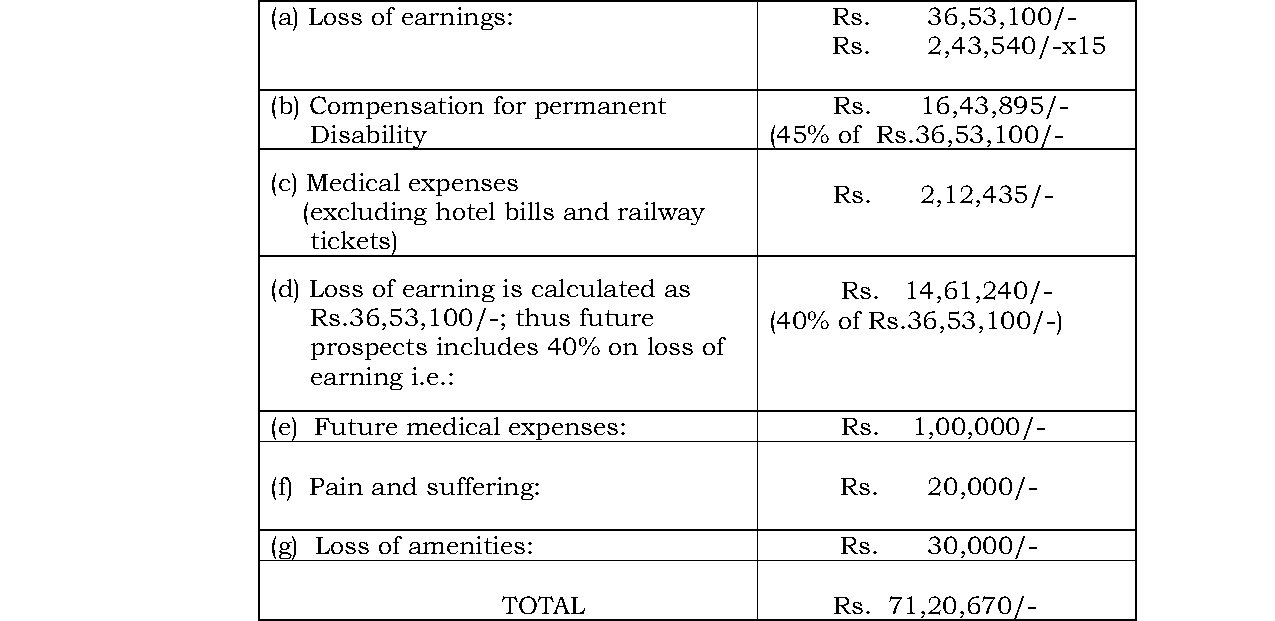
1. The National Insurance Company Limited (the appellants) is aggrieved by the award of Rs.71,20,670/- dated 27.03.2024 granted in favour of the respondent no.1 (the claimant) by the Motor Accident Claims Tribunal (the learned Tribunal).
2. The respondent no.2 is the owner of the vehicle which met with an accident.
3. The learned Tribunal has concluded that the accident occured on 19.04.2016; the driver died on the spot; the claimant sustained injuries and was evacuated to Bahadurganj Hospital after which he underwent medical treatment in Siliguri, West Bengal. The claimant was examined and a disability certificate (exhibit-17) was issued certifying that he had sufferred 45% permanent physical impairment.
Rash and negligent driving
4. The learned Tribunal did not accept the contention of the appellants that their authorised investigator had found out that the accident occured when the driver was trying to save the vehicle from colliding with the rods on the bridge and as such rash and negligent driving was not proved since the authorised investigator was not examined.
5. Under section 166 of the Motor Vehicles Act, 1988 (the MV Act) it was incumbent upon the learned Tribunal to conclusively opine that the accident occured due to the rash and negligent act of the driver. The learned Tribunal however, did not give any conclusive opinion as to whether the accident occured due to rash and negligent driving of the deceased driver or not.
6. Admittedly, the deceased driver died on the spot at the time of the accident. It is noticed that the First Information Report (FIR) (exhibit-1) was filed against the deceased driver alleging that the driver was driving the vehicle fast and negligently. It is also noticed that pursuant to the FIR registered against the deceased driver, criminal investigation followed and a final report (exhibit-2) was submitted alleging that the deceased driver (as an accused person) had driven the vehicle fast thereby causing the accident. Accordingly, charge-sheet no. 83/16 dated 30.04.2016 was submitted under section 279/337/338/304 (A) of the Indian Penal Code, 1860 (the IPC) against the deceased driver. Thereafter, the investigation was closed. This Court is unable to understand how an FIR was lodged, investigation conducted and charge-sheet filed against a dead man. This Court therefore, excludes the FIR as well as the charge- sheet from consideration.
7. The claim application asserted that the cause of accident was due to rash and negligent driving on the part of the deceased driver. As the claimant was the only person amongst the witnesses who was physically present at the time of the accident his evidence is of relevance. Although the appellants denied the assertion of the claimant the respondent no.2 did not do so. The claimant in his evidence on affidavit reiterated that the accident was caused due to rash and negligent driving of the deceased driver. This assertion of the claimant could not be demolished during his cross-examination. As such the claimant has been able to prove that the accident occured due to negligence of the deceased driver.
8. The learned Tribunal has concluded that the insurance policy (exhibit-5) and the driving license (exhibit-3) of the deceased driver were valid and proved. The appellants have not contested the fact that the insurance policy (exhibit-5) covers the accident. Therefore, this Court shall examine only the issues th



An indispensable Tool for Legal Professionals, Endorsed by Various High Court and Judicial Officers
Please visit our Training & Support
Center or Contact Us for assistance

Scan Me!
India’s Legal research and Law Firm App, Download now!


For Daily Legal Updates, Join us on :



 Back to top


