
 Back
Back





HIGH COURT OF SIKKIM
Meenakshi Madan Rai, J
Chandra Maya Sunwar – Appellant
Versus
Geeta Mukhia – Respondent
MAC App. No.10 of 2024
| Table of Content |
|---|
| 1. nature of claim petitions under the motor vehicles act. (Para 1 , 2 , 3 , 4 , 6) |
| 2. analysis of section 163a, 164, and 166 applicability and the doctrine of res ipsa loquitur. (Para 7) |
| 3. recalculation of just compensation based on established income, future prospects, and multiplier method. (Para 8 , 9 , 10 , 11 , 12 , 13 , 14) |
JUDGMENT (ORAL)
Meenakshi Madan Rai, J.
1. The instant Appeal arises out of the grievance of the Claimant/Appellant, on account of the Learned Motor Accidents Claims Tribunal, Gangtok, Sikkim (hereinafter, “MACT”), disposing of the matter as one under Section 163A of the Motor Vehicles Act, 1988 (hereinafter, the “MV Act”), instead of Section 166 of the MV Act, while contrarily granting compensation of ₹ 5,00,000/- to the Appellant/Claimant under Section 164 of the MV Act (as amended in 2019).
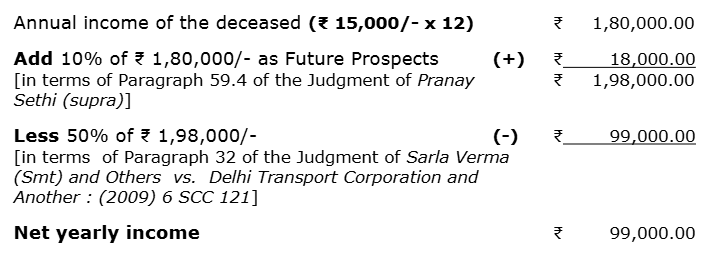
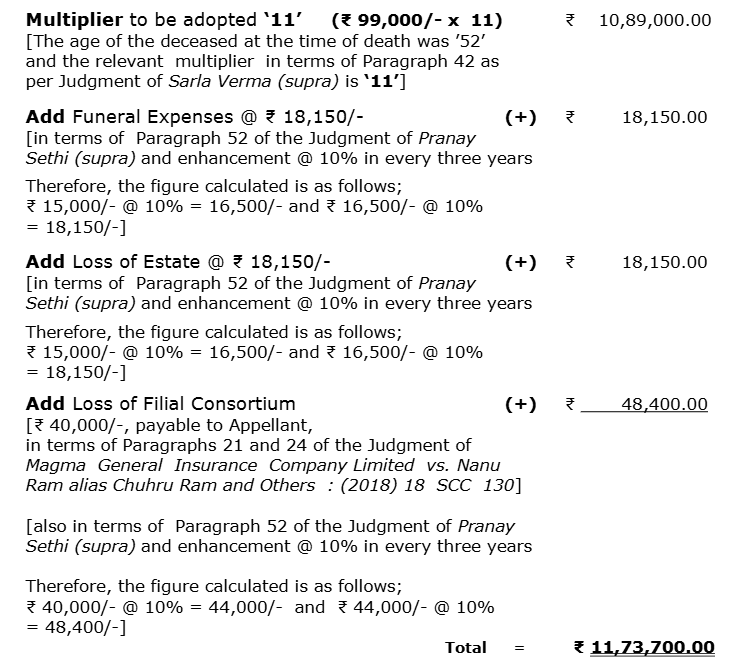
2. Learned Counsel for the Appellant, opening his arguments, contended that, not only was the Learned MACT in error in disposing of the Petition as mentioned above but also in observing erroneously in the impugned Judgment that, as compensation under Section 163A of the MV Act, would be much less than that under Section 164 of the Amended Act, hence the latter provision was being invoked as favourable to the Claimant. Compensation of ₹ 5,00,000/- (Rupees five lakhs) only, was accordingly granted. Admitting the error committed by the Appellant in filing the Application, before the Learned MACT, by inadvertently mentioning the provision in the Petition as “Section 166A” of the MV Act, instead of Section 166 as provided by the Act, it was urged by Learned Counsel for the Appellant that, the Learned MACT ought to have taken into consideration that a Petition under Section 163A of the MV Act would not be countenanced if the income of the deceased was above ₹ 40,000/- (Rupees forty thousand) only, per annum, as in the instant case, where the deceased was earning ₹ 15,000/- (Rupees fifteen thousand) only, per month, and thereby much above ₹ 40,000/- (Rupees forty thousand) only, per annum. The responses/written objection, of the Respondents also makes it evident that they considered the Claim Petition to be one under Section 166 of the MV Act and not under Section 163A of the MV Act. That, the error committed by the Learned MACT, Gangtok, Sikkim, may be rectified by setting aside the impugned Judgment, dated 27-02-2024, in MACT Case No.34 of 2022 and compensation may be granted to the Appellant in terms of Section 166 of the MV Act computed at ₹ 23,55,000/- (Rupees twenty three lakhs and fifty five thousand) only.
3. Learned Counsel for the Respondent No.1, the owner of the vehicle in accident, while conceding that, the Claim Petition is indeed one under Section 166 of the MV Act and not under Section 163A of the MV Act, in view of the projected income per annum of the deceased, added that, all documents pertaining to the vehicle, including the Insurance Policy Exbt-12, were valid and effective at the time of the accident and were furnished before the Learned MACT. In the given circumstance, the Respondent No.2 had the responsibility of indemnifying the Appellant.
4. Learned Counsel for the Respondent No.2, while also conceding on the same grounds as Respondent No.1 that, the Claim Petition was one under Section 166 of the MV Act, however contended that, the age of the deceased was mentioned as forty-six years in the Claim Petition, when in fact all documents pertaining to the deceased, establish that, he was aged fifty-two at the time of the accident. That, the Claimant failed to file any documentary evidence to indicate that, the deceased, prior to his death was earning ₹ 15,000/- (Rupees fifteen thousand) only, per month. That, the salary certificate Exbt 7, submitted by the Claimant, was issued only after the fatality in the accident, and therefore deserves to be disregarded as unreliable. That, as per the Sikkim Government Gazette No.440, dated 15-09-2017, the wages of the deceased may be computed at ₹ 3



An indispensable Tool for Legal Professionals, Endorsed by Various High Court and Judicial Officers
Please visit our Training & Support
Center or Contact Us for assistance

Scan Me!
India’s Legal research and Law Firm App, Download now!


For Daily Legal Updates, Join us on :



 Back to top


