Back
Back





2018 Supreme(Online)(Tel) 4374
IN THE HIGH COURT FOR THE STATE OF TELANGANA AT HYDERABAD
SURESH KUMAR KAIT, N. BALAYOGI, JJ
Nawab Mir Barkat Ali Khan Waleshan Bahadur, Prince Mukkaram Jah Bahadur, H.E.H. The Nizam VIII of Hyderabad rep. by his Special Power of Attorney Holder Mir Hasan Ali – Appellant
Versus
Princess Manolya Jah – Respondent
F.C.A.Nos. 99 OF 2006 AND 131 OF 2006
For the Appellants/Petitioners: Sri D.Prakash Reddy, Sri R.Raghunandan, Sri C.Tulasi Krishna, Sri C.V. Mohan Reddy, Sri C.Sumon
For the Respondents: Sri Ch.Pushyam Kiran, Sri D.Prakash Reddy, Sri R.Raghunandan, Sri C.Tulasi Krishna
The Family Court may receive documents without adherence to strict evidentiary rules, acknowledged pre-existing rights, and enforce maintenance obligations despite registration issues.
Headnote:(A) Family Courts Act, 1984 - Section 19(1) - Admissibility of documents - Family court's power to receive documents not strictly adhering to evidentiary standards is acknowledged, allowing consideration of agreements without registration. The court considered Exs.A.5 to A.8 in light of pre-existing rights acknowledged by the defendant, ruling that no enforceable rights were created by those documents relating to payment obligations and property transfers, notably under the Muslim Women (Protection of Rights on Divorce) Act, 1986 and customary marital agreements. (Paras 20, 72, 90)
(B) Maintenance - The court upheld the first plaintiff's entitlement to maintenance and rejected claims of impermissible document evidence arising from non-fulfillment of stamp duties for agreements executed during marriage, confirming monthly maintenance to the plaintiff and their daughter. The court ruled findings are legal and valid exempt from strict evidence rules laid by the Indian Evidence Act. (Paras 73, 92)
(C) Court's findings on admissibility of evidence show thorough analysis of parties' rights concerning dower, maintenance arrangements, and property claims, emphasizing the role of family courts in family disputes. (Paras 86, 90)
| Table of Content |
|---|
| 1. overview of case details and appeals (Para 1 , 2) |
| 2. key grounding of appeals by parties (Para 3 , 4 , 5) |
| 3. family court's issue framing (Para 6 , 8 , 9) |
| 4. arguments concerning admissibility and registration (Para 10 , 11 , 12) |
| 5. relevant facts regarding divorce and financial agreements (Para 16 , 18) |
| 6. court's discretion on document's admissibility (Para 70 , 73 , 90) |
| 7. final conclusion and orders of the court (Para 92 , 93) |
COMMON JUDGMENT:
(per Hon’ble Sri Justice N. Balayogi)
1. Inasmuch as both these appeals arise out of one and the same judgment and decree, and parties being same, they are heard together and being disposed of by this common judgment:
F.C.A.No.99 OF 2006:
2. The appellant/defendant being aggrieved by the judgment and decree dated 23.06.2006 passed in O.S.No.52 of 1996 by the learned Judge, Family Court, City Civil Courts, at Hyderabad preferred this appeal under Section 19(1) of the Family Courts Act , 1984 on the grounds that:
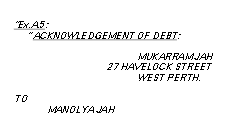
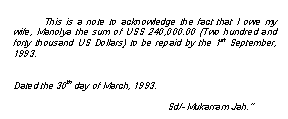
(a) the judgment and decree of the Family Court is contrary to law, weight of evidence and probabilities of the case; that the Family Court erred in partly decreeing the suit O.S.No.52 of 1996 based on Exs.A.5 to A.8 without considering the objections of the appellant with regard to the admissibility and enforceability of the documents as required under Section 49 of the Registration Act and that Exs.A.7 and A.8 are required to be stamped in accordance with the relevant entries in Schedule 1-A of the Indian Stamp Act and compulsorily registerable under Section 17 of the Indian Registration Act .
(b) The Family Court erred in altering the issue as to “whether the Agreements dated 9.7.1992 (Ex.A.7) and 18.11.1994 (Ex.A.8) are true, valid and binding on the defendant” from the issue originally framed as to “Whether the said agreements are valid in law and are enforceable ?”. The Family Court erred in holding that the said documents were admissible in evidence under Section 14 of the Family Courts Act , 1984 without recognizing that Section 14 of the Family Courts Act ,1984 only permitted a departure from the ordinary rules of the Indian Evidence Act , 1872 and not from the mandatory and peremptory provisions respectively of the Indian Stamp Act , 1899 and the Indian Registration Act , 1908.
(c) It is contended that Exs.A.5 and A.6 constitute security bonds if not promissory notes and a charge was created in Ex.A.6 over immovable property over the value of Rs.100/- and hence they are improperly stamped and are inadmissible in evidence.
(d) The Family Court erred in considering the appellant’s objection that Exs.A.7 and A.8 are not based upon any consideration and are void, being contrary to Section 25 of the Indian Contract Act. Ex.A.7 contemplates gifts for future which are void under Islamic/Mohammedian law and are unenforceable and are required to be registerable under Section 123 of the Transfer of Property Act .
(e) It is further contended that Exs.A.7 and A.8 were never meant to be acted upon. Ex.A.7 dated 9.7.1992 was during the subsistence of marriage and Ex.A.8 dated 18.11.1994 was before the divorce became final. Therefore it was only a form of security agreed to by the appellant and was not meant to be acted upon. Further Exs.A.7 and 8 are contingent in nature and have become unenforceable in view of the settlement of jewellery and valuables made by the appellant in favour of the first defendant at the time of divorce.
(f) The Family Court completely ignored Ex.B.4 declaration under which the appellant categorically stated that Exs.A.7 and A.8 documents were never meant to be acted upon and were at any rate withdrawn and cancelled.
(g) The judgments cited by the appellant on inadmissibility of the documents constituting Exs.A.5 to A.8 were not considered by the Family Court.
(h) The recitals of the agreements do not entitle the respondents for any perpetual injunction on the suit schedule property and the agreements themselves do not confer any such right or authorit