Back
Back





2024 MarsdenLR 1853
HIGH COURT MALAYA KUALA LUMPUR
JOHAN LEE KIEN HOW, J
CHEW CHENG SANG – Appellant
Versus
SUMBER BARISAN DEVELOPMENT SDN BHD & ANOR – Respondent
[Civil Suit No: WA-22NCvC-516-07-2019]
The court upheld the validity of the consultancy agreement and letters of undertaking, ruling that dishonoured cheques constituted an admission of debt and did not involve illegal moneylending.
Headnote:(A) Companies Act 2016 - Sections 10(1), 20, and 64 - Contracts Act 1950 - Validity and enforceability of consultancy agreement and undertaking letters - The court found that the consultancy agreement was valid and enforceable, and the plaintiff had fulfilled his obligations under it. The defendant's claims of illegality and lack of consideration were rejected, and the dishonoured cheques constituted admission of indebtedness. (Paras 34, 118, 120)
(B) Moneylenders Act - The court ruled that the undertaking letters did not constitute illegal moneylending and were valid contracts, dismissing the defendant's arguments regarding the applicability of the Moneylenders Act. (Paras 96, 119)
Facts of the case:
The plaintiff entered into a consultancy agreement with the defendant company, which later issued two letters of undertaking guaranteeing payments. The plaintiff claimed unpaid amounts due to dishonoured cheques issued by the defendant. (Paras 1-14)
Findings of Court:
The court found the consultancy agreement and letters of undertaking valid and enforceable, with the defendant liable for the amounts due. (Paras 34, 118)
Issues: The main issues were the validity of the consultancy agreement, the enforceability of the undertaking letters, and the implications of dishonoured cheques. (Paras 34, 118)
Ratio Decidendi: The court held that the consultancy agreement was valid and that the defendant's claims of illegality were unfounded. The dishonoured cheques provided a cause of action for the plaintiff. (Paras 34, 120)
Result: Plaintiff's claims allowed; defendant's counterclaim dismissed.
JUDGMENT
Introduction
[1] This is an action ("this suit") brought by Mr Chew Cheng Sang ("the plaintiff") to recover certain sum of money promised by Sumber Barisan Development Sdn Bhd ("the first defendant"). The first defendant is acompany involved in the construction and development sector. In 2011, the plaintiff was one of the two directors of the first defendant. The total number of directors increased to five in 2014 (inclusive of the plaintiff).
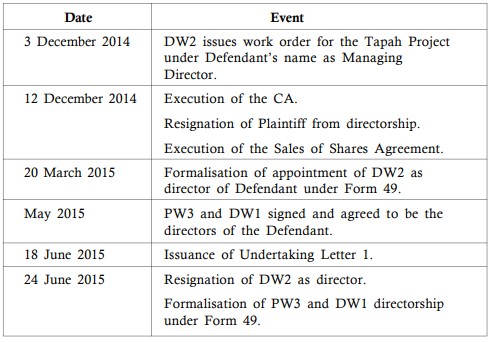
[2] As in the course of business and in life, nothing can be considered constant and permanent. The plaintiff and the other four directors entered into a sales of shares agreement dated 12 December 2014 ("the SSA") to dispose of the plaintiff's shares in the first defendant. However, this second set of shareholders were unable to fulfil the terms of the SSA. Hence, the reigns of the first defendant were handed over to two other individuals including the second defendant.
[3] Prior to the change of owners, the first defendant was involved in two projects (collectively, "the projects") to develop two properties in Perak:
(i) a residential development at Lot 1622, Mukim Bidor, Daerah Batang, Perak ("the Bidor project"); and
(ii) a commercial and residential development at Lot 407, Mukim Batang, Daerah Batang Padang, Perak ("the Tapah project").
[4] These two development projects played pivotal roles in the first defendant's history and become umbilical cords attached to the plaintiff that eventually became the core of the dispute in this suit.
The Dispute
[5] As part of the SSA's terms and conditions, the first defendant was to enter into a consultancy agreement with the plaintiff. The agreement was to employ the plaintiff's expertise and utilise his skills in the property development industry to oversee the completion of the projects. This consultancy agreement ("the CA ") was entered into by the parties on the same day of the SSA namely 12 December 2014. It was signed by one Shukhen Dutt and one Loke Siew Fun on behalf of the first defendant. Both signatories were part of the second set of shareholders of the first defendant.
[6] The first defendant through the CA had agreed to pay the plaintiff RM500,000.00 by way of transfer of one unit of single-storey semi-detached house located within either the Bidor project or the Tapah project. It was agreed that in the event the value of the property is less than RM500,000.00, the shortfall would be paid in cash.
[7] However, the second set of shareholders were unable to fulfil the conditions set out in the CA . After further discussions, the third set of owners took over the management and shareholding of the first defendant in 2015.
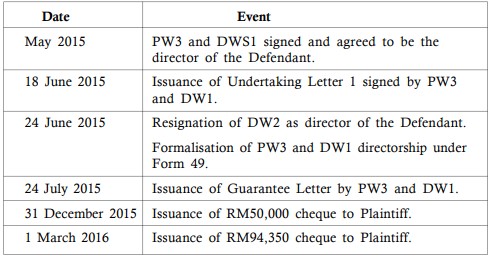
[8] After the transfer of shareholding from the second set to the third set of shareholders, two letters of undertaking (collectively, "LUs") were issued by the first defendant under the hand of the third set of shareholders to the plaintiff:
(i) the first undertaking letter dated 18 June 2015 ("undertaking letter 1") had guaranteed the payment of, among others:
(a) a sum of RM50,000.00 before 20 July 2015 without interest;
(b) another sum of RM50,000.00 before 20 August 2015 without interest;
(c) a sum of RM94,350.00 before 20 November 2015 without interest as contra payment of one semi-detached property; and
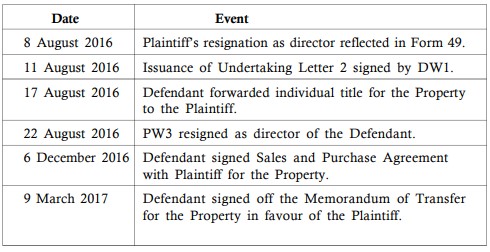
(ii) the second undertaking letter dated 11 August 2016 ("undertaking letter 2") had guaranteed payment of, among others:
(a) a sum of RM158,450.00 calculated from moneys owed in undertaking letter 1 with the breakdown of RM93,450.00 plus RM50,000.00 and RM15,000.00; and
(b) the payments would be paid in four instalments: RM28,450.00 (on or before 10 September 2016), RM40,000.00 (on or before 10 October 2016), RM40,000.00 (on or before 10 November 2016), and RM50,000.00 (on or before 10 December 2016).
(iii) under both LUs, the transfer of one 3,955 square feet semi-detached property known as Lot No 18, Jalan Ixora, Taman Ixora, 35400 Tapah, Perak ("the property") was agreed to be the property to