Back
Back





2026 MarsdenLR 1829
HIGH COURT MALAYA JOHOR BAHRU
NORADURA HAMZAH, JC
MUHAMMAD ALIFF IKHMAL JEFFRY – Appellant
Versus
PENGARAH HOSPITAL KOTA TINGGI JOHOR BAHRU & ORS – Respondent
[Civil Suit No: JA-21NCvC-5-02/2021]
A defendant cannot raise an unpleaded defence of res judicata in closing submissions. Furthermore, separate tortfeasors are not protected by prior settlements between the plaintiff and other parties, and a defendant cannot use the consequences of its own failure to provide protocol-mandated rehabilitation to diminish damages for prosthetic support.
Headnote:(A) Rules of Court 2012 - Order 18 Rule 8(1) - Medical negligence - Quantum of damages - Res judicata and estoppel - The principle of pleading; party seeking to rely on estoppel must specifically plead facts giving rise to it - Failure to plead an affirmative defence in pleadings creates a fatal procedural irregularity. (Paras 14, 15)
(B) Civil Law Act 1956 - Section 10 - Apportionment of liability - Double recovery - Principle against double recovery does not operate as a blanket bar to a subsequent action for distinct causes of action arising from different tortious acts, provided that compensation already received for overlapping heads of damage is deducted. (Paras 16, 17, 23)
(C) Medical Negligence - Assessment of damages - Prosthetic devices - Where the failure to adapt to a prosthetic limb is a direct result of the lack of mandatory, standard-protocol rehabilitation care, a defendant may not rely on the plaintiff's non-adaptation to minimize the quantum of damages for a more appropriate device. (Paras 49, 52, 54)
Facts of the case:
A plaintiff initiated a claim for medical negligence after suffering a limb amputation due to a failure to diagnose and treat a vascular injury. The defendants sought to invoke the principle of res judicata, arguing that a prior settlement regarding the accident that caused the initial injury acted as a bar to the present medical negligence claim. Evidence further showed that the plaintiff was not referred to critical follow-up rehabilitation following the amputation, which impacted the plaintiff's ability to utilize prosthetic technology.
Findings of Court:
The court held that the defendants' failure to plead res judicata in their defence prevented them from raising it at the stage of closing submissions. Furthermore, the court found the doctrine inapplicable as the parties and causes of action were distinct. The court awarded damages for pain and suffering based on the current judicial trend and allowed the cost of a high-tech prosthetic system, holding that the institution's failure to provide rehab could not be used to justify a lower-tier device for the plaintiff.
Issues: Whether a prior consent judgment in an accident claim acts as a bar to a subsequent medical negligence claim against different parties; whether an unpleaded defence can be raised in closing submissions; and the appropriate quantum of damages for a young amputee, specifically regarding prosthetic selection.
Ratio Decidendi: The court affirmed that parties are strictly bound by their pleadings and cannot introduce unpleaded defences late in proceedings. On the merits, distinct torts involving different parties do not trigger cause of action estoppel. Damages for medical negligence must be assessed based on established trends, and a defendant cannot rely on the consequences of its own systemic negligence (failure to rehabilitate) to limit the quality of assistive devices provided to the plaintiff.
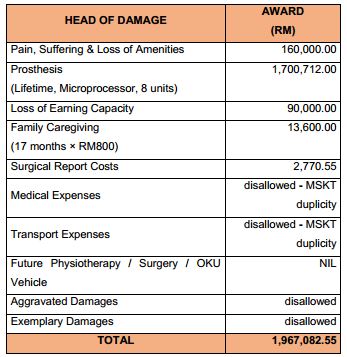
Result: Judgment for the plaintiff in the sum of RM1,967,082.55.
| Table of Content |
|---|
| 1. factual history of medical negligence and amputation. (Para 1 , 2 , 3 , 4 , 5 , 6 , 7 , 8 , 9 , 10) |
| 2. res judicata and estoppel in successive tort claims. (Para 11 , 12 , 13 , 14 , 15 , 16 , 17 , 18 , 19 , 20 , 21 , 22 , 23) |
| 3. assessment of general damages for limb loss. (Para 24 , 25 , 26 , 27 , 28 , 29 , 30 , 31 , 32 , 33 , 34 , 35 , 36 , 37 , 38 , 39 , 40 , 41) |
| 4. liability for prosthetic costs despite rehabilitation failures. (Para 42 , 43 , 44 , 45 , 46 , 47 , 48 , 49 , 50 , 51 , 52 , 53 , 54 , 55 , 56 , 57 , 58) |
| 5. compensation for loss of earning capacity. (Para 59 , 60 , 61 , 62 , 63 , 64 , 65) |
| 6. mitigation of special damages via prior settlements. (Para 66 , 67 , 68 , 69 , 70 , 71 , 72) |
| 7. threshold for aggravated and exemplary damages. (Para 73 , 74 , 75 , 76 , 77 , 78) |
| 8. final calculation of damages and litigation costs. (Para 79 , 80) |
JUDGMENT
Introduction
[1] This is a civil action for damages arising from medical negligence. Liability has been admitted by the defendants. The sole matter for the court's determination is the quantum of damages to be awarded to the plaintiff.
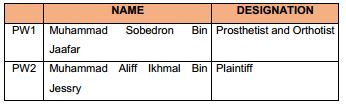
[2] The trial began on 23 September 2024 and 17 January 2025 before Justice Nurulhuda Noraini binti Mohd Nor, with PW1 and proceeded before me upon her ladyship's transfer to Kuala Lumpur High court. I concluded the trial on 11 and 12 December 2025 with PW2 and defendants' witness. In total 3 witnesses testified for the parties as follows:
(a) Plaintiff's Witnesses
(b) Defendants' Witness

[3] Parties filed in written submissions and bundle of authorities and relied solely on the submissions. The court now delivers its decision based on the cause papers, record of proceedings, CRT and parties' submissions and bundle of authorities.
Backgrounds
[4] The plaintiff, Muhammad Aliff Ikhmal bin Jeffry, was 19 years of age at the material time. He was a national-level cricket athlete, having been selected to represent Malaysia and trained at Sekolah Sukan Bukit Jalil, one of the nation's premier sports schools. The plaintiff now stands before this court at the age of 26, having lost his right leg above the knee as a direct consequence of the medical negligence of the defendants.
[5] The defendants are the Directors of Hospital Kota Tinggi (D1) and Hospital Sultanah Aminah (D3); the treating doctors Dr Muhammad Feroz bin Hassan (D2) and Dr Faisal bin Arshad (D4); the surgeon Dr Gunaseelan a/l Ponnusamy (D5); and the Government of Malaysia (D6).
[6] On 22 February 2018, the Plaintiff was involved in a motorcycle accident and was brought to the Accident and Emergency Department of Hospital Kota Tinggi (HKT). He presented with severe right leg pain. D2 examined the plaintiff, ordered an X-ray which showed no fracture, diagnosed soft tissue injury and discharged the plaintiff with two days' medical leave.
[7] On 24 February 2018, the plaintiff returned to HKT with worsening pain and swelling. Clinical examination revealed absent dorsalis pedis and posterior tibial pulses, capillary refill time of 3 seconds and cold peripheries, classic signs of acute limb ischaemia. He was referred urgently to Hospital Sultan Ismail, where Doppler ultrasound and CT angiogram confirmed thrombosis of the distal right femoral and popliteal arteries. The plaintiff was subsequently transferred to Hospital Sultanah Aminah (HSA).
[8] At HSA, the plaintiff underwent emergency arterial repair with graft, fasciotomy and external fixation. Despite these interventions, gangrene developed and on 7 March 2018, the plaintiff underwent right above-knee amputation.
[9] A further critical failure was identified at trial. Following the amputation, the plaintiff was never referred to the Rehabilitation Department at HSA or HSI. The defendants' own expert, DW1, confirmed under cross examination that the standard protocol requires immediate inpatient referral to the rehabilitation specialist following above-knee amputation. He acknowledged that in this case, such referral app