Back
Back





2026 MarsdenLR 2253
HIGH COURT MALAYA MALACCA
ISA AZIZ IBRAHIM, JC
TAY KENG PIAU & ORS – Appellant
Versus
GOLDEN RADIUS SDN BHD – Respondent
[Originating Summons No: MA-24NCC-14-06/2025]
JUDGMENT
Introduction
[1] This suit concerns a dispute among family members who are shareholders of the defendant company. The Board of Directors, comprised of siblings, has declined to register the transfer of shares which their mother intends to convey to certain other siblings. In essence, the claim before the court arises from this refusal.
[2] It is a settled principle that laws exist for a purpose, and their interpretation must not be moulded to suit the factual matrix of a particular case. To do so would invite uncertainty, ambiguity, and inconsistency in both interpretation and application.
[3] Conversely, parties must appreciate that any intended outcome or arrangement within a corporate setting must first be anchored upon the governing law. The law provides the framework within which plans are to be devised and executed, thereby ensuring that objectives rest upon firm legal foundations. The oft-cited maxim of Benjamin Franklin, that 'failure to plan is planning to fail,' is particularly apt in the present context.
[4] It is undisputed that there was no shareholders' agreement to govern the relationship of the shareholders. The parties were probably under the assumption that since the defendant is a family-owned company with shareholders being siblings and parents, there was no real necessity to prepare one and that may only be true if all parties were on the same page, with the same intentions and same objectives.
[5] In Dato' Sng Chong Keong v. PC Manufacturng Solutions Sdn Bhd, the very first paragraph of the said judgment clearly describes the common cause of cases of this nature:
"...the common habit of shareholders of private companies who do not take the tedious and costly step of incorporating the relevant terms of their shareholders agreement into the private companies' M&A, would sometimes lead to lengthy and more costly litigation..."
[6] Further, based on the cause papers filed and the submissions of both counsels, from the outset, I am unable to accept the proposition that the law should first be approached through the prism of the factual context, and only thereafter interpreted, as to what the plaintiffs are suggesting in this case. Such an approach amounts to a Machiavellian exercise in construction, which, in my considered view, has no proper place within the administration of justice.
Facts
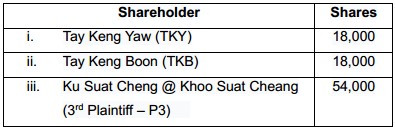
[7] At the time of the filing of this action, the defendant company consists of 3 shareholders with the following holdings:
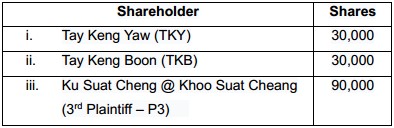
[8] TKY and TKB are the current directors of the defendant. They, together with P1 and P2 are siblings. P3 is the mother to all of them.
[9] Prior to June 2017, 1st and 2nd Plaintiffs (P1 and P2) used to be shareholders of the defendant, holding 12,000 shares each, amounting to 20% each of the equity of the defendant. The total paid up capital then was RM60,000.00, divided into 60,000 shares in the following proportions:
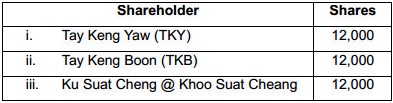
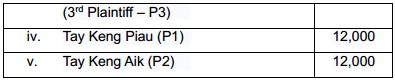
[10] Thereafter, in April 2017, the defendant wanted to obtain financing from Maybank Berhad. The plaintiffs alleged that it was akin to a restructuring exercise whilst the defendant described the same as financing to acquire an immovable asset, in the form of a piece of land in Mukim Labis, Daerah Segamat, Johor. According to the defendant, there was no such restructuring exercise.
[11] Whatever it was, a bank loan was required and in order to facilitate that, the said bank required all shareholders and directors to provide personal guarantees. That, P1 and P2, for reasons only known to themselves, refused to do.
[12] In June 2017, prior to the drawdown and utilisation of the financing facility, P1 and P2 then transferred all their shares to P3, their mother, in order to avoid the giving of any personal guarantees to the bank.
[13] P3 purportedly, was to hold their shares on trust, and that the said shares will be re-transferred back to P1 and P2 in the future.
[14] Apparently, share transfer forms were already pre-signed by P3 to effect future re-transfer to P1 and P2. H