1. Tender award for waste management services — Dispute over whether Letters of Tender Acceptance constituted a binding contract — Failure to fulfill conditions precedent. (Para 1 , 2 , 5 , 9 , 12 )
 Back
Next 





2026 MarsdenLR 1380
HIGH COURT SABAH & SARAWAK TAWAU
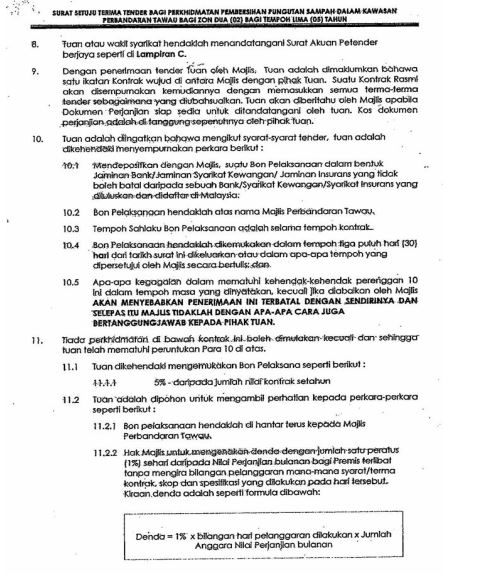
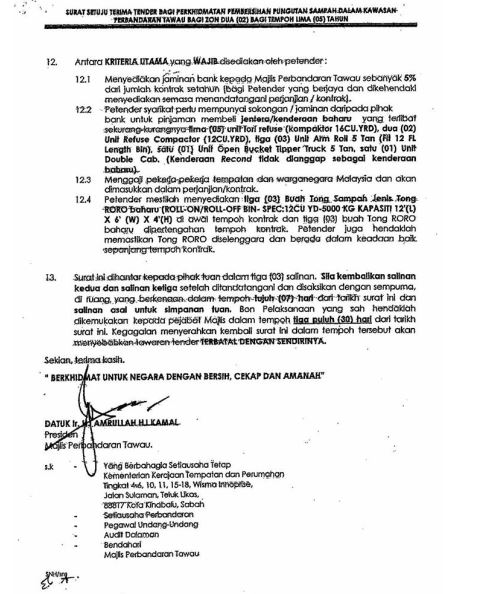
STEVE RITIKOS, JC
NEWGATES INDUSTRIES (BORNEO) SDN BHD – Appellant
Versus
MAJLIS PERBANDARAN TAWAU – Respondent
[Suit No: TWU-22NCvC-13-3/2024]
Important Points
A qualified acceptance of a tender, specifically one "subject to contract" or requiring the fulfillment of conditions precedent before a formal agreement is signed, does not constitute a binding contract but is a letter of intent.
Subject
Contract Law - Formation of Contract
Act Referred
Companies Act 2016
Local Government Ordinance 1961: S.7, S.37(1)
Civil Law Act 1956: S.11
Evidence Act 1950: S.101, S.102, S.103
Contracts Act 1950: S.7, S.56(2)
Local Government Ordinance 1961: S.7, S.37(1)
Civil Law Act 1956: S.11
Evidence Act 1950: S.101, S.102, S.103
Contracts Act 1950: S.7, S.56(2)
Headnote
(A) Contracts Act 1950 - Section 56(2) - Evidence Act 1950 - Section 101 - Formation of contract - Acceptance of tender - Whether a letter of tender acceptance containing conditions precedent and a provision for a future formal contract constitutes a binding agreement - A qualified acceptance or an arrangement "subject to contract" generally indicates that parties are still in a state of negotiation and do not intend to be bound unless and until a formal contract is exchanged (Paras 32, 36, 44).
(B) Conditions Precedent - If an agreement stipulates conditions to be fulfilled before the commencement of services or the execution of a formal agreement, the failure to satisfy such conditions prevents the formation of a legally binding contract (Paras 33, 46, 61).
(C) Burden of Proof - In civil proceedings, the burden of proof lies with the party asserting the existence of a legal right or liability to establish the facts on a balance of probabilities (Paras 15, 16).
Facts of the case:
A municipal council issued two letters of tender acceptance to a company for waste management services. The letters specified that a formal contract would be executed later and required the company to provide a performance bond and bank guarantees for the purchase of specific machinery. The company failed to provide the required performance bond within the stipulated time and did not secure adequate financial guarantees for the necessary equipment. The council subsequently terminated the arrangement. The company sued for breach of contract, claiming a binding agreement existed upon the issuance of the letters of acceptance.
Findings of Court:
The court found that the letters of tender acceptance were not unconditional offers but were akin to letters of intent. The requirement for a formal contract and the failure to meet the conditions precedent meant no binding contract had been concluded. Furthermore, the company failed to prove it had fulfilled the pre-requisite requirements regarding machinery and financial security, and was not ready to perform the works.
Issues: Whether there was a concluded and binding contract between the parties; whether the failure to execute a formal contract estopped the council from relying on the conditions precedent; and whether the company had breached the terms of the tender acceptance.
Ratio Decidendi: A letter of acceptance that is qualified by the necessity of a future formal contract and the fulfillment of specific conditions precedent does not create a binding legal obligation but serves as a record of terms for negotiation. Where the party fails to satisfy these conditions, no enforceable contract arises, and the other party is entitled to terminate the arrangement.
Result: Plaintiff's claim dismissed with costs.
Legal Category Hierarchy
Petitioner Advocates:Joan Goh,Phang Fui Fong ,Respondent Advocate: Mark Rosaidey
Table of Contents
2. Whether Letters of Tender Acceptance formed a binding contract or were merely letters of intent subject to a formal agreement and fulfillment of conditions precedent. (Para 10 , 11 )
3. The letters were qualified acceptances subject to contract and the fulfillment of specific conditions precedent, which the plaintiff failed to satisfy. (Para 30 , 31 , 32 , 33 , 44 , 45 , 46 , 54 , 55 , 56 )
4. Agreements made subject to a formal contract or conditional upon the fulfillment of prerequisites are inchoate and not legally binding until such conditions are met. (Para 34 , 35 , 36 , 41 , 44 )
5. Plaintiff's claim dismissed with costs. (Para 63 )
6. Does a letter of tender acceptance automatically create a binding contract?
Not necessarily. If the acceptance is qualified or states that a formal contract will be executed later, it may be construed as a letter of intent or an agreement subject to contract, which is not binding until the formal agreement is exchanged or conditions are met. (Para 30 , 31 , 32 , 44 )
7. What is the legal effect of an agreement described as subject to contract?
The formula subject to contract creates a strong presumption that the parties do not intend to be bound until a formal contract is executed, indicating that the parties are still in a state of negotiation. (Para 32 , 35 , 36 )
8. How do conditions precedent affect the formation of a contract?
Where specific prerequisites, such as performance bonds or financial guarantees, are stipulated as conditions precedent, no binding contract exists until those terms are fully complied with. (Para 30 , 33 , 45 , 46 )
9. Can a party repudiate an agreement if conditions precedent are not met?
Yes. If a party fails to perform essential terms or conditions precedent within the stipulated time, the other party is entitled to repudiate the agreement under Section 56(2) of the Contracts Act 1950. (Para 55 , 57 )
JUDGMENT
Introduction
[1] The Plaintiff is a company registered in Malaysia under the Companies Act 2016 with its registered address at Unit 07-03, 7th Floor, Wisma Damai Point, 88300 Kota Kinabalu, Sabah.
[2] The Defendant, Majlis Perbandaran Tawau, is the municipal council for Tawau district in Sabah and whose duties under the Local Government Ordinance includes to execute works of such general advantage to the health, convenience or comfort of the inhabitants for Tawau as seem desirable.
[3] The Defendant, pursuant to s 7 of the Local Government Ordinance 1961 is also a body corporate having perpetual succession and a common seal and shall be capable in law of suing and being sued in its corporate title.
[4] The Plaintiff's claims against the Defendant are for the following relief:
(a) A declaration that the Defendant has breached the 2 Letters of Acceptance of Tender dated 28 July 2020;
(b) Damages to be assessed against the Defendant;
(c) Interest on damages assessed at the rate of 5% per annum pursuant to s 11 of the Civil Law Act 1956 or at such rate to be determined by this Court from 1 April 2021 to date of judgment;
(d) Interest at the rate of 5% per annum on the damages assessed from the date of judgment to the date of realization;
(e) Cost; and
(f) Such other order may be made as the Court thinks fit and just.
Brief Facts Of Case
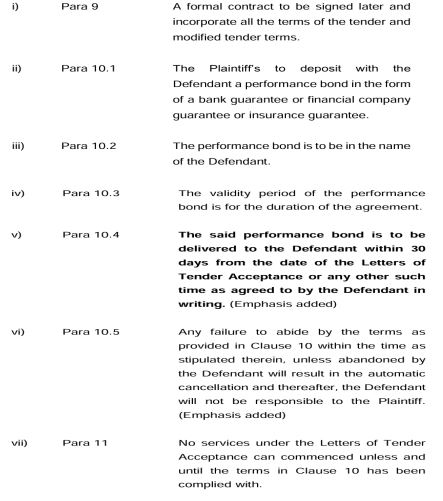
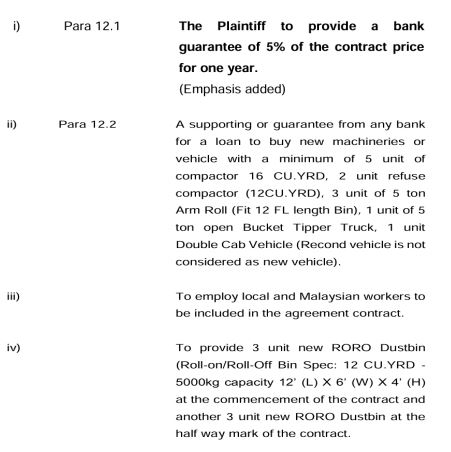
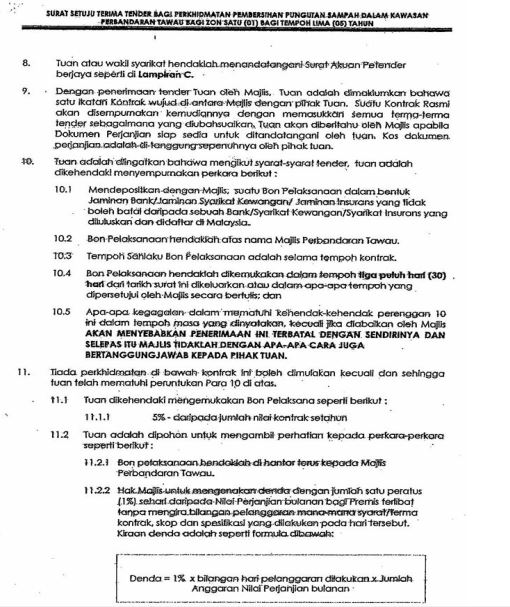
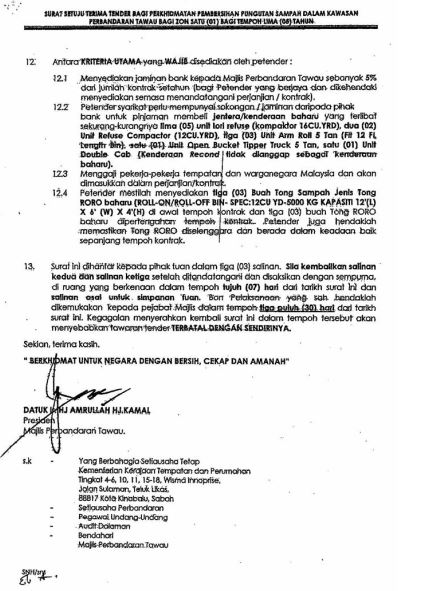
[5] By 2 Letters of Tender Acceptance dated 28 July 2020 (interchangeably referred to as "the contract"), the Defendant awarded to the Plaintiff tender works for the services of rubbish clearing and collection within Tawau District for Zone 1 and Zone 2 for a period of 5 years commencing from the 26 October 2020 until 25 October 2025, and subject to the terms and condition as particularized in cls 10, 11 and 12 of the said Letters.
[6] The Plaintiff accepted the award for the tender works and be bound by the terms of the tender, contract and specifications contained in the tender documents.
[7] The contract price for Zone 1 is RM142,637.13 per month and the total contract price is RM8,558,228.00.
[8] The contract price for Zone 2 is RM141,734.36 per month and the total contract price is RM8,504,061.50.
[9] The Defendant alleged that the Plaintiff failed to perform or fulfill the condition precedent in accordance with the terms of the said Letters of Tender Acceptance dated 28 July 2020 and vide a letter dated 1 April 2021, the Defendant terminated the contract between the parties. Thus, the present suit is brought by the Plaintiff against the Defendant.
Plaintiff's Claims
[10] The contentions of the Plaintiff are basically as follows:
(i) The Plaintiff alleged, inter-alia, that upon acceptance of the 2 Letters of Tender Acceptance, a contract is concluded between the plaintiff and the defendant (despite the clear terms of the Letters that there be a formal contract prepared and entered into later on by the parties incorporating all the terms of the tender as shall be modified).
(ii) The Plaintiff alleged that due to the refusal and/or failure of the Defendant to prepare and sign the formal agreement, they were unable to obtain bank loans to be released, as a consequence of which they have suffered losses.
(iii) The Plaintiff's contention is that a formal contract must be signed first in order to enable them to perform their mandatory obligation as stipulated under the Tenders, particularly cl 12.2 of the said Tenders.
Defendant's Defence
[11] The Defendant's defence is premised on 3 main grounds, namely:
(i) There was no concluded and/or binding contract between the plaintiff and the defendant. By stating in cl 9 of the Letters of Tender Acceptance that there be a formal contract prepared and entered into later on by the parties incorporating all the terms of the tender as shall be modified, the said Letters were merely a letter of intent.
(ii) That there must be a prior approval of the Minister of Local Government and Housing, Sabah for the Defendant to enter into the contract, pursuant to s 37(1