1. Employment dispute — placement of employees on unpaid leave due to refusal of COVID-19 vaccination required for workplace entry — claim for loss of salary and benefits. (Para 1 , 2 , 8 , 11 , 25 )
 Back
Next 





2026 MarsdenLR 1285
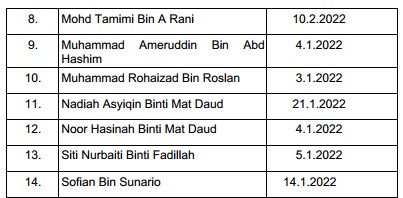
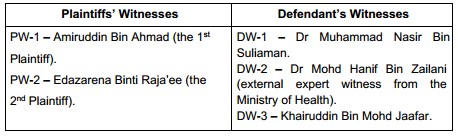
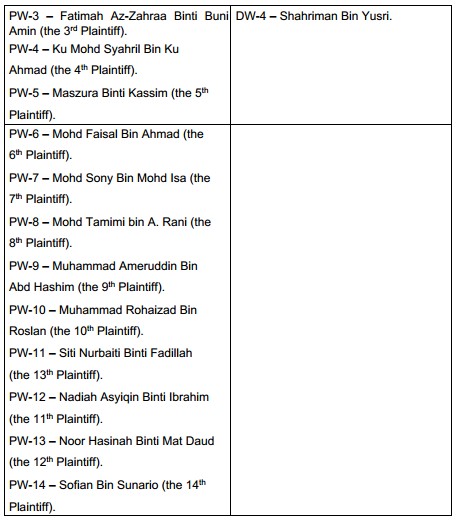
HIGH COURT MALAYA KUALA LUMPUR
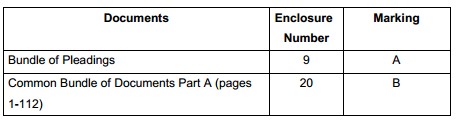
SUZANA MUHAMAD SAID, J
AMIRUDDIN AHMAD & ORS – Appellant
Versus
PETROLIAM NASIONAL BERHAD – Respondent
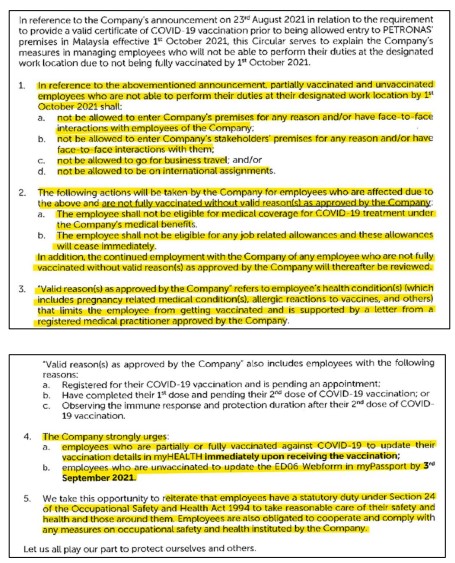
[Civil Suit No: WA-22NCvC-285-05/2022]
Important Points
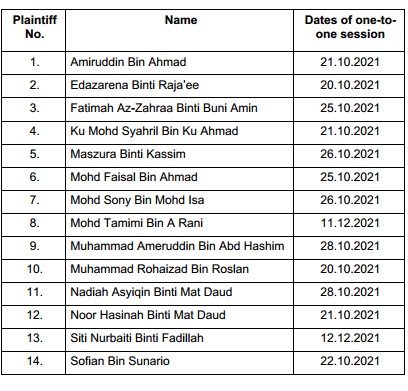
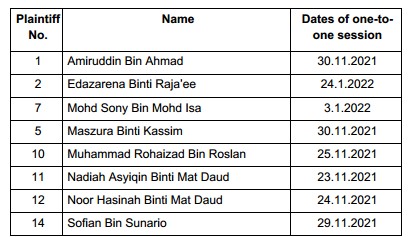
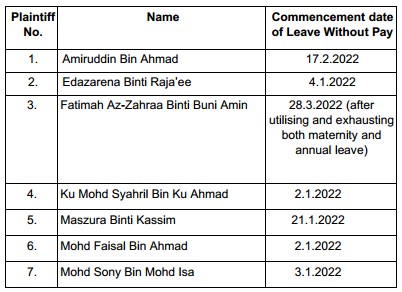
An employer's statutory duty to ensure workplace safety justifies vaccination requirements for premises entry. Constitutional rights under Article 5(1) are enforceable only against state actors, not private employers, and employees must comply with reasonable workplace safety policies or bear the consequences.
Subject
Employment Law - Workplace Health and Safety
Act Referred
Occupational Safety and Health Act 1994: S.15, S.16, S.17, S.19, S.24
Federal Constitution: Art.5(1)
EA 1950: S.101, S.102
Headnote
(A) Occupational Safety and Health Act 1994 - Sections 15, 16, 17 and 19 - Employer's statutory duty to ensure, so far as is practicable, the safety, health and welfare at work of all employees (Para 41) - Failure to comply with these provisions is a punishable offence (Para 42) - Employer entitled to implement measures to prevent the spread of infectious diseases in the workplace to protect employees and the public (Para 44, 49).
(B) Federal Constitution - Article 5(1) - Right to personal liberty - Claims based on violation of constitutional rights can only arise if the violating party is the Legislature, the Executive, or its agencies wielding statutory powers (Para 56) - A private body cannot be sued for breach of constitutional rights; such claims must be based on the employment contract or tort (Para 57).
(C) Employment Law - Master-Servant Relationship - Employees are obliged to comply with an employer's policies, rules, regulations, and instructions (Para 47) - It is the prerogative of the employer to regulate workplace rules and procedures (Para 47).
Facts of the case:
Employees of a company refused vaccination against a pandemic virus. The employer implemented a requirement for a vaccination certificate to enter the premises. Due to their refusal and lack of medical exemptions, the employees were placed on leave without pay as they were unable to perform their duties at the designated work location. The employees claimed loss of salary and benefits, alleging discrimination and violation of constitutional rights.
Findings of Court:
The employer acted within its statutory obligations to ensure workplace safety. The decision to place employees on leave without pay was a consequence of the employees' refusal to comply with safety requirements without valid medical reasons. The claim for constitutional violation was unsustainable as the employer is a private entity.
Issues: Whether the requirement for employees to be vaccinated violates their rights under the Federal Constitution and whether the resulting placement on leave without pay entitles them to damages.
Ratio Decidendi: The court held that the statutory duty of an employer to ensure workplace health and safety outweighs the individual's choice to remain unvaccinated when such choice prevents the employee from safely accessing the workplace. Furthermore, constitutional rights are enforceable only against state actors, not private employers.
Result: Plaintiffs' claim dismissed with costs.
Legal Category Hierarchy
- employment law
- constitutional law
Petitioner Advocates:Muhammad Amin Anuar,Adrian Yeow Way Thiam ,Respondent Advocate: Vijayan Venugopal,Chia Jia Xin,Adam Thye Yong Wei
Table of Contents
2. Plaintiffs allege breach of constitutional right to personal liberty and discrimination; defendant asserts statutory duty under OSHA 1994 to ensure workplace safety and health. (Para 34 , 35 )
3. Employer's statutory duty under OSHA 1994 justifies safety measures; public interest in pandemic control outweighs individual rights; constitutional claims are unsustainable against private entities. (Para 41 , 42 , 43 , 44 , 45 , 46 , 47 , 48 , 49 , 51 , 52 , 53 , 54 )
4. Constitutional rights under the Federal Constitution are enforceable only against the State or its agencies, not private bodies; employers may impose reasonable safety measures under OSHA 1994. (Para 49 , 56 )
6. Can an employer mandate vaccination for workplace entry?
Yes, provided the employer is statutorily obligated under OSHA 1994 to ensure workplace safety and health. Such measures are considered reasonable to prevent the spread of disease and do not necessarily constitute a breach of employment terms. (Para 41 , 43 , 44 , 49 )
7. Does a private employer's vaccination mandate violate the right to personal liberty under Article 5 of the Federal Constitution?
No. Causes of action based on the violation of constitutional rights arise only if the violating party is the Legislature, the Executive, or their agencies wielding statutory powers. Private bodies are not subject to such constitutional claims. (Para 56 )
8. How is the conflict between individual rights and public health objectives resolved regarding mandatory vaccination?
The public interest in protecting the community and maintaining herd immunity outweighs individual rights during a pandemic to ensure societal recovery and safety. (Para 52 , 53 , 54 )
JUDGMENT
(After Full Trial)
Introduction
[1] Fourteen individual employees (plaintiffs) have commenced the present claim against their employer, Petroliam Nasional Berhad (commonly known as PETRONAS) (defendant), arising from the defendant's action of placing the plaintiffs on unpaid leave or leave without pay due to their unvaccinated status during the COVID-19 outbreak.
[2] The plaintiffs sought relief for loss of salary and benefits, and a declaration that the defendant acted discriminatorily towards the plaintiffs. The plaintiffs claim that:
a. Defendan membayar segala jumlah gaji dan manfaat tertunggak termasuk dan tidak terhad kepada gaji bulanan, pembayaran caruman Kumpulan Wang Simpanan Pekerja (KWSP), Pertubuhan Keselamatan Sosial (PERKESO), manfaat perubatan dan lain-lain manfaat yang diakibatkan oleh paksaan cuti tanpa gaji terhadap plaintif-plaintif dan berterusan beserta faedah pada kadar 5% setahun ke atas jumlah tersebut mulai daripada tarikh perintah / penghakiman tindakan ini sehingga ke tarikh penyelesaian penuh;
b. Selanjutnya dan/atau secara alternatifnya, suatu jumlah ganti rugi am untuk ditentukan dan/atau ditaksirkan oleh mahkamah yang mulia ini beserta faedah pada kadar 5% setahun ke atas jumlah tersebut mulai daripada tarikh perintah / penghakiman tindakan ini sehingga ke tarikh penyelesaian penuh;
c. Defendan membayar ganti rugi teruk dan/atau ganti rugi teladan sebanyak Ringgit Malaysia Tujuh Juta (RM7,000,000.00) beserta faedah pada kadar 5% setahun ke atas jumlah tersebut mulai daripada tarikh perintah / penghakiman tindakan ini sehingga ke tarikh penyelesaian penuh;
d. Suatu deklarasi bahawa arahan yang dikeluarkan defendan berkenaan larangan kemasukan plaintif-plaintif ke premis defendan dan tindakan-tindakan diskriminasi oleh defendan terhadap plaintif-plaintif adalah tidak menuruti perlembagaan dan/atau tidak sah;
e. Suatu arahan mahkamah agar defendan untuk mengeluarkan arahan alternatif bagi plaintif-plaintif dan pekerja-pekerja yang tidak divaksinasi dengan vaksinasi Covid-19 dalam menjalankan tugasan dan tanggungjawab mereka; dan
f. Kos
[3] The trial took place for 14 days on 22 January 2024, 23 January 2024, 24 January 2024, 22 April 2024, 23 April 2024, 4 November 2024, 5 November 2024, 6 November 2024, 9 May 2025, 13 June 2025, 20 June 2025, 18 July 2025, 25 July 2025 and 8 October 2025 respectively.
[4] Throughout the trial of this matter, all of the plaintiffs were called as witnesses, and the defendant called four (4) witnesses. The witnesses that testified were:
[5] The relevant cause papers and documents filed are as follows:
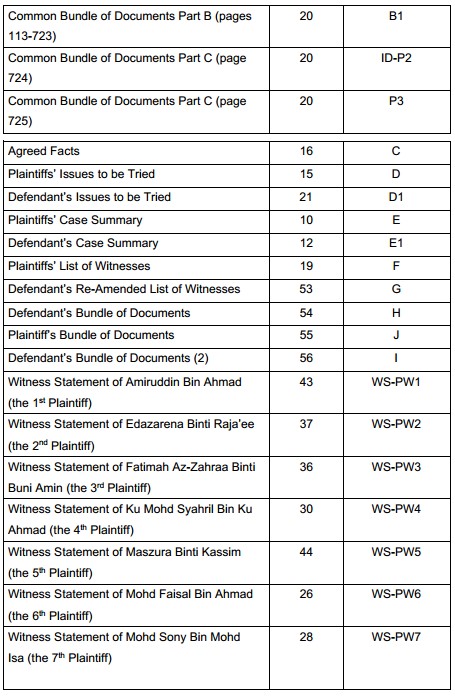
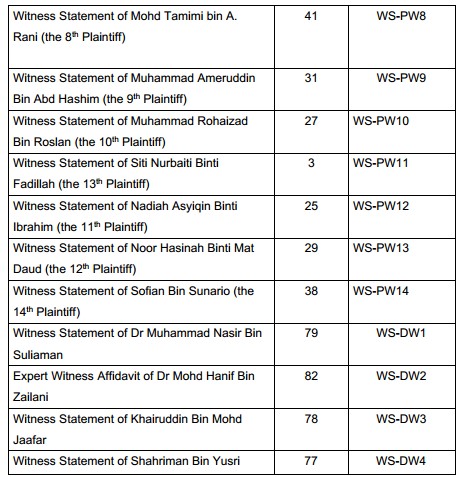
[6] The Agreed Notes of Proceedings for this matter have been filed in encls 96 and 97 (NOP).
[7] At the end of the trial, this court dismissed the plaintiffs' claim with costs. The reasons are as deliberated.
Brief Facts
[8] The plaintiffs, collectively, are employees of the defendant and refused the COVID-19 vaccination during the COVID-19 outbreak.
[9] According to the plaintiffs in their Statement of Claim, by a notice/announcement issued by the defendant on 27 August 2021 (notice), the plaintiffs were required to complete the online Form ED06 to update their vaccination status. The defendant's action is believed to have been carried out following the relaxation and/or permission to attend the workplace issued by the Ministry of Health and/or the National Security Council through public announcement.
[10] Following the notice, the defendant further announced that all employees are required to be physically present at the defendant's premises to carry out their duties. However, according to the plaintiffs, the defendant failed to provide any alternatives for them to perform their duties.
[11] Later in November 2021, the defendant asked the plaintiffs, who had refused to receive the COVID-19 vaccination, to sign a document either to receive compensation or to be granted leave without pay. The defendant has also retracted benefits, including EPF, SOCSO, and