


 Back
Back




2026 MarsdenLR 1808
THE HIGH COURT OF MALAYA IN KUALA LUMPUR
ELAINE YAP CHIN GAIK, JC
TA JIN KIAT – Plaintiff
Versus
TA WEE DHER – Defendant
GUAMAN NO: WA-22NCC-111-02/2026
An interim injunction to preserve the status quo is not granted where the plaintiff fails to show a real risk of imminent harm directly connected to the relief sought; damages are adequate when the subject matter is quantifiable shares, and delay in seeking relief indicates lack of urgency.
Headnote:(A) Interim Injunction - Malaysian law - Principles for granting interlocutory injunction - Bona fide issues to be tried - Balance of justice - Adequacy of damages - Delay - The court, having found that an issue has been disclosed requiring further investigation, must consider where the justice of the case lies and weigh the harm that the injunction would produce by its grant against the harm that would result from its refusal, and take into account all discretionary considerations such as delay or any adequate alternative remedy that would satisfy the plaintiff's equity, such as an award of monetary compensation (Keet Gerald Francis Noel John v Mohd Noor @ Harun Abdullah & Ors [1995] 1 CLJ 293). An interlocutory injunction to preserve the status quo must be in response to a threatened change in the status quo; the plaintiff must demonstrate a real risk of harm if interim relief is refused. The adequacy of damages is fact-specific; difficulty in quantifying damages does not, without more, render damages an inadequate remedy (Tenaga Nasional Bhd v Teobros Development Sdn Bhd [2008] 6 MLJ 391 considered). Delay is a relevant factor in considering whether to grant an injunction.
Facts of the case:
The plaintiff and the first to fourth defendants are half-siblings, children of the deceased. The plaintiff transferred shares in family companies to the defendants, allegedly under duress, coercion, or fraudulent inducement while in custody of the Malaysian Anti-Corruption Commission. The defendants claim the shares were promised to them by their late father and held on trust. The plaintiff sought an interim injunction to restrain the defendants from dealing with or exercising rights attached to the shares, pending trial, and to recover the shares. The defendants conceded there were bona fide issues to be tried.
Findings of Court:
The application for an interim injunction was dismissed. The balance of justice did not favour the plaintiff as there was no evidence of a threatened change in the status quo; the shares had already been transferred, and the plaintiff's fears of disposal or irreversible alteration were speculative. Damages were an adequate remedy as the shares were minority shareholdings in private companies, and professional valuers could quantify them. The plaintiff's delay in seeking interim relief (over a year after the transfer) pointed to the absence of imminent harm.
Issues: The main issues were whether the balance of justice favoured the grant of an interim injunction, whether damages were an adequate remedy, and whether there was undue delay in moving the court.
Ratio Decidendi: The court reasoned that an interim injunction is not warranted where the plaintiff has not shown a real risk of harm directly connected to the relief sought. Here, the plaintiff's claims of harm were speculative and unconnected to the exercise of shareholder rights. Damages were adequate because the shares were quantifiable assets, and the plaintiff's delay indicated no urgency.
Result: Enclosure 21 dismissed with costs of RM8,000.00, subject to allocatur.
| Table of Content |
|---|
| 1. facts: background facts of the case, including the dispute over shares, the plaintiff's claims of duress, and the parties' positions. (Para 1 , 2 , 3 , 4 , 5 , 6 , 7 , 8) |
| 2. court's legal framework for assessing interlocutory injunctions, including the balance of justice and adequacy of damages. (Para 9 , 10 , 11) |
| 3. assessment of the balance of justice and the need for a factual basis demonstrating real risk of harm. (Para 12 , 13 , 14 , 15 , 16 , 17) |
| 4. adequacy of damages as a remedy for the plaintiff's claims. (Para 18 , 19 , 20 , 21 , 22) |
| 5. delay in seeking injunctive relief and the conclusion dismissing the application. (Para 23 , 24 , 25) |
GROUNDS OF JUDGMENT
Introduction
1. The Plaintiff filed Enclosure 21 seeking an interim injunction st th pending trial, to restrain the 1 to 4 Defendants (“D1” to “D4”), who are his half siblings, from (a) dealing with and/or (b) exercising any th th rights attached to, certain shares in the 5 to 15 Defendants (“D5 to “D15”) that the Plaintiff had transferred to D1 to D4 (“Shares”). In this action, the Plaintiff is seeking the return of those Shares.
Background facts
2. The Plaintiff and D1 to D4 are all children of the late Ta Kin Yan (deceased) but born of different mothers. The deceased passed away on 15-6-2024, leaving behind numerous family-owned companies, including D5 to D15. D5 to D15 operate slot machine businesses and/or manage clubs with gaming licenses. The Plaintiff personally held minority stakes in all of D5 to D15.
3. The Plaintiff claims that he had signed the transfer forms for the Shares to be transferred to D1 to D4 while under duress, coercion and/or that he was fraudulently induced by D1 and D2 to do so while in the custody of the Malaysian Anti-Corruption Commission (“MACC”) on 11-3-2025. He implicates D1 to D4 in orchestrating his arrest by the MACC in a “corporate mafia” style takeover of his Shares.
4. After his release from remand, the Plaintiff sent notices to the company secretary and demanded the return of his Shares but the transfer was nevertheless effected on 24-3-2025. The Plaintiff lodged a police report on 7-5-2025, commenced this action on 13- 2-2026, and filed Enclosure 21 on 7-5-2026.
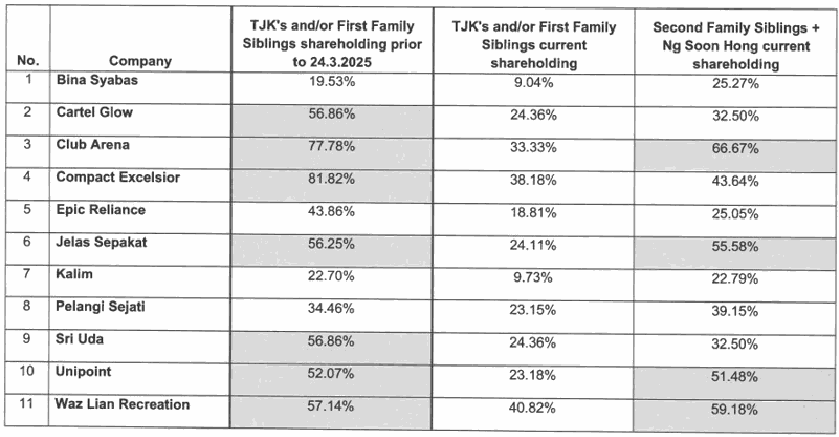
5. In moving the Court for urgent interim relief, the Plaintiff contends that D1 to D4 have been using the Shares to consolidate control over D5 to D15 as a faction comprising his half-siblings, while his own faction collectively lost majority control over 4 of the 11 companies.
6. After the impugned transfer of Shares, majority control of the companies shifted between the two factions as follows:
7. The position taken by D1 to D4 is that the Shares were promised to them in equal shares by their late father and held on trust for D1 to D4. They described very different factual circumstances under which the share transfers were signed and delivered to them by the Plaintiff.
8. D1 to D4 have filed a counterclaim against the Plaintiff, two other half-siblings in the Plaintiff’s faction (“D2-CC” and “D3-CC”), the executor of their deceased father’s estate (“D4-CC”) and one Jennifer Kok (“D5-CC”). D1 to D4 also claim a trust over shares in other family companies (“D6-CC” to “D10-CC”).
Analysis and findings
9. The Court ordered an inter partes hearing of Enclosure 21. In resisting Enclosure 21, D1 to D4 conceded that there are bona fide issues to be tried in this action. The disputes of fact surrounding the impugned transfer of the Shares and the existence of the alleged trust cannot be resolved without investigation in a full trial.
10. As explained in Keet Gerald Francis Noel John v Mohd Noor @ Harun Abdullah & Ors [1995] 1 CLJ 293, having found that an issue has been disclosed that requires further investigation, the Court must:
a) consider where the justice of the case lies and weigh the harm that the injunction would produce by its grant against the harm that would result from its refusal; and
b) take into account all discretionary considerations such as delay or any a












