Back
Back





2025 Supreme(SRI)(CA) 190
IN THE COURT OF APPEAL OF THE DEMOCRATIC SOCIALIST REPUBLIC OF SRI LANKA In the matter of an Appeal in terms of section 331 of the Code of Criminal Procedure Act No.15 of 1979 read with Article 139 of the Constitution of the Democratic Socialist Republic of Sri Lanka.
Democratic Socialist Republic of Sri Lanka.
Complainant Court of Appeal Case No.:
CA HCC 0454/17 Vs.
High Court of Colombo Case No.:
HC 574/2001
1. Gnanaiyah Jeyagaran 2. Pon Sinig Anbu Sing Accused AND NOW BETWEEN Gnanaiyah Jeyagaran Accused-Appellant Vs.
Hon. Attorney General, Attorney General’s Department, Colombo 12.
Complainant-Respondent Before: B. Sasi Mahendran, J.
Amal Ranaraja, J.
Counsel: Kaneel Maddumage with Praveen Premathilaka for the 1st Accused-Appellant.
Maheshika Silva, D.S.G. for the Respondent.
Argued on : 03.07.2025 Decided on: 31.07.2025
Kaneel Maddumage with Praveen Premathilaka for the 1st Accused-Appellant. Maheshika Silva, D.S.G. for the Respondent.
JUDGMENT
AMAL RANARAJA, J.
1. The Accused-Appellant (hereinafter referred to as the “Appellant”) has been indicted in the High Court of Colombo together with one other person in High Court case number HCC 574/2001.
2. The charges in the indictment are as follows;
Charge That between May 01, 2000 and June 30, 2000, the 1st accused- appellant, deceived one Ratnadeshapriya Samaraweera, the manager of the People’s Bank branch in Ginthupitiya, and induced him to hand over certain property to the appellant, namely bills of lading bearing no. PONLBOM 70999283 and 70999284 and the invoices bearing no.s MS77 and MS78 dated May 07, 2000 by dishonestly asserting that the relevant order value of Rs.850,000 would be paid to the International Division of People’s Bank and thereby committed an offence punishable under section 5(2) of the Offences Against Public Property Act No.12 of 1982.
3. At the conclusion of the trial, the Learned High Court Judge has convicted the appellant of the 1st charge, acquitted the 2nd person named as the accused in the 2nd charge, and sentenced the appellant as follows;
For a term of 26 months simple imprisonment and also imposed a fine of Rs. 2,550,000 with a term of 3 years’ simple imprisonment in default.
Case of the prosecution
4. The bank branch where PW01 served as a manager has received a set of documents related to a consignment of goods imported into Sri Lanka by a business entity named Durga Agencies, which have been sourced from a business entity in India.
5. On May 22,2000 the appellant has met with PW01, who, in accordance with the bank’s standard procedure provided the bills of lading and the invoices, accompanied by a covering letter, addressed to the bank’s international branch. This has been done on the appellant’s assurance to ensure payment to the international branch before the goods were cleared.
6. However, although the consignment of goods had been subsequently cleared, it has been later discovered that the additional documents related to the payment made to the importer’s bank had been forged.
As a result, it is alleged that the appellant engaged in deceptive practices against PW01, thus, committing an offence as outlined in the 1st charge in the indictment.
Case of the appellant
7. The appellant has maintained his innocence during the proceedings. He has asserted that he was manipulated by the person named as the 2nd accused in the indictment into participating in transactions that, on the surface appeared to be innocuous.
8. The crux of the appellant’s argument lies in the assertion that he was misled and coerced into those dealings, which he believed to be legitimate exchanges with PW01.
Grounds of appeal
9. When the matter was taken up for argument, the Learned Counsel for the appellant urged the following grounds of appeal;
i. Whether the indictment is defective as the necessary ingredients of the offence of cheating are not contained in the charges of the indictment?
ii. Whether the prosecution has failed to prove the ingredient of damage or loss caused to the government in the offence of cheating?
iii. Whether the Learned High Court Judge has failed to consider PW01 is not a credible witness and his evidence should not be relied upon?
iv. Whether the Learned High Court Judge has failed to properly consider and evaluate the evidence of the defence? v. Whether the Learned High Court Judge has misdirected himself by coming to erroneous or irrelevant conclusions/findings in the judgment and therefore whether the judgment is bad in law?
vi. Whether the sentence imposed on the appellant is excessive considering the circumstances of the appellant?
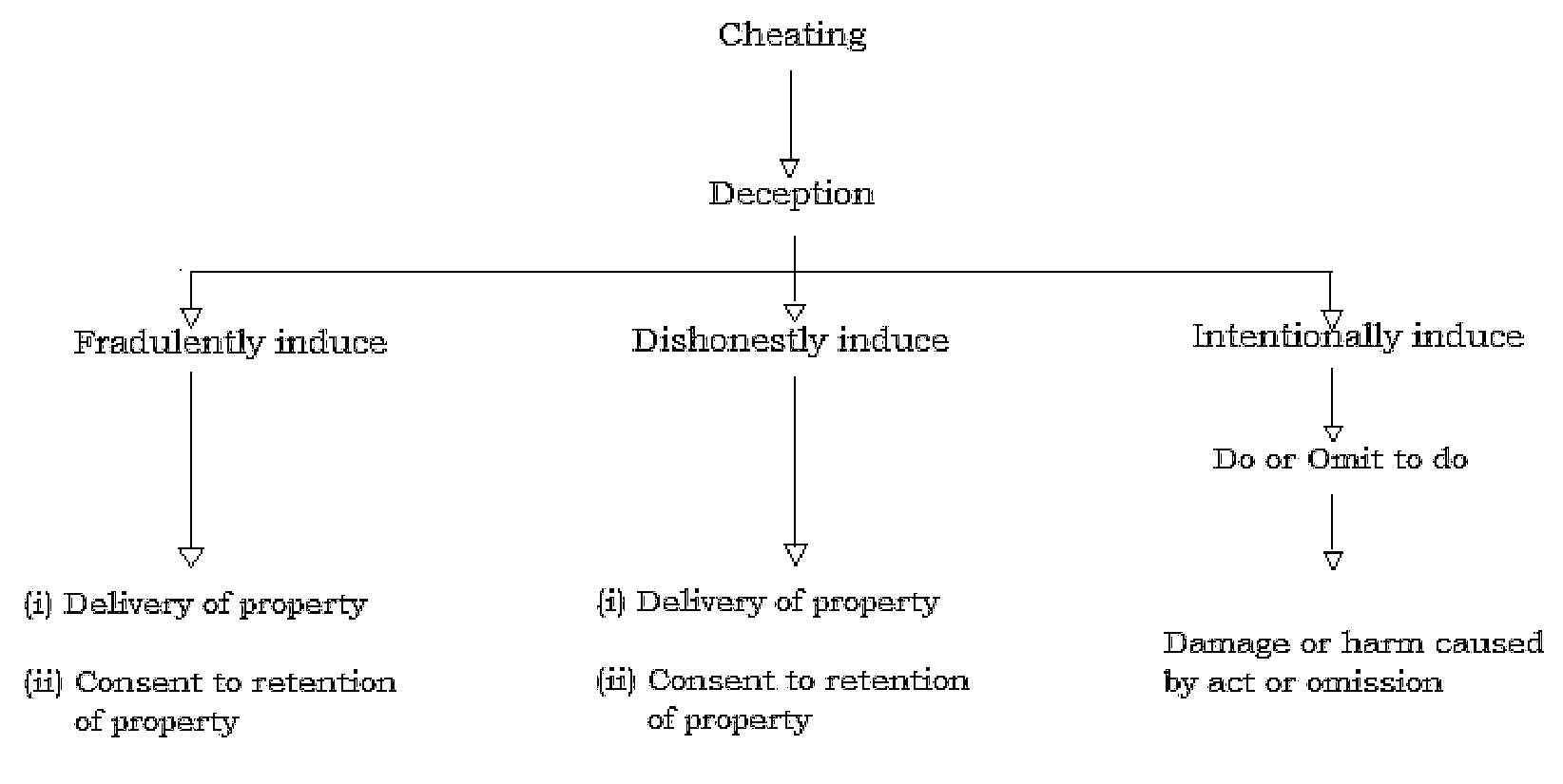
10. The offence of cheating is described as follows in the Penal Code; Section 398 “Whoever, by deceiving any person, fraudulently or dishonestly induces the person so deceived to deliver any property to any person, or to consent that any person shall retain any property, or intentionally induces the person so deceived to do or omit to do anything which he would not