Back
Back





2025 Supreme(SRI)(SC) 9775
Janak De Silva, J.
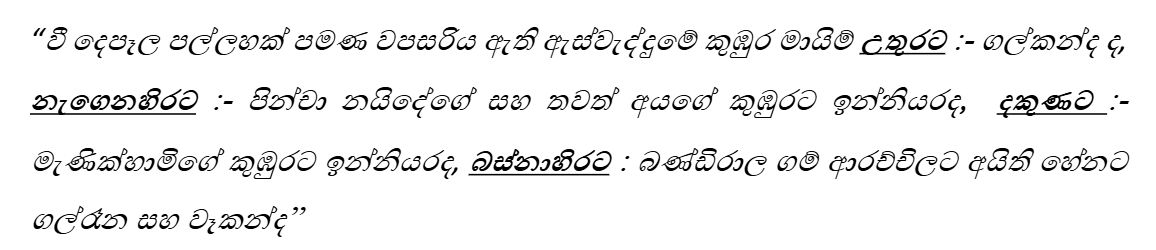
The Plaintiff-Respondent-Respondent (Plaintiff) instituted this action to partition the corpus identified as Aswaddume Kumbura containing දෙපෑල පල්ලහක් පමණ වපසරිය of paddy sowing. In the schedule of the plaint filed in 1974, the corpus is described as follows:
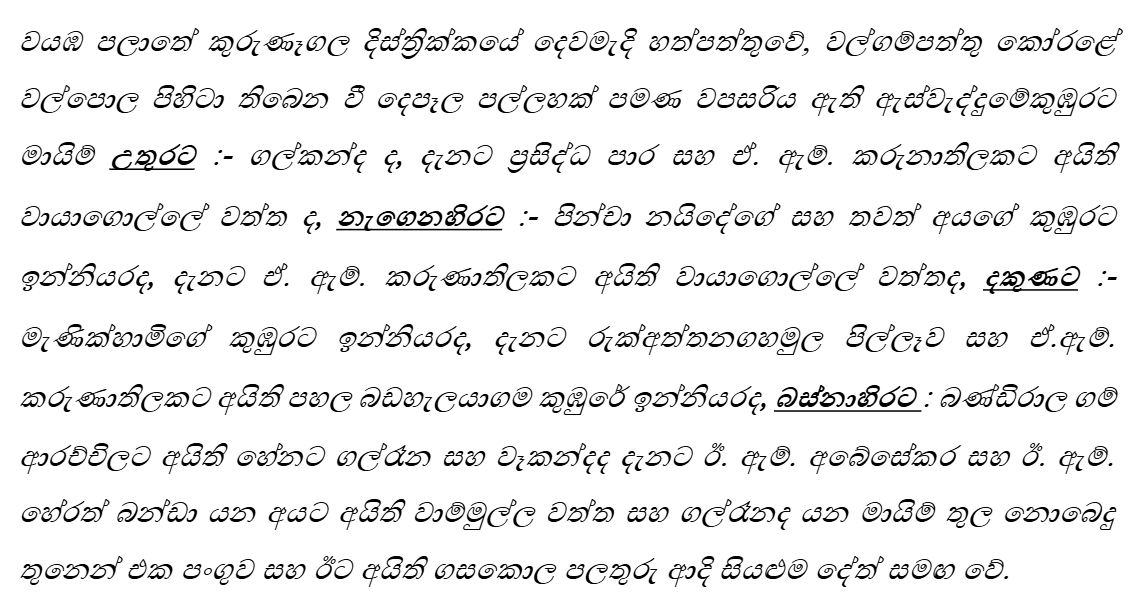
According to the Plaintiff, Bandirala was at one time the owner of the corpus. He had three children named Appuhamy, Hethuhamy and Punchi Menika. Bandirala died intestate. Accordingly, Appuhamy, Hethuhamy and Punchi Menika each inherited an undivided 1/3 share of the corpus.
By deed No. 7808 dated 31.08.1921 (P1) and attested by C.P. Senayanake, Notary Public, Appuhamy sold his undivided 1/3 share to his two children, Dingiri Menika and Ukku Menika. They sold their shares to the Plaintiff by deed No. 33, attested by O.G.W. Dassanayake dated 06.07.1968 (P5).
According to the Plaintiff, Hethuhamy died intestate and his share was inherited by the 1st to 6th Defendant-Respondent-Respondents (1st to 6th Defendants).
Punchi Menika died intestate leaving her son Punchi Banda who inherited her undivided 1/3 share of the corpus. He also died intestate leaving as his heirs’ 7th to 15th Defendant- Respondent-Respondents (7th to 15th Defendants).
The main contest between the parties was the identity of the corpus.
The learned trial judge held that the corpus was correctly identified and entered interlocutory decree accepting the pedigree presented by the Plaintiff.
Aggrieved by the judgment of the District Court, the 1A (16), 17th, 18th and 19th Defendants appealed to the Court of Appeal. The Court of Appeal afÏrmed the judgment of the District Court.
Aggrieved by the judgment of the Court of Appeal, 1B (16A) and 19th Defendant-Appellant- Appellants (Appellants) appealed to this Court. Special leave to appeal was granted on the questions of law set out in paragraph 26 of the petition.
Nevertheless, during the argument, parties agreed to limit the appeal to the questions of law set forth in paragraph 26 (b), (c) and (d). They are as follows:
(1) In the circumstances pleaded, is the Court of Appeal correct in holding that there is sufÏcient evidence to identify the corpus and that the land shown in the preliminary plan consist of the corpus?
(2) Has the Court of Appeal considered the fact that the Plaintiff had not established his pedigree by leading cogent evidence?
(3) Since the learned District Judge had not answered the points of contest raised at the trial, and also due to the fact that the learned District Judge had not analysed and evaluated the evidence adduced at the trial in the correct perspective, is the judgment of the learned District Judge compliant with the provisions in Section 187 of the Civil Procedure Code?
Identity of the Corpus Section 25 of the Partition Law No. 21 of 1977 (Partition Law) requires the trial judge to examine the title of each party to the land to which the action relates. This duty to investigate the title can only be embarked upon after the corpus is properly identified. Once the corpus is identified, the trial judge must examine the documentary and oral evidence to ascertain the title of each party to the corpus so identified.
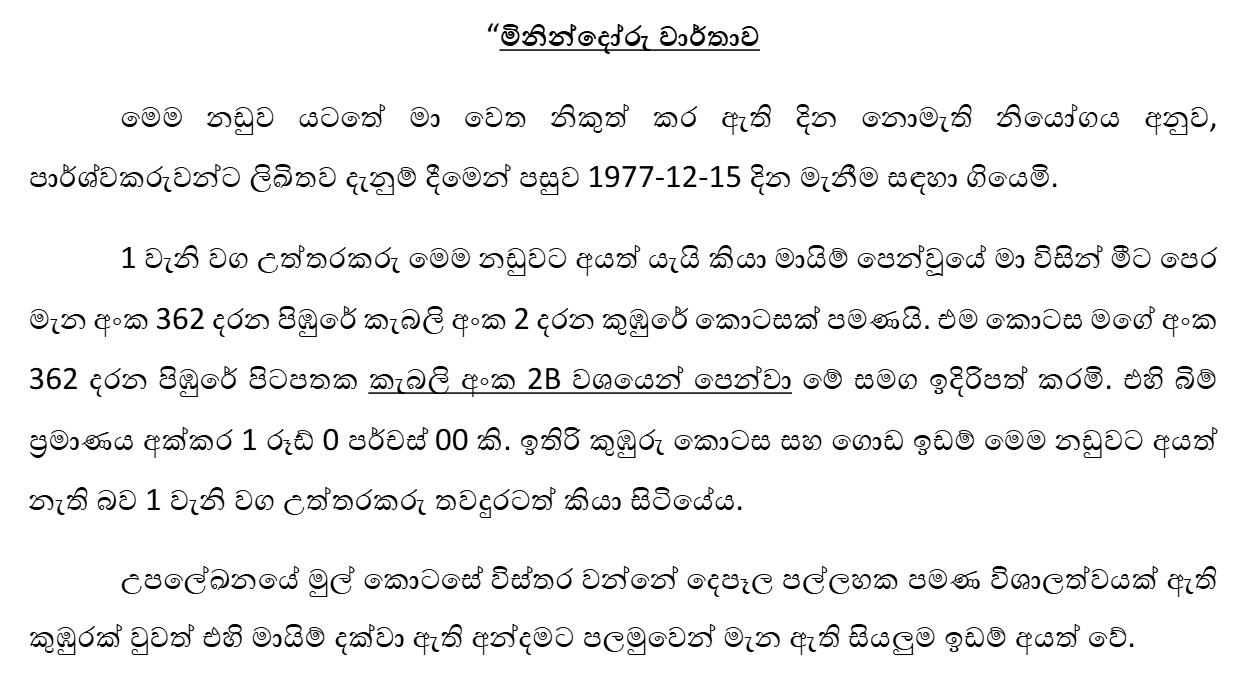
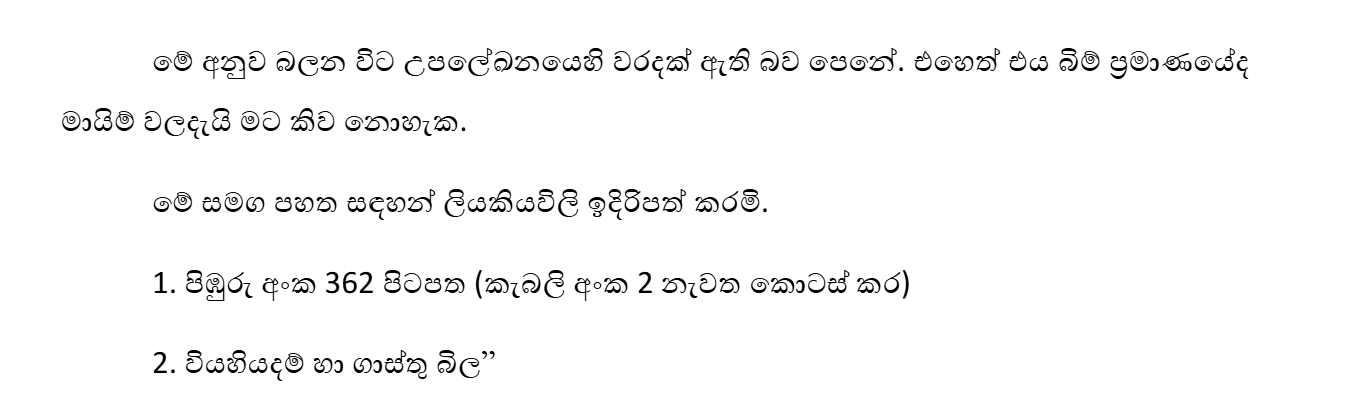
There was no admission on the identity of the corpus. The Plaintiff raised a point of contest on whether the corpus sought to be partitioned is depicted as lot Nos. 1, 2 and 3 in plan No. 362. The 1st and 10th Defendants raised a point of contest on whether the land described in the plaint is depicted as lot No. 2B in plan 362. In other words, the 1st and 10th Defendants took up the position that the partition action must be limited to lot No. 2B in plan 362.
Plan No. 362 was prepared by W.C.S.M. Abeysekera, Licensed Surveyor after a preliminary survey. According to it, the total extent of the corpus is 3A 3R 12P. Lot 2B therein is 1A 0R 25P in extent.
The Appellants contend that according to the schedule to the plaint, the corpus to be partitioned is වී දෙපෑල පල්ලහක් පමණ වපසරිය which is the English equivalent to 1A 2R