


 Back
Back





2022 Supreme(SRI)(SC) 672
Mahinda Samayawardhena, J.
The plaintiff instituted this action against the defendant in the District Court of Nugegoda, seeking a declaration that lot 4 in the final decree entered in partition case No. 5399/P belongs to the parties to that action, and the defendant has no right of way over lot 4. The defendant filed amended answer seeking dismissal of the plaintiff’s action. He also made a cross-claim in the answer stating that he has acquired prescriptive title to lot 4 (not right of way by prescription) and/or he is entitled to use lot 4 as a way of necessity.
At the trial it was recorded as an admission (admission No. 3) that the said lot 4 had been given as a road to the parties to that partition action by the final decree. It is common ground that the defendant was not a party to that partition action.
The plaintiff raised the following issues at the trial:
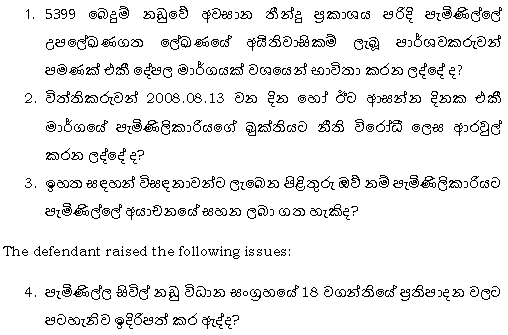
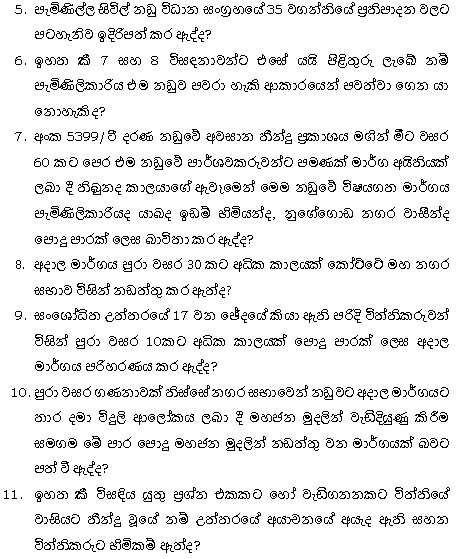
Although the defendant in the prayer to the answer claimed lot 4 on prescription and/or use of lot 4 as a way of necessity as the substantive relief, he changed the character of his case by way of the issues. By way of the issues, he took up the position that lot 4 is now a public road and therefore the plaintiff’s action shall fail. He confined his case only to that issue. His last issue (issue No. 11) is, if one or all of the said issues are answered in the affirmative, whether the defendant is entitled to the reliefs as prayed for in the prayer to the answer. In other words, if the defendant fails to prove that lot 4 is a public road, the defendant’s case fails.
After trial, the District Court entered judgment for the plaintiff. The defendant preferred an appeal to the Hight Court of Civil Appeal of Mt. Lavinia. On appeal he again changed his case. He abandoned all his defences taken in the answer and issues and took up an entirely new position, that is: what the plaintiff filed in the District Court was an action known as actio negatoria; only an owner having soil rights can file such an action; since the plaintiff does not have soil rights to lot 4, the plaintiff’s action must fail. The High Court accepted this new position taken for the first time on appeal and set aside the judgment of the District Court and directed the District Court to enter judgment for the defendant granting all the reliefs as prayed for in the answer. It may be recalled that the defendant’s first cross-claim is that he is the owner of lot 4 by prescription.
The plaintiff is before this Court against the judgment of the High Court. This Court granted leave to appeal on the following questions of law as formulated by learned counsel for the plaintiff.
a. Did the Learned Provincial High Court Judges err in law in deciding that an issue on the nature of a case is a question of Law?
b. Did the Learned Provincial High Court Judges err in law in allowing a new issue in Appeal which affects the nature of the case?
c. Did the Learned Provincial High Court Judges err in law in deciding that the Plaintiff-Petitioner’s case is in the nature of actio negatoria?
d. Did the Learned Provincial High Court Judges err in law in not considering that neither the Plaintiff-Petitioner nor the Defendant-Respondent has raised any issue on the basis of actio negatoria at the trial?
e. Did the Provincial High Court Judges err in law in deciding that the Plaintiff-Petitioner has no soil rights to the subject matter to the case (lot No. 4, corpus morefully described in the schedule to the plaint)?
f. Did the Learned Provincial High Court Judges err in law in not considering that the concept of actio negatoria in Roman Dutch Law cannot be applied on the subject matter which was partitioned in terms of the provisions of the Partition Law?
g. Did the Learned Provincial High Court Judges err in law in not considering the admission by the parties which is marked as “P14” in allowing the Appeal of the Defendant-Respondent?
A party to an action cannot change his position as he pleases to suit the occasion. Firstly, a party cannot presen












